Howard Steven J, Vasseleu Elena, Neilsen-Hewett Cathrine, Cliff Ken
Early Start, University of Wollongong, Wollongong, NSW, 2522, Australia.
School of Education, University of Wollongong, Northfields Avenue, Wollongong, NSW, Australia.
Trials. 2018 Jan 24;19(1):64. doi: 10.1186/s13063-018-2455-4.
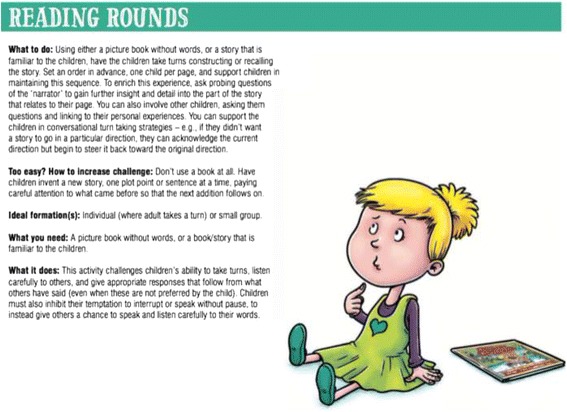
For children with low self-regulation in the preschool years, the likelihood of poorer intellectual, health, wealth and anti-social outcomes in adulthood is overwhelming. Yet this knowledge has not yielded a framework for understanding self-regulatory change, nor generated particularly successful methods for enacting this change. Reconciling insights from cross-disciplinary theory, research and practice, this study seeks to implement a newly developed program of low-cost and routine practices and activities for supporting early self-regulatory development within preschool contexts and to evaluate its effect on children's self-regulation, executive function and school readiness; and educator perceived knowledge, attitudes and self-efficacy related to self-regulation.
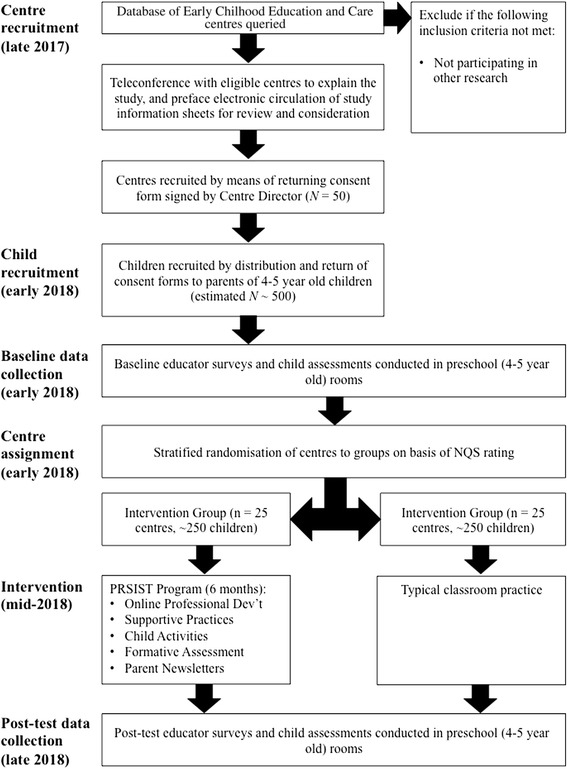
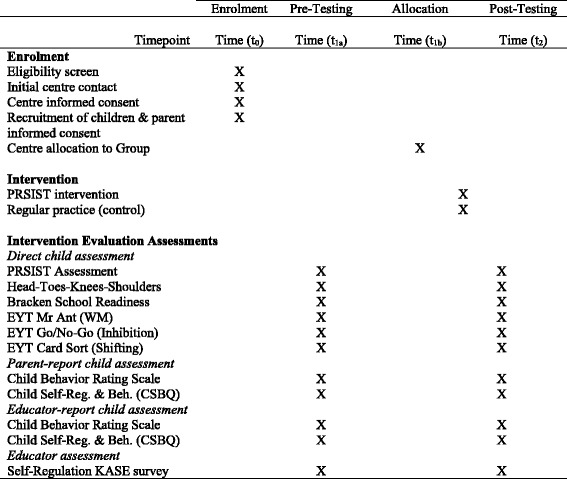
METHODS/DESIGN: The Early Start to Self-Regulation study is a cluster randomized, controlled trial for evaluating benefits of the Preschool Situational Self-Regulation Toolkit (PRSIST) program, when implemented by early childhood educators, compared with routine practice. The PRSIST program combines professional learning, adult practices, child activities and connections to the home to support children's self-regulation development. Fifty preschool centers in New South Wales, Australia, will be selected to ensure a range of characteristics, namely: National Quality Standards (NQS) ratings, geographic location and socioeconomic status. After collection of baseline child and educator data, participating centers will then be randomly allocated to one of two groups, stratified by NQS rating: (1) an intervention group (25 centers) that will implement the PRSIST program; or (2) a control group (25 centers) that will continue to engage in practice as usual. Primary outcomes at the child level will be two measures of self-regulation: Head-Toes-Knees-Shoulders task and the PRSIST observational assessment. Secondary outcomes at the child level will be adult-reported measures of child self-regulation, executive function and school readiness. Outcomes at the educator level will involve a survey of their perceived knowledge, attitudes and self-efficacy for supporting children's self-regulatory development. In all cases, data collectors will be blinded to group allocation.
This is the first randomized controlled trial of a new program to foster early self-regulation, using low-cost practices and activities that are aligned with early-years contexts, routines and practices. Results will provide important information about the efficacy of this approach and evaluate its underlying model of self-regulatory change.
Australian New Zealand Clinical Trials Registry, ACTRN12617001568303 . Registered on 21 November 2017.
对于学龄前自我调节能力较低的儿童,成年后智力、健康、财富状况较差以及出现反社会行为的可能性极大。然而,这一认识尚未产生一个理解自我调节变化的框架,也未产生特别成功的促进这种变化的方法。本研究融合跨学科理论、研究和实践的见解,旨在实施一项新开发的低成本常规实践与活动计划,以支持学龄前儿童的早期自我调节发展,并评估其对儿童自我调节、执行功能和入学准备的影响;以及教育工作者对与自我调节相关的知识、态度和自我效能的认知。
方法/设计:“自我调节早期启动”研究是一项整群随机对照试验,旨在评估幼儿教育工作者实施学龄前情境自我调节工具包(PRSIST)计划相较于常规实践的益处。PRSIST计划结合了专业学习、成人实践、儿童活动以及与家庭的联系,以支持儿童的自我调节发展。将从澳大利亚新南威尔士州选取50所学前教育中心,以确保涵盖一系列特征,即:国家质量标准(NQS)评级、地理位置和社会经济地位。在收集儿童和教育工作者的基线数据后,参与的中心将被随机分配到两组中的一组,按NQS评级分层:(1)干预组(25个中心),将实施PRSIST计划;或(2)对照组(25个中心),将继续照常开展实践。儿童层面的主要结果将是自我调节的两项测量指标:头-趾-膝-肩任务和PRSIST观察评估。儿童层面的次要结果将是成人报告的儿童自我调节、执行功能和入学准备的测量指标。教育工作者层面的结果将涉及对他们支持儿童自我调节发展的认知知识、态度和自我效能的调查。在所有情况下,数据收集者将对分组情况不知情。
这是首次对一项促进早期自我调节的新计划进行随机对照试验,该计划采用与早期环境、日常活动和实践相一致的低成本实践与活动。研究结果将提供有关该方法有效性的重要信息,并评估其自我调节变化的潜在模型。
澳大利亚新西兰临床试验注册中心,ACTRN12617001568303。于2017年11月21日注册。