MD, Psychiatric Rehabilitation Clinic Villa San Pietro,Trento,Italy.
Departments of Health Promotion and Human Behavior,Kyoto University Graduate School of Medicine/School of Public Health,Kyoto,Japan.
Psychol Med. 2018 Sep;48(12):1945-1953. doi: 10.1017/S0033291717003919. Epub 2018 Jan 25.
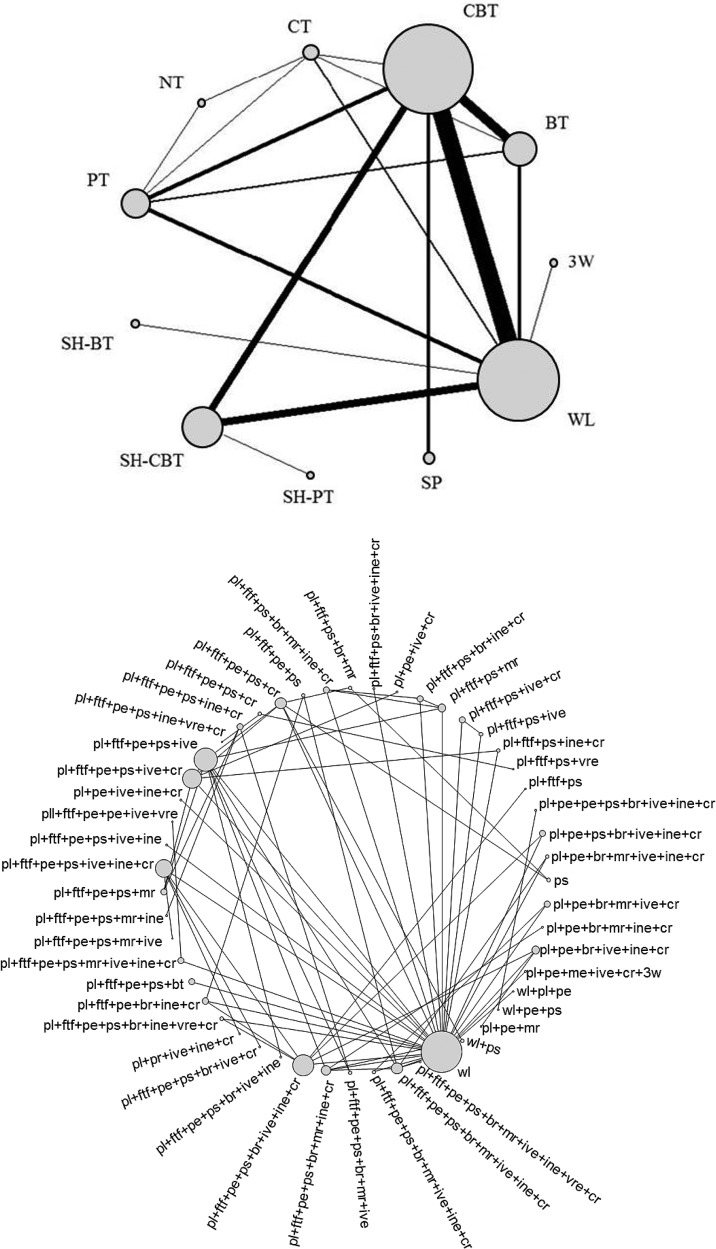
Cognitive-behaviour therapy (CBT) for panic disorder may consist of different combinations of several therapeutic components such as relaxation, breathing retraining, cognitive restructuring, interoceptive exposure and/or in vivo exposure. It is therefore important both theoretically and clinically to examine whether specific components of CBT or their combinations are superior to others in the treatment of panic disorder. Component network meta-analysis (NMA) is an extension of standard NMA that can be used to disentangle the treatment effects of different components included in composite interventions. We searched MEDLINE, EMBASE, PsycINFO and Cochrane Central, with supplementary searches of reference lists and clinical trial registries, for all randomized controlled trials comparing different CBT-based psychological therapies for panic disorder with each other or with control interventions. We applied component NMA to disentangle the treatment effects of different components included in these interventions. After reviewing 2526 references, we included 72 studies with 4064 participants. Interoceptive exposure and face-to-face setting were associated with better treatment efficacy and acceptability. Muscle relaxation and virtual-reality exposure were associated with significantly lower efficacy. Components such as breathing retraining and in vivo exposure appeared to improve treatment acceptability while having small effects on efficacy. The comparison of the most v. the least efficacious combination, both of which may be provided as 'evidence-based CBT,' yielded an odds ratio for the remission of 7.69 (95% credible interval: 1.75 to 33.33). Effective CBT packages for panic disorder would include face-to-face and interoceptive exposure components, while excluding muscle relaxation and virtual-reality exposure.
认知行为疗法(CBT)治疗惊恐障碍可能包括放松、呼吸训练、认知重构、内感受暴露和/或现场暴露等多种治疗成分的不同组合。因此,从理论和临床角度来看,检查 CBT 的特定成分或其组合是否优于惊恐障碍治疗中的其他成分都非常重要。成分网络荟萃分析(NMA)是标准 NMA 的扩展,可以用于理清复合干预中包含的不同成分的治疗效果。我们检索了 MEDLINE、EMBASE、PsycINFO 和 Cochrane Central,同时还检索了参考文献列表和临床试验登记处,以查找比较不同基于 CBT 的心理疗法治疗惊恐障碍的随机对照试验,以及这些干预措施与对照干预措施的比较。我们应用成分 NMA 来理清这些干预措施中包含的不同成分的治疗效果。在审查了 2526 篇参考文献后,我们纳入了 72 项研究,共有 4064 名参与者。内感受暴露和面对面设置与更好的治疗效果和可接受性相关。肌肉放松和虚拟现实暴露与疗效显著降低相关。呼吸训练和现场暴露等成分似乎提高了治疗的可接受性,而对疗效的影响较小。最有效的组合与最无效的组合的比较,两者都可能作为“循证 CBT”提供,其缓解的优势比为 7.69(95%可信区间:1.75 至 33.33)。惊恐障碍的有效 CBT 方案将包括面对面和内感受暴露成分,同时排除肌肉放松和虚拟现实暴露。