Department of Epidemiology, Bloomberg School of Public Health, Johns Hopkins University, Baltimore, Maryland, USA.
Rakai Health Sciences Program, Entebbe, Uganda.
AIDS. 2018 Mar 27;32(6):819-824. doi: 10.1097/QAD.0000000000001761.
To assess geospatial patterns of HIV antiretroviral therapy (ART) treatment facility use and whether they were impacted by viral load suppression.
We extracted data on the location and type of care services utilized by HIV-positive persons accessing ART between February 2015 and September 2016 from the Rakai Community Cohort Study in Uganda. The distance from Rakai Community Cohort Study households to facilities offering ART was calculated using the open street map road network. Modified Poisson regression was used to identify predictors of distance traveled and, for those traveling beyond their nearest facility, the probability of accessing services from a tertiary care facility.
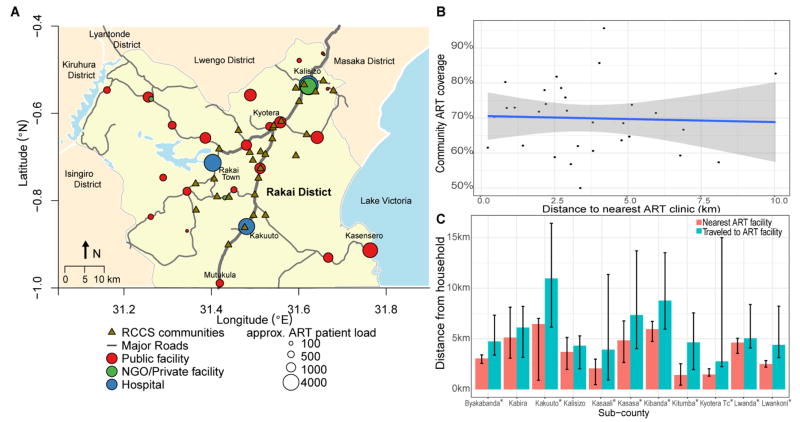
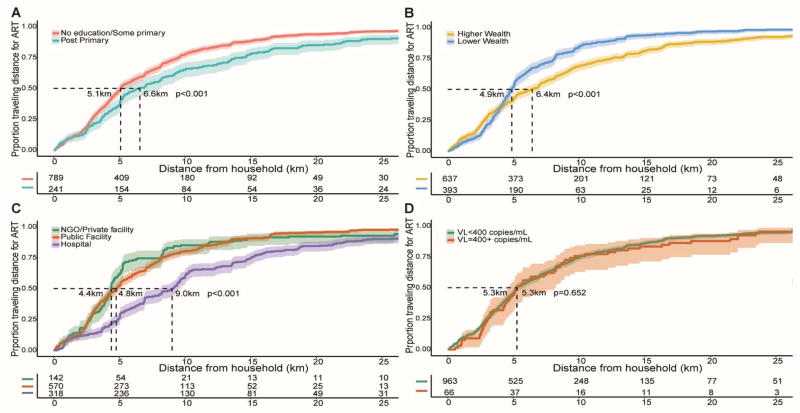
In total, 1554 HIV-positive participants were identified, of whom 68% had initiated ART. The median distance from households to the nearest ART facility was 3.10 km (interquartile range, 1.65-5.05), but the median distance traveled was 5.26 km (interquartile range, 3.00-10.03, P < 0.001) and 57% of individuals travelled further than their nearest facility for ART. Those with higher education and wealth were more likely to travel further. In total, 93% of persons on ART were virally suppressed, and there was no difference in the distance traveled to an ART facility between those with suppressed and unsuppressed viral loads (5.26 vs. 5.27 km, P = 0.650).
Distance traveled to HIV clinics was increased with higher socioeconomic status, suggesting that wealthier individuals exercise greater choice. However, distance traveled did not vary by those who were or were not virally suppressed.
评估艾滋病毒抗逆转录病毒疗法(ART)治疗设施的地理空间使用模式,以及这些模式是否受到病毒载量抑制的影响。
我们从乌干达的 Rakai 社区队列研究中提取了 2015 年 2 月至 2016 年 9 月期间艾滋病毒阳性者接受 ART 时利用的地点和类型的护理服务数据。使用开放街道地图道路网络计算 Rakai 社区队列研究家庭与提供 ART 的设施之间的距离。采用修正泊松回归确定距离的预测因素,对于那些超出最近设施的距离的人,确定从三级保健设施获取服务的概率。
共确定了 1554 名艾滋病毒阳性参与者,其中 68%已开始接受 ART。从家庭到最近的 ART 设施的中位数距离为 3.10km(四分位距,1.65-5.05),但中位数旅行距离为 5.26km(四分位距,3.00-10.03,P<0.001),且 57%的人旅行距离超过最近的设施接受 ART。受教育程度和财富较高的人更有可能走得更远。在接受 ART 的人中,共有 93%的人病毒得到抑制,而在病毒载量得到抑制和未得到抑制的人中,到 ART 设施的旅行距离没有差异(5.26 与 5.27km,P=0.650)。
社会经济地位较高者前往艾滋病毒诊所的距离增加,表明较富裕的人有更多的选择。但是,旅行距离不因病毒是否得到抑制而有所不同。