• 文献检索
  • 文档翻译
  • 深度研究
  • 学术资讯
  • Suppr Zotero 插件Zotero 插件
  • 邀请有礼
  • 套餐&价格
  • 历史记录
应用&插件
Suppr Zotero 插件Zotero 插件浏览器插件Mac 客户端Windows 客户端微信小程序
定价
高级版会员购买积分包购买API积分包
服务
文献检索文档翻译深度研究API 文档MCP 服务
关于我们
关于 Suppr公司介绍联系我们用户协议隐私条款
关注我们

Suppr 超能文献

核心技术专利:CN118964589B侵权必究
粤ICP备2023148730 号-1Suppr @ 2026

文献检索

告别复杂PubMed语法,用中文像聊天一样搜索,搜遍4000万医学文献。AI智能推荐,让科研检索更轻松。

立即免费搜索

文件翻译

保留排版,准确专业,支持PDF/Word/PPT等文件格式,支持 12+语言互译。

免费翻译文档

深度研究

AI帮你快速写综述,25分钟生成高质量综述,智能提取关键信息,辅助科研写作。

立即免费体验

病毒传入在维持乌干达农村社区艾滋病流行中的作用:来自空间聚类、系统发生学和个体中心传播模型的证据。

The role of viral introductions in sustaining community-based HIV epidemics in rural Uganda: evidence from spatial clustering, phylogenetics, and egocentric transmission models.

机构信息

Department of Epidemiology, Bloomberg School of Public Health, Johns Hopkins University, Baltimore, Maryland, United States of America.

Laboratory of Immunoregulation, Division of Intramural Research, National Institute of Allergy and Infectious Diseases, National Institutes of Health, Bethesda, Maryland, United States of America.

出版信息

PLoS Med. 2014 Mar 4;11(3):e1001610. doi: 10.1371/journal.pmed.1001610. eCollection 2014 Mar.

DOI:10.1371/journal.pmed.1001610
PMID:24595023
原文链接:https://pmc.ncbi.nlm.nih.gov/articles/PMC3942316/
Abstract

BACKGROUND

It is often assumed that local sexual networks play a dominant role in HIV spread in sub-Saharan Africa. The aim of this study was to determine the extent to which continued HIV transmission in rural communities--home to two-thirds of the African population--is driven by intra-community sexual networks versus viral introductions from outside of communities.

METHODS AND FINDINGS

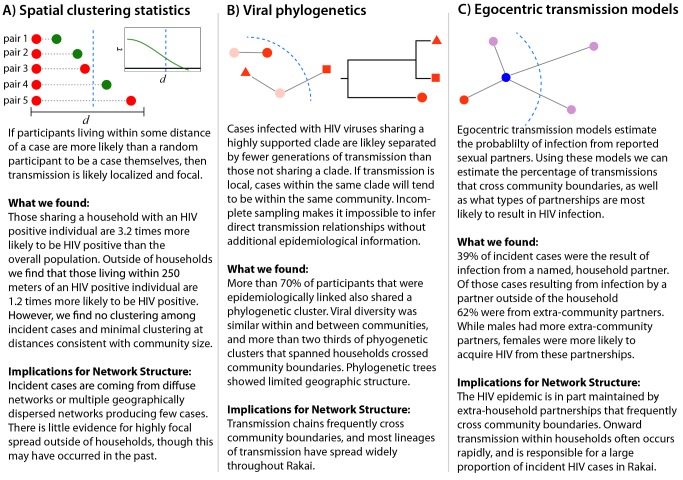
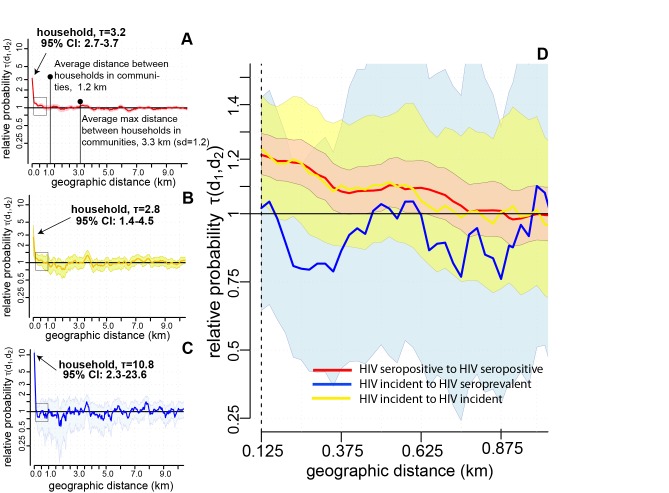
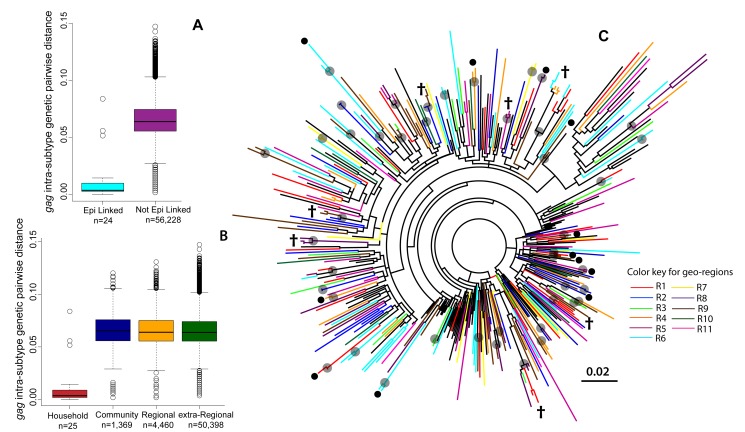
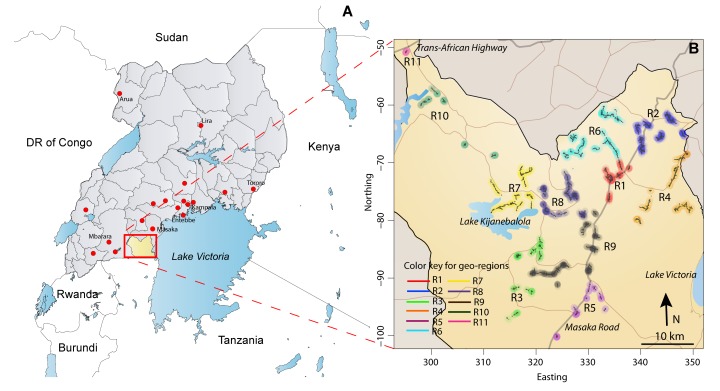
We analyzed the spatial dynamics of HIV transmission in rural Rakai District, Uganda, using data from a cohort of 14,594 individuals within 46 communities. We applied spatial clustering statistics, viral phylogenetics, and probabilistic transmission models to quantify the relative contribution of viral introductions into communities versus community- and household-based transmission to HIV incidence. Individuals living in households with HIV-incident (n = 189) or HIV-prevalent (n = 1,597) persons were 3.2 (95% CI: 2.7-3.7) times more likely to be HIV infected themselves compared to the population in general, but spatial clustering outside of households was relatively weak and was confined to distances <500 m. Phylogenetic analyses of gag and env genes suggest that chains of transmission frequently cross community boundaries. A total of 95 phylogenetic clusters were identified, of which 44% (42/95) were two individuals sharing a household. Among the remaining clusters, 72% (38/53) crossed community boundaries. Using the locations of self-reported sexual partners, we estimate that 39% (95% CI: 34%-42%) of new viral transmissions occur within stable household partnerships, and that among those infected by extra-household sexual partners, 62% (95% CI: 55%-70%) are infected by sexual partners from outside their community. These results rely on the representativeness of the sample and the quality of self-reported partnership data and may not reflect HIV transmission patterns outside of Rakai.

CONCLUSIONS

Our findings suggest that HIV introductions into communities are common and account for a significant proportion of new HIV infections acquired outside of households in rural Uganda, though the extent to which this is true elsewhere in Africa remains unknown. Our results also suggest that HIV prevention efforts should be implemented at spatial scales broader than the community and should target key populations likely responsible for introductions into communities.

摘要

背景

人们通常认为,地方性行为网络在撒哈拉以南非洲的艾滋病毒传播中起着主导作用。本研究的目的是确定在农村社区(占非洲人口的三分之二)中,持续的艾滋病毒传播是由社区内的性行为网络驱动,还是由社区外的病毒传入驱动。

方法和发现

我们利用乌干达 Rakai 区一个包含 46 个社区的 14594 个人的队列数据,分析了艾滋病毒传播的空间动态。我们应用空间聚类统计、病毒系统发生和概率传播模型,量化了病毒传入社区与社区内和家庭内传播对艾滋病毒发病率的相对贡献。与一般人群相比,与 HIV 新发感染者(n=189)或 HIV 现患感染者(n=1597)同住的家庭中,个人感染 HIV 的风险高 3.2 倍(95% CI:2.7-3.7),但家庭外的空间聚类相对较弱,仅限于距离<500 m。 gag 和 env 基因的系统发生分析表明,传播链经常跨越社区边界。共确定了 95 个系统发生簇,其中 44%(42/95)是共享一个家庭的两个人。在其余的簇中,72%(38/53)跨越了社区边界。利用自我报告性伴侣的位置,我们估计 39%(95% CI:34%-42%)的新病毒传播发生在稳定的家庭伴侣关系内,而在那些感染了家庭外性伴侣的人中,有 62%(95% CI:55%-70%)是感染了社区外的性伴侣。这些结果依赖于样本的代表性和自我报告伴侣关系数据的质量,可能无法反映 Rakai 以外的艾滋病毒传播模式。

结论

我们的研究结果表明,艾滋病毒传入社区很常见,在乌干达农村地区,社区外获得的新 HIV 感染中有很大一部分是由社区外传入引起的,尽管在非洲其他地方的情况尚不清楚。我们的研究结果还表明,艾滋病毒预防工作应该在比社区更大的空间尺度上实施,并应针对可能导致社区内传入的关键人群。
https://cdn.ncbi.nlm.nih.gov/pmc/blobs/255d/3942316/2d596146718e/pmed.1001610.g004.jpg
https://cdn.ncbi.nlm.nih.gov/pmc/blobs/255d/3942316/b8af67b6454e/pmed.1001610.g001.jpg
https://cdn.ncbi.nlm.nih.gov/pmc/blobs/255d/3942316/c39b58fadc86/pmed.1001610.g002.jpg
https://cdn.ncbi.nlm.nih.gov/pmc/blobs/255d/3942316/43052d1cb48c/pmed.1001610.g003.jpg
https://cdn.ncbi.nlm.nih.gov/pmc/blobs/255d/3942316/2d596146718e/pmed.1001610.g004.jpg
https://cdn.ncbi.nlm.nih.gov/pmc/blobs/255d/3942316/b8af67b6454e/pmed.1001610.g001.jpg
https://cdn.ncbi.nlm.nih.gov/pmc/blobs/255d/3942316/c39b58fadc86/pmed.1001610.g002.jpg
https://cdn.ncbi.nlm.nih.gov/pmc/blobs/255d/3942316/43052d1cb48c/pmed.1001610.g003.jpg
https://cdn.ncbi.nlm.nih.gov/pmc/blobs/255d/3942316/2d596146718e/pmed.1001610.g004.jpg

相似文献

1
The role of viral introductions in sustaining community-based HIV epidemics in rural Uganda: evidence from spatial clustering, phylogenetics, and egocentric transmission models.病毒传入在维持乌干达农村社区艾滋病流行中的作用:来自空间聚类、系统发生学和个体中心传播模型的证据。
PLoS Med. 2014 Mar 4;11(3):e1001610. doi: 10.1371/journal.pmed.1001610. eCollection 2014 Mar.
2
HIV-1 transmission networks in high risk fishing communities on the shores of Lake Victoria in Uganda: A phylogenetic and epidemiological approach.乌干达维多利亚湖沿岸高危捕鱼社区的HIV-1传播网络:一种系统发育和流行病学方法。
PLoS One. 2017 Oct 12;12(10):e0185818. doi: 10.1371/journal.pone.0185818. eCollection 2017.
3
Quantifying HIV transmission flow between high-prevalence hotspots and surrounding communities: a population-based study in Rakai, Uganda.量化乌干达拉凯高发热点地区与周边社区之间的 HIV 传播流:基于人群的研究。
Lancet HIV. 2020 Mar;7(3):e173-e183. doi: 10.1016/S2352-3018(19)30378-9. Epub 2020 Jan 14.
4
The social dynamics of HIV transmission as reflected through discordant couples in rural Uganda.通过乌干达农村地区的异性配偶所反映出的艾滋病毒传播的社会动态。
AIDS. 1995 Jul;9(7):745-50. doi: 10.1097/00002030-199507000-00012.
5
Trends in HIV-1 prevalence may not reflect trends in incidence in mature epidemics: data from the Rakai population-based cohort, Uganda.在成熟的疫情中,HIV-1流行趋势可能无法反映发病率趋势:来自乌干达基于拉凯人群的队列研究数据。
AIDS. 1997 Jul;11(8):1023-30. doi: 10.1097/00002030-199708000-00011.
6
Phylogenetic and Demographic Characterization of Directed HIV-1 Transmission Using Deep Sequences from High-Risk and General Population Cohorts/Groups in Uganda.使用来自乌干达高危和普通人群队列/群组的深度测序对定向 HIV-1 传播进行系统发育和人口统计学特征分析。
Viruses. 2020 Mar 18;12(3):331. doi: 10.3390/v12030331.
7
Type of partnership and heterosexual spread of HIV infection in rural Uganda: results from simulation modelling.乌干达农村地区艾滋病病毒感染的伙伴关系类型与异性传播:模拟建模结果
Int J STD AIDS. 1999 Nov;10(11):718-25. doi: 10.1258/0956462991913394.
8
HIV-1 subtype distribution trends and evidence of transmission clusters among incident cases in a rural clinical cohort in southwest Uganda, 2004-2010.2004 - 2010年乌干达西南部农村临床队列中新发病例中HIV - 1亚型分布趋势及传播簇证据
AIDS Res Hum Retroviruses. 2013 Mar;29(3):520-7. doi: 10.1089/AID.2012.0170. Epub 2012 Dec 16.
9
Incidence of HIV-1 infection in a rural region of Uganda.乌干达某农村地区的HIV-1感染发病率。
BMJ. 1994 Jan 15;308(6922):171-3. doi: 10.1136/bmj.308.6922.171.
10
AIDS in rural Africa: a paradigm for HIV-1 prevention.非洲农村地区的艾滋病:HIV-1预防范例
Int J STD AIDS. 1996 Jul;7(4):236-43. doi: 10.1258/0956462961917906.

引用本文的文献

1
Robust phylodynamic inference and model specification for HIV transmission dynamics.用于HIV传播动力学的稳健系统发育动力学推断和模型规范。
Epidemics. 2025 Jul 16;52:100846. doi: 10.1016/j.epidem.2025.100846.
2
Evidence from HIV sequencing for blood-borne transmission in Africa.来自非洲血液传播的艾滋病毒测序证据。
J Public Health Afr. 2025 Apr 30;16(1):715. doi: 10.4102/jphia.v16i1.715. eCollection 2025.
3
Intra- and inter-subtype HIV diversity between 1994 and 2018 in southern Uganda: a longitudinal population-based study.

本文引用的文献

1
Extra-couple HIV transmission in sub-Saharan Africa: a mathematical modelling study of survey data.撒哈拉以南非洲的额外性伴侣 HIV 传播:基于调查数据的数学建模研究。
Lancet. 2013 May 4;381(9877):1561-9. doi: 10.1016/S0140-6736(12)61960-6. Epub 2013 Feb 5.
2
Revealing the microscale spatial signature of dengue transmission and immunity in an urban population.揭示城市人群中登革热传播和免疫的微观空间特征。
Proc Natl Acad Sci U S A. 2012 Jun 12;109(24):9535-8. doi: 10.1073/pnas.1120621109. Epub 2012 May 29.
3
MrBayes 3.2: efficient Bayesian phylogenetic inference and model choice across a large model space.
1994年至2018年乌干达南部艾滋病毒亚型内和亚型间的多样性:一项基于人群的纵向研究。
Virus Evol. 2024 Aug 24;10(1):veae065. doi: 10.1093/ve/veae065. eCollection 2024.
4
"Someone who hates themself doesn't come for their drugs": Experiences of mental health along the HIV care continuum in South-Central, Uganda.“厌恶自己的人不会来取他们的药物”:乌干达中南部艾滋病毒护理连续体沿线的心理健康体验。
PLoS One. 2024 Oct 10;19(10):e0290809. doi: 10.1371/journal.pone.0290809. eCollection 2024.
5
Cognitive interviewing to assess and adapt three measures of mental health symptoms among people living with HIV in Rakai, Uganda: the Thinking a Lot Questionnaire, the Patient Health Questionnaire 9 (PHQ-9), and the Hopkins Symptoms Checklist (HSCL).在乌干达拉凯地区对感染艾滋病毒者的三种心理健康症状测量方法进行认知访谈以评估和调整:《反复思考问卷》、《患者健康问卷9项版》(PHQ - 9)和《霍普金斯症状清单》(HSCL)。
Res Sq. 2024 Jul 10:rs.3.rs-4697900. doi: 10.21203/rs.3.rs-4697900/v1.
6
Okweraliikirira and Okwenyamira: Idioms of Psychological Distress Among People Living with HIV in Rakai, Uganda.奥克韦拉利基里拉与奥克韦尼亚米拉:乌干达拉凯地区艾滋病病毒感染者心理困扰的习语表达
Res Sq. 2024 Jul 2:rs.3.rs-4656465. doi: 10.21203/rs.3.rs-4656465/v1.
7
Integrating Phylogenetic Biomarker Data and Qualitative Approaches: An example of HIV Transmission Clusters as a Sampling Frame for Semistructured Interviews and Implications for the COVID-19 Era.整合系统发育生物标志物数据与定性方法:以HIV传播集群作为半结构化访谈的抽样框架为例及其对COVID-19时代的启示
J Mix Methods Res. 2021 Jul;15(3):327-347. doi: 10.1177/15586898211012786. Epub 2021 May 8.
8
Increasing intra- and inter-subtype HIV diversity despite declining HIV incidence in Uganda.尽管乌干达的艾滋病病毒发病率在下降,但艾滋病病毒亚型内和亚型间的多样性却在增加。
medRxiv. 2024 Mar 15:2024.03.14.24303990. doi: 10.1101/2024.03.14.24303990.
9
High prevalence of pre-treatment and acquired HIV-1 drug resistance mutations among non-citizens living with HIV in Botswana.博茨瓦纳非公民艾滋病毒感染者中治疗前和获得性艾滋病毒-1耐药突变的高流行率。
Front Microbiol. 2024 Feb 20;15:1338191. doi: 10.3389/fmicb.2024.1338191. eCollection 2024.
10
Temporal dynamics and drivers of durable HIV viral load suppression and persistent high- and low-level viraemia during Universal Test and Treat scale-up in Uganda: a population-based study.乌干达普遍检测和治疗扩大规模期间持久的 HIV 病毒载量抑制和持续的高、低水平病毒血症的时间动态和驱动因素:一项基于人群的研究。
J Int AIDS Soc. 2024 Feb;27(2):e26200. doi: 10.1002/jia2.26200.
MrBayes 3.2:在大型模型空间中进行高效的贝叶斯系统发育推断和模型选择。
Syst Biol. 2012 May;61(3):539-42. doi: 10.1093/sysbio/sys029. Epub 2012 Feb 22.
4
Treatment as prevention: translating efficacy trial results to population effectiveness.治疗即预防:将疗效试验结果转化为人群效果。
Curr Opin HIV AIDS. 2012 Mar;7(2):157-63. doi: 10.1097/COH.0b013e3283504ab7.
5
Analysis of genetic linkage of HIV from couples enrolled in the HIV Prevention Trials Network 052 trial.分析参加 HIV 预防试验网络 052 试验的夫妇的 HIV 基因连锁关系。
J Infect Dis. 2011 Dec 15;204(12):1918-26. doi: 10.1093/infdis/jir651. Epub 2011 Oct 11.
6
Effect of concurrent sexual partnerships on rate of new HIV infections in a high-prevalence, rural South African population: a cohort study.高发、农村南非人群中,同时性伴关系对新 HIV 感染率的影响:一项队列研究。
Lancet. 2011 Jul 16;378(9787):247-55. doi: 10.1016/S0140-6736(11)60779-4.
7
HIV-1 transmission among HIV-1 discordant couples before and after the introduction of antiretroviral therapy.抗逆转录病毒疗法引入前后 HIV-1 不一致夫妇间 HIV-1 的传播。
AIDS. 2011 Feb 20;25(4):473-7. doi: 10.1097/QAD.0b013e3283437c2b.
8
Changes in the distribution of HIV type 1 subtypes D and A in Rakai District, Uganda between 1994 and 2002.1994年至2002年间乌干达拉凯区1型艾滋病毒D和A亚型分布的变化。
AIDS Res Hum Retroviruses. 2010 Oct;26(10):1087-91. doi: 10.1089/aid.2010.0054. Epub 2010 Oct 6.
9
RDP3: a flexible and fast computer program for analyzing recombination.RDP3:一个灵活快速的计算机程序,用于分析重组。
Bioinformatics. 2010 Oct 1;26(19):2462-3. doi: 10.1093/bioinformatics/btq467. Epub 2010 Aug 26.
10
Decreases in community viral load are accompanied by reductions in new HIV infections in San Francisco.社区病毒载量的下降伴随着旧金山新的 HIV 感染的减少。
PLoS One. 2010 Jun 10;5(6):e11068. doi: 10.1371/journal.pone.0011068.