Department of Life Sciences, Korea University, Seoul 02841, Korea.
Mol Cells. 2018 Jan 31;41(1):27-34. doi: 10.14348/molcells.2018.2274. Epub 2018 Jan 23.
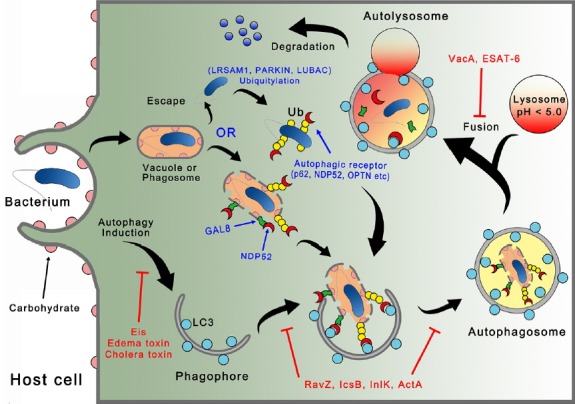
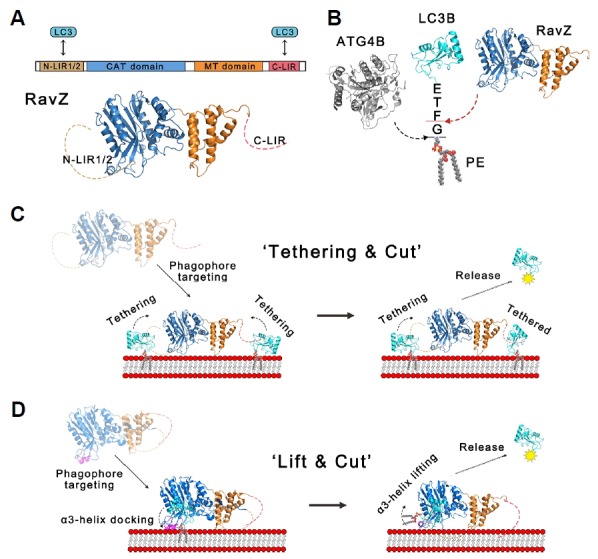
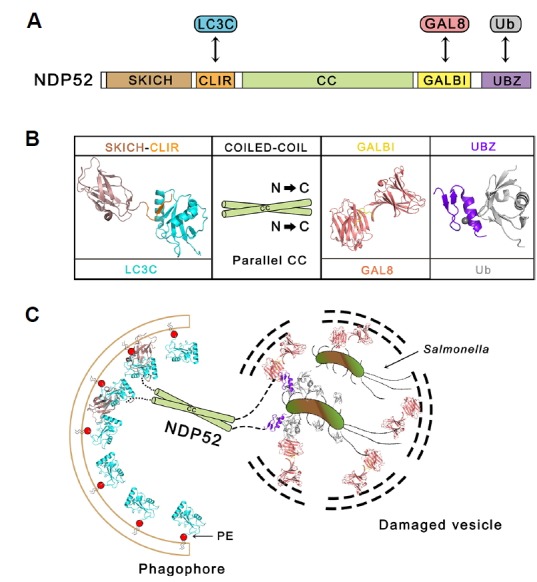
The cytoplasm in mammalian cells is a battlefield between the host and invading microbes. Both the living organisms have evolved unique strategies for their survival. The host utilizes a specialized autophagy system, xenophagy, for the clearance of invading pathogens, whereas bacteria secrete proteins to defend and escape from the host xenophagy. Several molecules have been identified and their structural investigation has enabled the comprehension of these mechanisms at the molecular level. In this review, we focus on one example of host autophagy and the other of bacterial defense: the autophagy receptor, NDP52, in conjunction with the sugar receptor, galectin-8, plays a critical role in targeting the autophagy machinery against ; and the cysteine protease, RavZ secreted by cleaves the LC3-PE on the phagophore membrane. The structure-function relationships of these two examples and the directions of future research will be discussed.
哺乳动物细胞的细胞质是宿主和入侵微生物之间的战场。为了生存,这两个生物体都进化出了独特的策略。宿主利用专门的自噬系统——异噬作用来清除入侵的病原体,而细菌则分泌蛋白质来防御和逃避宿主的异噬作用。已经鉴定出了几种分子,它们的结构研究使我们能够在分子水平上理解这些机制。在这篇综述中,我们集中讨论了宿主自噬和细菌防御的一个例子:自噬受体 NDP52 与糖受体半乳糖凝集素-8 一起,在针对 的自噬机制靶向中起着关键作用;而由 分泌的半胱氨酸蛋白酶 RavZ 会在吞噬体膜上切割 LC3-PE。将讨论这两个例子的结构-功能关系以及未来研究的方向。