Brenelli Lívia, Squina Fabio M, Felby Claus, Cannella David
1Faculty of Science, Department of Geosciences and Natural Resource Management, University of Copenhagen, Frederiksberg C, Denmark.
2Brazilian Bioethanol Science and Technology Laboratory (CTBE), Brazilian Center for Research in Energy and Materials (CNPEM), Campinas, Sao Paulo, Brazil.
Biotechnol Biofuels. 2018 Jan 17;11:10. doi: 10.1186/s13068-017-0985-8. eCollection 2018.
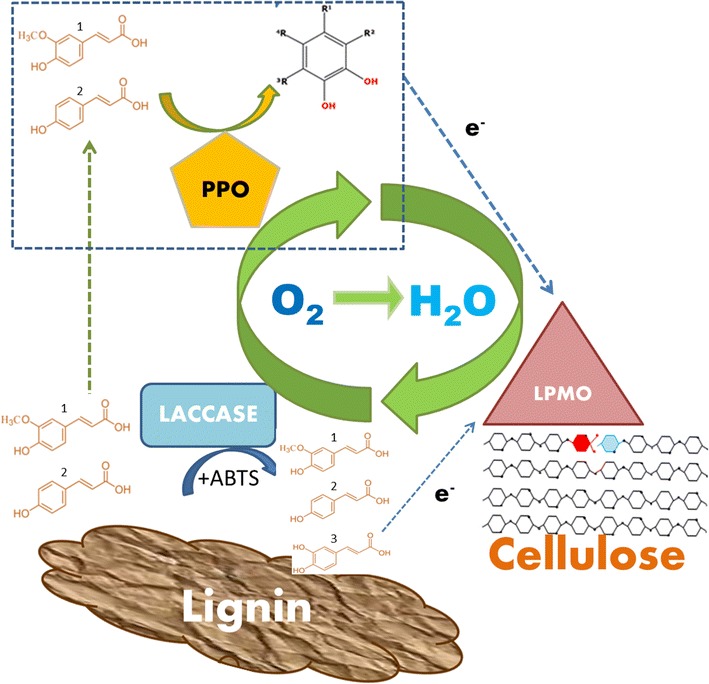
The discovery of lignin as activator for the redox enzyme lytic polysaccharide monooxygenases (LPMOs) for the oxidation of cell-wall polysaccharides opens a new scenario for investigation of the interplay between different lignocellulose-degrading enzymes. The lignin-active enzymes in one hand, and the carbohydrate active in the other, are linked through a variety of electrons carrier molecules either derived from lignin or enzymatically transferred. Likewise, in nature, many lignocellulose-degrading organisms are expressing those enzymes simultaneously, and we wanted to test if a major commercial available lignin oxidase enzyme, i.e., laccase could benefit and synergize the activity of the LPMOs by depolymerizing the insoluble lignin.
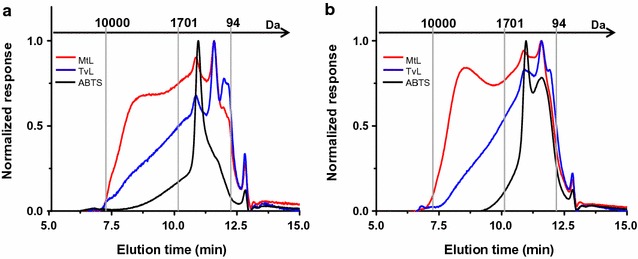
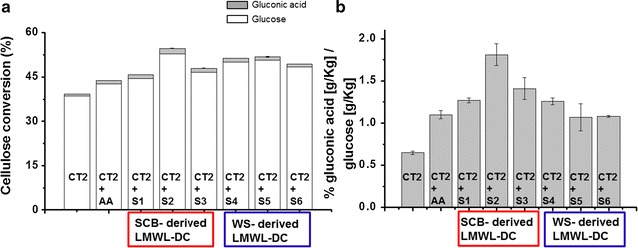
In this work, two fungal laccases together with a mediator (ABTS) were used to isolate low-molecular-weight lignin from lignocellulosic biomass. The isolated lignins were used as electron donors for activation of LPMOs. A direct correlation between the low-molecular-weight lignin isolated with laccases and an increased activity of a cellulolytic cocktail containing LPMO was found when pure cellulose was hydrolyzed. We then tried to implement existing commercial cellulases cocktail with laccase enzymes, but under the conditions tested, the co-incubation of laccases with LPMOs showed a substrate competition towards oxygen inhibiting the LPMO. In addition, we found that laccase treatment may cause other modifications to pure cellulose, rendering the material more recalcitrant for enzymatic saccharification.
Laccase-mediated system was able to depolymerize lignin from pre-treated and native sugarcane bagasse and wheat straw, and the released phenolic molecules were able to donate electrons to LPMO enzymes boosting the overall enzymatic hydrolysis of cellulose. Likewise, other poly-phenol oxidase, we might have just started showing possible pros or cons in applying several oxidase enzymes for a simultaneous degradation of cellulose and lignin, and we found that the competition towards oxygen and their different consumption rates must be taken into account for any possible co-application.
木质素作为氧化还原酶裂解多糖单加氧酶(LPMOs)氧化细胞壁多糖的激活剂的发现,为研究不同木质纤维素降解酶之间的相互作用开辟了新的研究前景。一方面是木质素活性酶,另一方面是碳水化合物活性酶,它们通过多种源自木质素或酶促转移的电子载体分子相互联系。同样,在自然界中,许多木质纤维素降解生物同时表达这些酶,我们想测试一种主要的市售木质素氧化酶,即漆酶,是否可以通过解聚不溶性木质素来促进LPMOs的活性并产生协同作用。
在这项工作中,两种真菌漆酶与一种介质(ABTS)一起用于从木质纤维素生物质中分离低分子量木质素。分离出的木质素用作激活LPMOs的电子供体。当纯纤维素被水解时,发现用漆酶分离出的低分子量木质素与含有LPMO的纤维素分解酶混合物活性增加之间存在直接相关性。然后,我们尝试将现有的商业纤维素酶混合物与漆酶一起使用,但在所测试的条件下,漆酶与LPMOs的共孵育显示出对氧气的底物竞争,从而抑制了LPMO。此外,我们发现漆酶处理可能会对纯纤维素造成其他修饰,使该材料更难进行酶促糖化。
漆酶介导的系统能够使预处理的天然甘蔗渣和小麦秸秆中的木质素解聚,释放出的酚类分子能够向LPMO酶提供电子,从而促进纤维素的整体酶促水解。同样,对于其他多酚氧化酶,我们可能刚刚开始展现出在应用几种氧化酶同时降解纤维素和木质素方面可能存在的优缺点,并且我们发现,对于任何可能的共同应用,都必须考虑对氧气的竞争及其不同的消耗速率。