Monroy Claire, Gerson Sarah, Hunnius Sabine
Donders Institute for Brain, Cognition and Behaviour, Radboud University Nijmegen, Nijmegen, Netherlands.
Department of Otolaryngology - Head and Neck Surgery, Ohio State University Wexner Medical Center, Columbus, OH, United States.
Front Psychol. 2017 Dec 12;8:2174. doi: 10.3389/fpsyg.2017.02174. eCollection 2017.
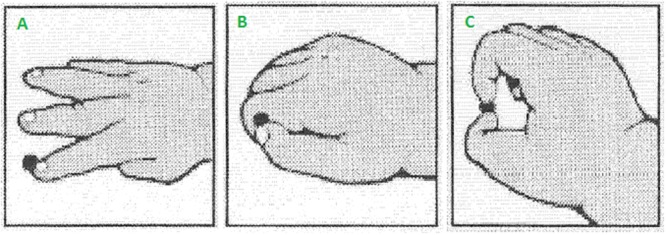
Prior research has shown that infants learn statistical regularities in action sequences better than they learn non-action event sequences. This is consistent with current theories claiming that the same mechanism guides action observation and action execution. The current eye-tracking study tested the prediction, based on these theories, that infants' ability to learn statistical regularities in action sequences is modulated by their own motor abilities. Eight- to eleven-month-old infants observed an action sequence containing two deterministic action pairs (i.e., action always followed by action ) embedded within an otherwise random sequence. One pair was performed with a whole-hand grasp. The second pair was performed with a pincer grasp, a fine motor skill that emerges around 9 months of age. Infants were then categorized into groups according to which grasp was dominant in their motor repertoire. Predictive looks to correct upcoming actions during the deterministic pairs were analyzed to measure whether infants learned and anticipated the sequence regularities. Findings indicate that infants learned the statistical regularities: across motor groups, they made more correct than incorrect predictive fixations to upcoming actions. Overall, learning was not significantly modulated by their dominant grasping abilities. However, infants with a dominant pincer grasp showed an earlier increase in correct predictions for the pincer grasp pair and not the whole-hand grasp. Likewise, infants with a dominant whole-hand grasp showed an early increase in correct predictions for the pair performed with a whole-hand grasp, and not the pincer grasp. Together, these findings suggest that infants' ability to learn action sequences is facilitated when the observed action matches their own action repertoire. However, findings cannot be explained entirely by motor accounts, as infants also learned the actions less congruent with their own abilities. Findings are discussed in terms of the interplay between the motor system and additional non-motor resources during the acquisition of new motor skills in infancy.
先前的研究表明,婴儿学习动作序列中的统计规律比学习非动作事件序列更好。这与当前的理论一致,即相同的机制指导动作观察和动作执行。当前的眼动追踪研究基于这些理论测试了一个预测,即婴儿学习动作序列中统计规律的能力会受到其自身运动能力的调节。8至11个月大的婴儿观察了一个动作序列,该序列包含两个确定性动作对(即动作总是接着动作),并嵌入在一个其他部分随机的序列中。一对动作是用全手抓握完成的。第二对动作是用钳形抓握完成的,钳形抓握是一种精细运动技能,大约在9个月大时出现。然后,根据哪种抓握方式在婴儿的运动技能中占主导地位,将他们分为不同的组。分析了在确定性动作对期间对即将到来的正确动作的预测性注视,以测量婴儿是否学习并预测了序列规律。研究结果表明,婴儿学习了统计规律:在所有运动组中,他们对即将到来的动作做出的正确预测性注视比错误的更多。总体而言,学习并没有受到他们占主导地位的抓握能力的显著调节。然而,以钳形抓握为主的婴儿对钳形抓握对的正确预测出现得更早,而不是对全手抓握的预测。同样,以全手抓握为主的婴儿对用全手抓握完成的动作对的正确预测出现得更早,而不是对钳形抓握的预测。总之,这些发现表明,当观察到的动作与他们自己的动作技能相匹配时,婴儿学习动作序列的能力会得到促进。然而,研究结果不能完全由运动方面的解释来解释,因为婴儿也学习了与他们自己能力不太一致的动作。研究结果将根据婴儿期新运动技能习得过程中运动系统与其他非运动资源之间的相互作用进行讨论。