Li Xiaoliang, Zhou Yun, Zhan Xianlin, Huang Weichun, Wang Xing
Department of Laboratory Medicine, Shanghai Children's Medical Center, Shanghai Jiaotong University School of Medicine, Shanghai, China.
Department of Intensive Care Unit, Huashan Hospital, Fudan University, Shanghai, China.
Front Microbiol. 2018 Jan 11;8:2639. doi: 10.3389/fmicb.2017.02639. eCollection 2017.
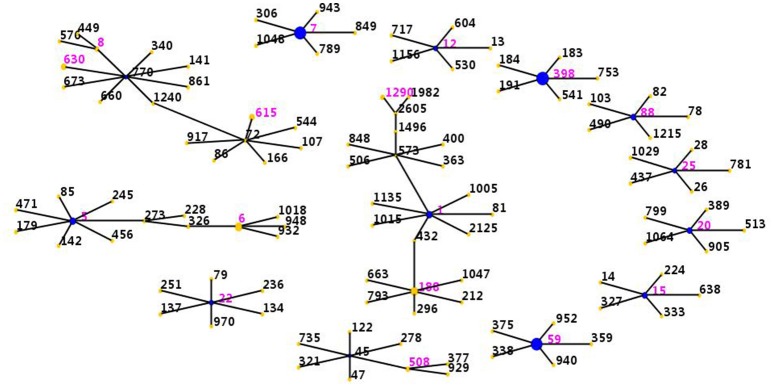
Breast milk is the first choice in feeding newborn infants and provides multiple benefits for their growth and development. usually exists in breast milk and is considered one of the most important causative infective agents. To be effective in preventing and controlling infections among infants, the aim of this study was to determine the occurrence and molecular characteristics of isolated from 1102 samples of breast milk between 2015 and 2016 in Shanghai, China. Out of 71 strains isolated, 15 (21.1%, 15/71) were MRSA and all the strains were characterized by typing, Multi-Locus Sequence Typing, SCC typing, antibiotic resistance testing and virulence-associated genes. A total of 18 distinct sequence types (STs) and 36 types were identified within the 71 isolates, among which the most frequently represented was ST398 (19.7%, 14/71), followed by ST7 (18.3%, 13/71), ST59 (16.9%, 12/71). The three predominant STs accounted for more than one half of all isolates. The most prevalent types were 091 (12.7%, 9/71), followed by 571 (8.5%, 6/71), 189 (7.0%, 5/71), 034 (5.6%, 4/71), 437 (5.6%, 4/71), and 701 (4.2%, 3/71). All MRSA isolates belonged to SCC IV and V, accounting for 66.7 and 33.3% respectively. Notably, 23 (32.4%) strains were multidrug resistance (MDR), including 4 (5.6%) MRSA and 19 (26.8%) MSSA strains, and MDR isolates were mostly resistant to penicillin, erythromycin and clindamycin. All isolates exhibited simultaneous carriage of at least 5 of 33 possible virulence genes and the most prevalent genes detected were (100%), (100%), (100%), (94.4%), 2 (88.7%), (57.8%). 39 (54.9%, 39/71) isolates, including 9 (12.7%) of MRSA isolates, harbored ≥10 tested virulence genes evaluated in this study. The gene was detected in 8 strains, which represented 5 different STs, with ST59 being the most one. Overall, our findings showed that strains isolated from breast milk were mainly MSSA (78.9%, 56/71) and exhibited high genetic diversity in Shanghai area of China. Breast milk was a reservoir for LA-SA (ST398) and CA-SA (ST59), which was likely a vehicle for transmission of multidrug-resistant and MRSA lineages. This is a potential public health risk and highlights the need for good hygiene practices to reduce the risk of infant infections.
母乳是喂养新生儿的首选,对其生长发育有诸多益处。[某种病菌]通常存在于母乳中,被认为是最重要的致病性感染因子之一。为有效预防和控制婴儿感染,本研究旨在确定2015年至2016年在中国上海采集的1102份母乳样本中分离出的[该病菌]的发生情况及分子特征。在分离出的71株菌株中,15株(21.1%,15/71)为耐甲氧西林金黄色葡萄球菌(MRSA),所有菌株均通过[某种分型方法]分型、多位点序列分型、葡萄球菌盒式染色体(SCC)分型、抗生素耐药性检测及毒力相关基因检测进行特征分析。在71株分离株中,共鉴定出18种不同的序列类型(STs)和36种[某种分型类型],其中最常见的是ST398(19.7%,14/71),其次是ST7(18.3%,13/71)、ST59(16.9%,12/71)。这三种主要的STs占所有分离株的一半以上。最常见的[某种分型类型]是091(12.7%,9/71),其次是571(8.5%,6/71)、189(7.0%,5/71)、034(5.6%,4/71)、437(5.6%,4/71)和701(4.2%,3/71)。所有MRSA分离株均属于SCC IV和V型,分别占66.7%和33.3%。值得注意的是,23株(32.4%)[该病菌]菌株为多重耐药(MDR),包括4株(5.6%)MRSA和19株(26.8%)甲氧西林敏感金黄色葡萄球菌(MSSA)菌株,且MDR分离株大多对青霉素、红霉素和克林霉素耐药。所有分离株均同时携带33种可能的毒力基因中的至少5种,检测到的最常见基因是[具体基因1](100%)、[具体基因2](100%)、[具体基因3](100%)、[具体基因4](94.4%)、[具体基因5](88.7%)、[具体基因6](57.8%)。39株(54.9%,39/71)分离株,包括9株(12.7%)MRSA分离株,携带≥10个本研究中检测的毒力基因。[某个基因]在8株菌株中被检测到,代表5种不同的STs,其中ST59最为常见。总体而言,我们的研究结果表明,从母乳中分离出的[该病菌]菌株主要是MSSA(78.9%,56/71),在中国上海地区表现出高度的遗传多样性。母乳是家畜源金黄色葡萄球菌(LA - SA,ST398)和社区获得性金黄色葡萄球菌(CA - SA,ST59)的储存库,这可能是多重耐药[该病菌]和MRSA谱系传播的载体。这是一个潜在的公共卫生风险,突出了良好卫生习惯对于降低婴儿感染风险的必要性。