Gao Pan, Li Chunjie, Chang Zheng, Wang Xiaoyi, Xuan Ming
State Key Laboratory of Oral Diseases, West China Hospital of Stomatology, Sichuan University, Chengdu, Sichuan 610041, P.R. China.
Department of Head and Neck Oncology, West China Hospital of Stomatology, Sichuan University, Chengdu, Sichuan 610041, P.R. China.
Oncol Lett. 2018 Jan;15(1):331-337. doi: 10.3892/ol.2017.7301. Epub 2017 Oct 31.
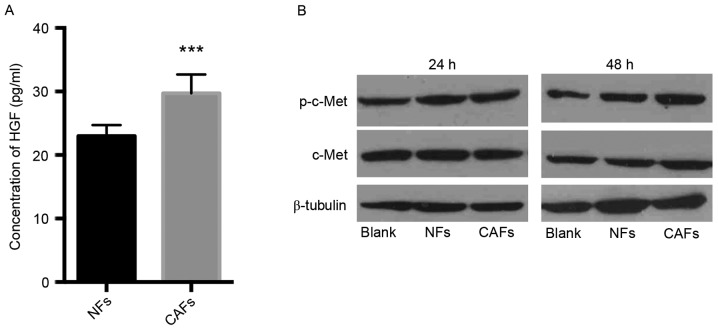
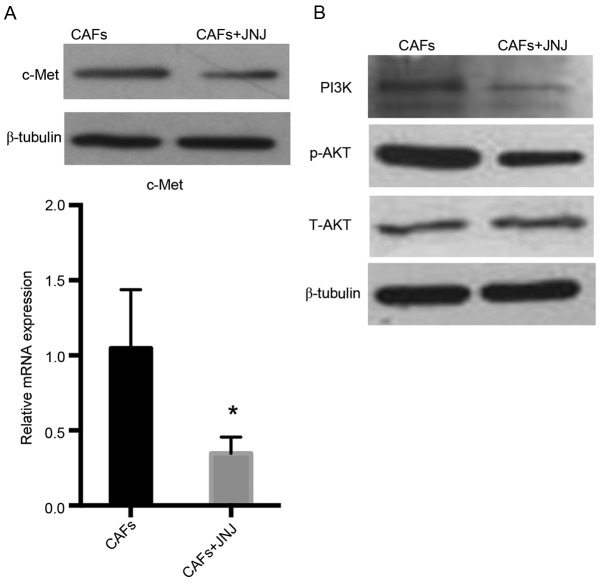
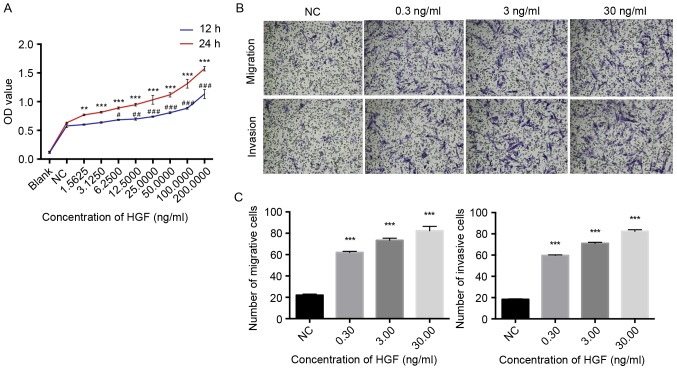
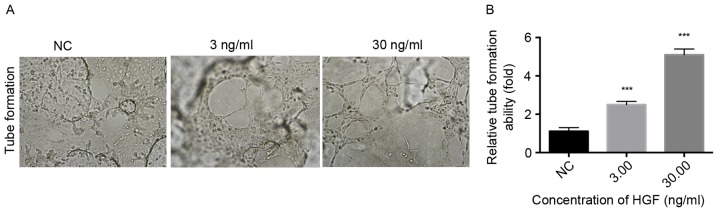
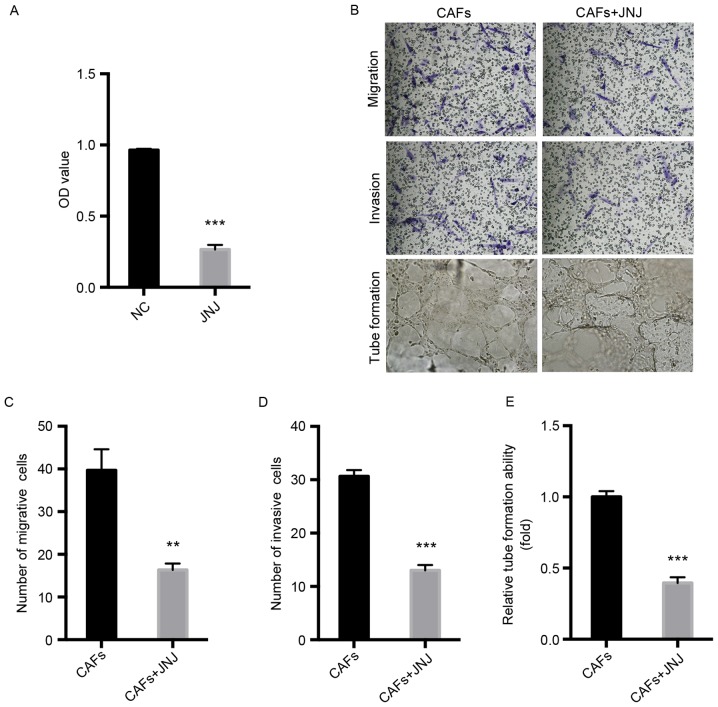
Carcinoma-associated fibroblasts (CAFs) are dominant components of the tumor microenvironment (TME) that promote the development, progression and metastasis of cancer. c-Met is a receptor of the hepatocyte growth factor (HGF), which is involved in lymphangiogenesis. Currently, the roles of CAFs during lymphangiogenesis are unknown. It has been hypothesized that CAFs contribute to lymphangiogenesis of oral squamous cell carcinoma (OSCC) via a HGF/c-Met complex. The expression of HGF in OSCC was determined using CAFs derived from OSCC tissue and it was demonstrated that HGF is overexpressed in OSCC-derived CAFs. It was also revealed that c-Met was highly expressed in human lymphatic endothelial cells (HLECs) when co-cultured with CAFs. Furthermore, it was demonstrated that recombinant human HGF significantly enhanced the proliferation, migration, invasion and tube formation of HLECs. By contrast, the inhibition of c-Met expression suppressed the aforementioned biological activities and also downregulated the expression of c-Met, phosphoinositide 3-kinase and phosphorylated protein kinase B. Taken together, these data demonstrate that c-Met is associated with the regulation of lymphangiogenesis. Thus, the results of the present study indicate that c-Met may be a promising novel therapeutic target to treat patients with OSCC.
癌相关成纤维细胞(CAFs)是肿瘤微环境(TME)的主要组成部分,可促进癌症的发生、发展和转移。c-Met是肝细胞生长因子(HGF)的受体,参与淋巴管生成。目前,CAFs在淋巴管生成过程中的作用尚不清楚。据推测,CAFs通过HGF/c-Met复合物促进口腔鳞状细胞癌(OSCC)的淋巴管生成。使用源自OSCC组织的CAFs测定OSCC中HGF的表达,结果表明HGF在源自OSCC的CAFs中过表达。研究还发现,与CAFs共培养时,人淋巴管内皮细胞(HLECs)中c-Met高表达。此外,研究表明重组人HGF显著增强了HLECs的增殖、迁移、侵袭和管腔形成。相反,抑制c-Met表达可抑制上述生物学活性,并下调c-Met、磷酸肌醇3激酶和磷酸化蛋白激酶B的表达。综上所述,这些数据表明c-Met与淋巴管生成的调节有关。因此,本研究结果表明,c-Met可能是治疗OSCC患者的一个有前景的新型治疗靶点。