Gélin Pauline, Fauvelot Cécile, Bigot Lionel, Baly Joseph, Magalon Hélène
UMR ENTROPIE (Université de La Réunion, IRD, CNRS) Université de La Réunion St Denis La Réunion.
Laboratoire d'excellence-CORAIL Perpignan France.
Ecol Evol. 2017 Dec 27;8(2):1411-1426. doi: 10.1002/ece3.3747. eCollection 2018 Jan.
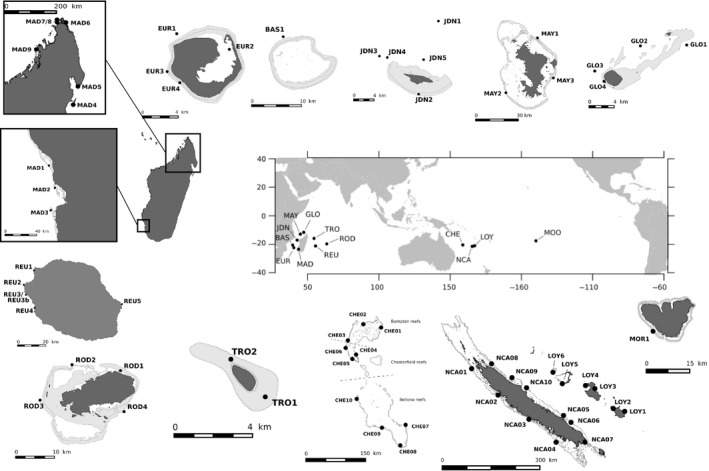
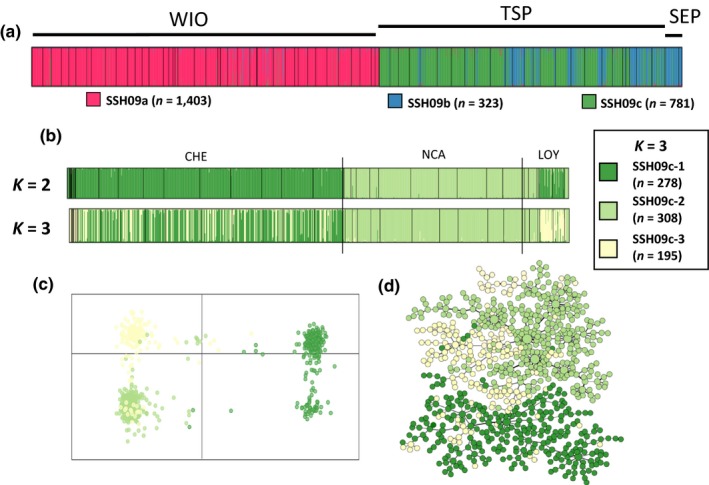
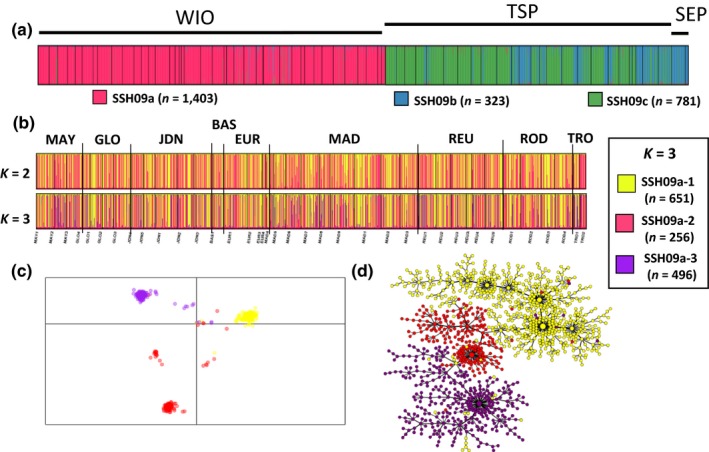
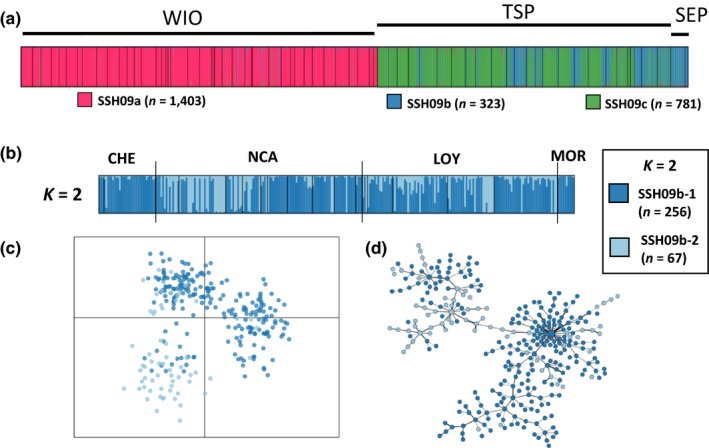
Here, we examined the genetic variability in the coral genus , in particular within the Primary Species Hypothesis PSH09, identified by Gélin, Postaire, Fauvelot and Magalon (2017) using species delimitation methods [also named complex , Schmidt-Roach, Miller, Lundgren, & Andreakis (2014)] and which was found to split into three secondary species hypotheses (SSH09a, SSH09b, and SSH09c) according to assignment tests using multi-locus genotypes (13 microsatellites). From a large sampling (2,507 colonies) achieved in three marine provinces [Western Indian Ocean (WIO), Tropical Southwestern Pacific (TSP), and Southeast Polynesia (SEP)], genetic structuring analysis conducted with two clustering analyses (structure and DAPC) using 13 microsatellites revealed that SSH09a was restricted to the WIO while SSH09b and SSH09c were almost exclusively in the TSP and SEP. More surprisingly, each SSH split into two to three genetically differentiated clusters, found in sympatry at the reef scale, leading to a pattern of nested hierarchical levels (PSH > SSH > cluster), each level hiding highly differentiated genetic groups. Thus, rather than structured populations within a single species, these three SSHs, and even the eight clusters, likely represent distinct genetic lineages engaged in a speciation process or real species. The issue is now to understand which hierarchical level (SSH, cluster, or even below) corresponds to the species one. Several hypotheses are discussed on the processes leading to this pattern of mixed clusters in sympatry, evoking formation of reproductive barriers, either by allopatric speciation or habitat selection.
在此,我们研究了珊瑚属的遗传变异性,特别是在由热兰、波斯泰尔、福韦洛和马加隆(2017年)使用物种界定方法[也称为复合物种,施密特 - 罗奇、米勒、伦德格伦和安德雷亚基斯(2014年)]确定的主要物种假说PSH09范围内,并且根据使用多位点基因型(13个微卫星)的分配测试发现该假说可分为三个次要物种假说(SSH09a、SSH09b和SSH09c)。通过在三个海洋区域[西印度洋(WIO)、热带西南太平洋(TSP)和东南波利尼西亚(SEP)]进行的大规模采样(2507个群体),使用13个微卫星通过两种聚类分析(结构分析和判别分析主成分)进行的遗传结构分析表明,SSH09a仅限于西印度洋,而SSH09b和SSH09c几乎仅存在于热带西南太平洋和东南波利尼西亚。更令人惊讶的是,每个SSH又分为两到三个遗传分化的簇,在珊瑚礁尺度上同域分布,导致一种嵌套层次模式(PSH > SSH > 簇),每个层次都隐藏着高度分化的遗传群体。因此,这三个SSH,甚至这八个簇,可能代表了参与物种形成过程的不同遗传谱系或真正的物种,而不是单一物种内的结构化种群。现在的问题是要了解哪个层次水平(SSH、簇,甚至更低层次)对应于物种层次。文中讨论了关于导致这种同域混合簇模式的过程的几种假说,涉及通过异域物种形成或栖息地选择形成生殖隔离。