Salazar Juan, Bermúdez Valmore, Calvo María, Olivar Luis Carlos, Luzardo Eliana, Navarro Carla, Mencia Heysa, Martínez María, Rivas-Ríos José, Wilches-Durán Sandra, Cerda Marcos, Graterol Modesto, Graterol Rosemily, Garicano Carlos, Hernández Juan, Rojas Joselyn
Endocrine-Metabolic Research Center, , University of Zulia, Maracaibo, Venezuela.
Grupo de Investigación Altos Estudios de Frontera (ALEF), Universidad Simón Bolívar, Cúcuta, Colombia.
F1000Res. 2017 Aug 7;6:1337. doi: 10.12688/f1000research.12170.3. eCollection 2017.
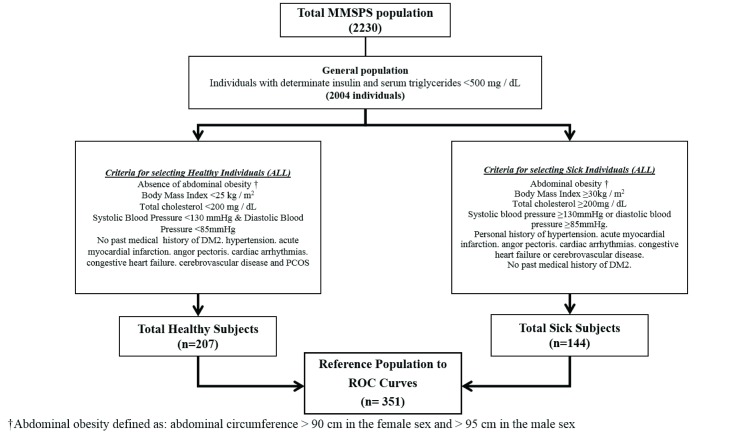
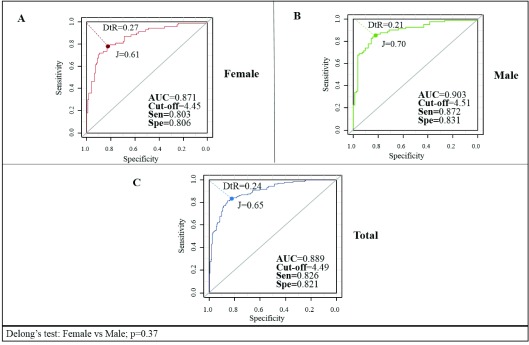
Insulin resistance (IR) evaluation is a fundamental goal in clinical and epidemiological research. However, the most widely used methods are difficult to apply to populations with low incomes. The triglyceride-glucose index (TGI) emerges as an alternative to use in daily clinical practice. Therefore the objective of this study was to determine an optimal cutoff point for the TGI in an adult population from Maracaibo, Venezuela. This is a sub-study of Maracaibo City Metabolic Syndrome Prevalence Study, a descriptive, cross-sectional study with random and multi-stage sampling. For this analysis, 2004 individuals of both genders ≥18 years old with basal insulin determination and triglycerides < 500 mg/dl were evaluated.. A reference population was selected according to clinical and metabolic criteria to plot ROC Curves specific for gender and age groups to determine the optimal cutoff point according to sensitivity and specificity.The TGI was calculated according to the equation: ln [Fasting triglyceride (mg / dl) x Fasting glucose (mg / dl)] / 2. The TGI in the general population was 4.6±0.3 (male: 4.66±0.34 vs. female: 4.56±0.33, p=8.93x10 ). The optimal cutoff point was 4.49, with a sensitivity of 82.6% and specificity of 82.1% (AUC=0.889, 95% CI: 0.854-0.924). There were no significant differences in the predictive capacity of the index when evaluated according to gender and age groups. Those individuals with TGI≥4.5 had higher HOMA2-IR averages than those with TGI <4.5 (2.48 vs 1.74, respectively, p<0.001). The TGI is a measure of interest to identify IR in the general population. We propose a single cutoff point of 4.5 to classify individuals with IR. Future studies should evaluate the predictive capacity of this index to determine atypical metabolic phenotypes, type 2 diabetes mellitus and even cardiovascular risk in our population.
胰岛素抵抗(IR)评估是临床和流行病学研究的一个基本目标。然而,最广泛使用的方法难以应用于低收入人群。甘油三酯 - 葡萄糖指数(TGI)应运而生,可用于日常临床实践。因此,本研究的目的是确定委内瑞拉马拉开波成年人群中TGI的最佳截断点。这是马拉开波市代谢综合征患病率研究的一项子研究,是一项采用随机多阶段抽样的描述性横断面研究。对于该分析,评估了2004名年龄≥18岁、测定了基础胰岛素且甘油三酯<500mg/dl的男女个体。根据临床和代谢标准选择参考人群,绘制性别和年龄组特异性的ROC曲线,根据敏感性和特异性确定最佳截断点。TGI根据以下公式计算:ln[空腹甘油三酯(mg/dl)×空腹血糖(mg/dl)]/2。一般人群中的TGI为4.6±0.3(男性:4.66±0.34,女性:4.56±0.33,p = 8.93×10)。最佳截断点为4.49,敏感性为82.6%,特异性为82.1%(AUC = 0.889,95%CI:0.854 - 0.924)。根据性别和年龄组评估时,该指数的预测能力没有显著差异。TGI≥4.5的个体的HOMA2-IR平均值高于TGI<4.5的个体(分别为2.48和1.74,p<0.001)。TGI是识别一般人群中IR的一个有价值的指标。我们建议采用单一截断点4.5来对IR个体进行分类。未来的研究应评估该指数在确定我们人群中的非典型代谢表型、2型糖尿病甚至心血管风险方面的预测能力。