Department of Health Promotion, School of Public Health, Sackler Faculty of Medicine, Tel Aviv University, Tel Aviv, Israel.
Department of Statistics and Operations Research, The Sackler Faculty of Exact Sciences, Tel Aviv University, Tel Aviv, Israel.
Addiction. 2018 May;113(5):805-816. doi: 10.1111/add.14134. Epub 2018 Jan 29.
Although smoking cessation medications have shown effectiveness in increasing abstinence in randomized controlled trials (RCTs), it is unclear to what extent benefits persist over time. This paper assesses whether the benefits of smoking cessation medications decline over the first year.
We selected studies from three systematic reviews published by the Cochrane Collaboration. RCTs of first-line smoking cessation medications, with 6- and 12-month follow-up, were eligible for inclusion. Meta-analysis was used to synthesize information on sustained abstinence (SA) at 6 versus 12 months and 3 versus 6 months, using the risk difference (RD) ('net benefit') between intervention and control group quit rates, the relative risk (RR) and the odds ratio (OR).
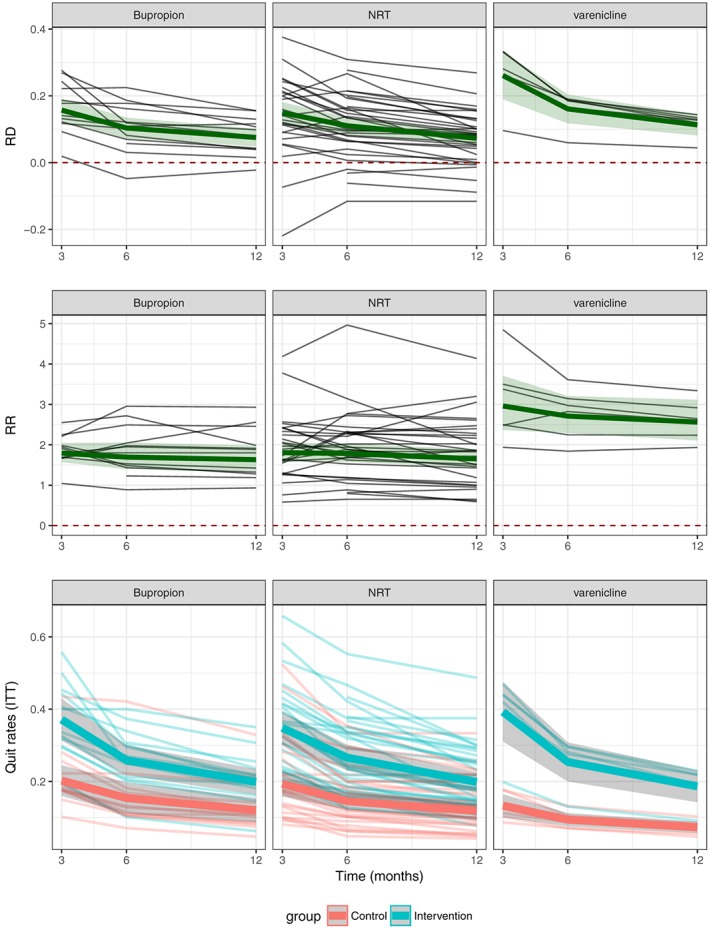
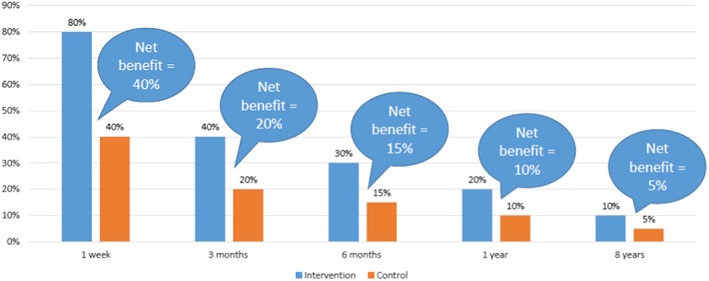
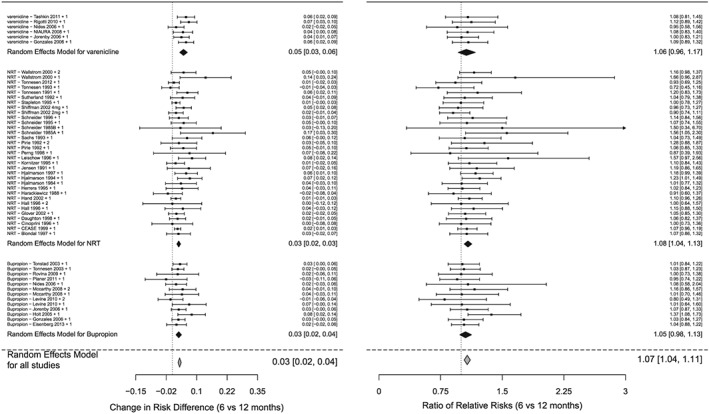
Sixty-one studies (27 647 participants) were included. Fewer than 40% of intervention group participants were sustained abstinent at 3 months (bupropion: 37.1%; nicotine replacement therapy (NRT): 34.8%; varenicline: 39.3%); approximately a quarter were sustained abstinent at 6 months (bupropion: 25.9%; NRT: 26.6%; varenicline: 25.4%), and approximately a fifth were sustained abstinent at 12 months (bupropion: 19.9%; NRT: 19.8%%; varenicline: 18.7%). There was only a small decline in RR (3 months: 1.95 [95% confidence interval (CI) = 1.74-2.18, P < 0.0001]; 6 months: 1.87 (95% CI = 1.67-2.08 P < 0.0001); 12 months: 1.75 (95% CI = 1.56-1.95, P < 0.0001) between intervention and control groups over time, but a substantial decline in net benefit [3 months: RD = 17.3% (14.5-20.1%); 6 months: RD = 11.8% (10.0-13.7%); 12 months: RD = 8.2% (6.8-9.6%)]. The decline in net benefit was statistically significant between 3 and 6 [RD = 4.95% (95% CI = 3.49-6.41%), P < 0.0001] and 6 and 12 months [RD = 3.00% (95% CI = 2.36%-3.64%), P < 0.0001)] for medications combined and individual medications.
The proportion of smokers who use smoking cessation medications who benefit from doing so decreases during the course of the first year, but a net benefit still remains at 12 months.
虽然戒烟药物在随机对照试验(RCT)中已显示出增加戒烟成功率的效果,但尚不清楚这些益处能持续多长时间。本文评估了戒烟药物的益处是否会在第一年中逐渐下降。
我们从 Cochrane 协作组织发表的三篇系统评价中选择了研究。有 6 个月和 12 个月随访的一线戒烟药物 RCT 符合纳入标准。使用干预组和对照组的戒烟率之间的风险差异(RD)(“净效益”),相对风险(RR)和比值比(OR),对 6 个月和 12 个月以及 3 个月和 6 个月的持续戒烟(SA)进行了荟萃分析。
共纳入了 61 项研究(27647 名参与者)。在 3 个月时,不到 40%的干预组参与者保持了戒烟状态(安非他酮:37.1%;尼古丁替代疗法(NRT):34.8%;伐尼克兰:39.3%);大约四分之一的参与者在 6 个月时保持了戒烟状态(安非他酮:25.9%;NRT:26.6%;伐尼克兰:25.4%),大约五分之一的参与者在 12 个月时保持了戒烟状态(安非他酮:19.9%;NRT:19.8%;伐尼克兰:18.7%)。RR 仅略有下降(3 个月:1.95 [95%置信区间(CI)= 1.74-2.18,P < 0.0001];6 个月:1.87 [95%CI= 1.67-2.08,P < 0.0001];12 个月:1.75 [95%CI= 1.56-1.95,P < 0.0001]),但净效益显著下降[3 个月:RD= 17.3%(14.5-20.1%);6 个月:RD= 11.8%(10.0-13.7%);12 个月:RD= 8.2%(6.8-9.6%)]。3 个月与 6 个月(RD= 4.95%(95%CI= 3.49-6.41),P < 0.0001)以及 6 个月与 12 个月(RD= 3.00%(95%CI= 2.36%-3.64),P < 0.0001)之间的净效益差异有统计学意义)。
在第一年中,使用戒烟药物的吸烟者中受益的比例逐渐下降,但在 12 个月时仍存在净效益。