Department of Parasitology-Mycology, Faculty of Medicine, University of Health Sciences, P.O. Box 4009, Libreville, Gabon.
International Center for Medical Research of Franceville, Franceville, Gabon.
Infect Dis Poverty. 2018 Jan 30;7(1):6. doi: 10.1186/s40249-017-0381-4.
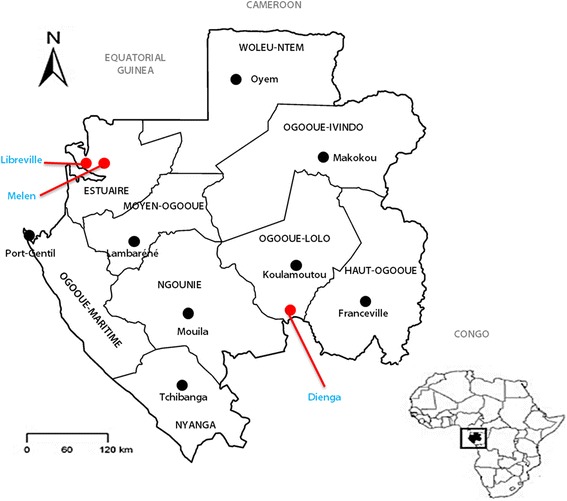
Malaria, filariasis, and intestinal parasitic infections (IPIs) are common and frequently overlap in developing countries. The prevalence and predictors of these infections were investigated in three different settlements (rural, semi-urban, and urban) of Gabon.
During cross-sectional surveys performed from September 2013 to June 2014, 451 individuals were interviewed. In addition, blood and stool samples were analysed for the presence of Plasmodium, filarial roundworm, intestinal protozoan, and helminth infections.
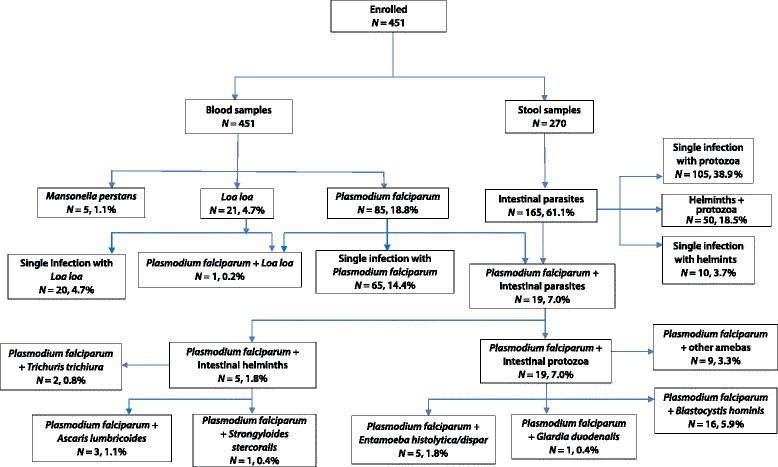
Intestinal parasitic infections (61.1%), including intestinal protozoa (56.7%) and soil-transmitted helminths (STHs) (22.2%), predominated, whereas Plasmodium falciparum (18.8%), Loa loa (4.7%), and Mansonella perstans (1.1%) were less prevalent. Filariasis and STHs were mainly found in rural settlements, whereas a higher plasmodial infection prevalence rate was observed in the periurban area. The most common IPI was blastocystosis (48.6%), followed by ascaridiasis (13.7%), trichuriasis (11.8%), amoebiasis (9.3%), giardiasis (4.8%), and strongyloidiasis (3.7%). Hookworm was detected in one adult from rural Dienga. Adults had a higher prevalence of Blastocystis hominis and STHs, whereas Giardia duodenalis was more frequently observed among children aged below 5 years (P < 0.01). The polyparasitism rate was 41.5%, with 7.0% Plasmodium-IPIs and 1.8% Plasmodium-STH co-infections. The multivariate analysis showed that living in a suburban area, belonging to the age group of 5-15 years, having none or a secondary education, or having an open body water close to home were significant risk factors for malaria (P ≤ 0.01). For STH infections, identified risk factors were drinking untreated water and living in a rural area (P ≤ 0.04). No significant predictors were identified for IPIs and malaria-IPI co-infection.
This study reports a high prevalence of IPIs and intestinal protozoa, but a low rate of malaria-IPI co-infections in the study sites. Improvements in the living conditions of the population such as adequate water supply and proper health education and sanitation should be integrated into control strategies for malaria, STHs, and IPIs.
疟疾、血丝虫病和肠道寄生虫感染(IPIs)在发展中国家很常见,且常相互重叠。本研究在加蓬的三个不同定居点(农村、半城市和城市)调查了这些感染的流行情况及其预测因素。
2013 年 9 月至 2014 年 6 月期间进行了横断面调查,共访谈了 451 人。此外,还分析了血液和粪便样本,以检测是否存在疟原虫、丝虫、肠道原生动物和寄生虫感染。
肠道寄生虫感染(61.1%),包括肠道原生动物(56.7%)和土壤传播性蠕虫(STHs)(22.2%)最为常见,而恶性疟原虫(18.8%)、盘尾丝虫(4.7%)和曼森氏线虫(1.1%)则较少见。丝虫病和 STHs 主要见于农村定居点,而城市周边地区则有较高的疟原虫感染率。最常见的 IPI 是芽囊原虫病(48.6%),其次是蛔虫病(13.7%)、鞭虫病(11.8%)、阿米巴病(9.3%)、贾第虫病(4.8%)和旋毛虫病(3.7%)。在农村的 Dienga 发现了一例钩虫感染的成年人。成年人感染肠道内共生体和 STHs 的患病率较高,而 5 岁以下儿童感染贾第鞭毛虫的比例较高(P<0.01)。多寄生虫感染率为 41.5%,7.0%的疟原虫与 IPI 共感染,1.8%的疟原虫与 STH 共感染。多变量分析显示,居住在郊区、5-15 岁年龄组、无或中学以下教育程度、或家中附近有开放性水体是疟疾的显著危险因素(P≤0.01)。对于 STH 感染,饮用水未经处理和居住在农村地区是已识别的危险因素(P≤0.04)。未发现肠道寄生虫感染和疟疾-IPI 共感染的显著预测因素。
本研究报告了这些研究地点的 IPI 和肠道原生动物的高流行率,但疟原虫-IPI 共感染率较低。改善人口的生活条件,如提供充足的供水、适当的卫生教育和卫生设施,应纳入疟疾、STHs 和 IPI 的控制策略。