Department of Neurochemistry, Stockholm University, Svante Arrhenius väg 16B, 106 91, Stockholm, Sweden.
Department of Pathology and Laboratory Medicine, Lunenfeld-Tanenbaum Research Institute-Mount Sinai Hospital, Toronto, ON, Canada.
Alzheimers Res Ther. 2018 Jan 29;10(1):9. doi: 10.1186/s13195-018-0336-4.
Kallikrein 6 (KLK6) is known to be an age-related protease expressed at high levels in the central nervous system. It was previously shown to be involved in proteolysis of extracellular proteins implicated in neurodegenerative diseases such as Alzheimer's disease (AD), prompting validation of KLK6 as a potential biomarker of disease. However, analyses of both plasma and cerebrospinal fluid (CSF) levels of KLK6 in patients with AD have been inconclusive. We present a detailed analysis of KLK6 in plasma and CSF in two separate cohorts in a cross-sectional and a longitudinal clinical setting.
The cross-sectional cohort included control subjects without dementia and patients with AD, and the longitudinal cohort included patients with MCI and patients with AD followed over a 2-year period. Plasma and CSF levels of KLK6 were quantified by use of a previously developed and validated enzyme-linked immunosorbent assay. Statistical analyses were performed to compare KLK6 levels between diagnostic groups and to identify potential associations between KLK6 level, age, apolipoprotein E (APOE) genotype, total apoE level and the classical CSF AD biomarkers.
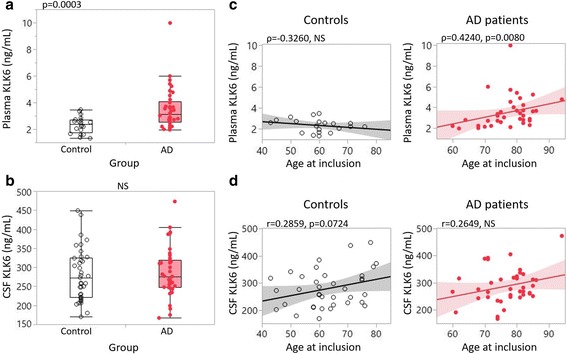
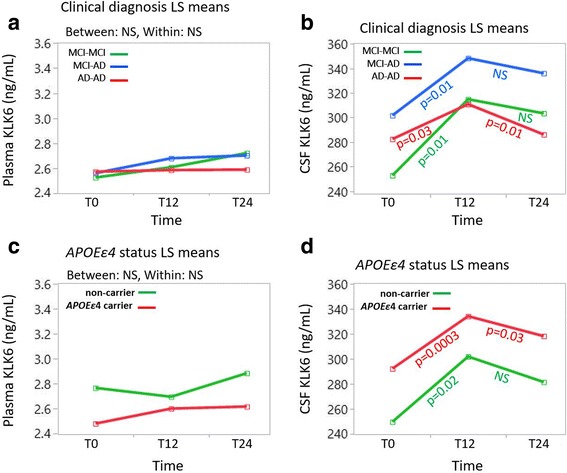
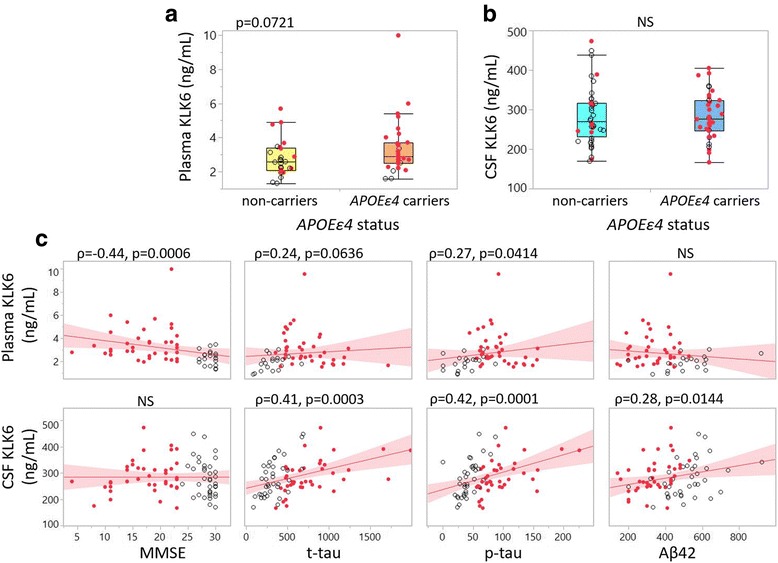
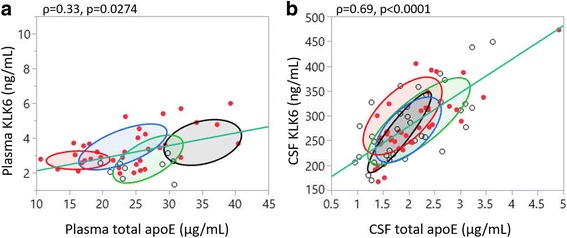
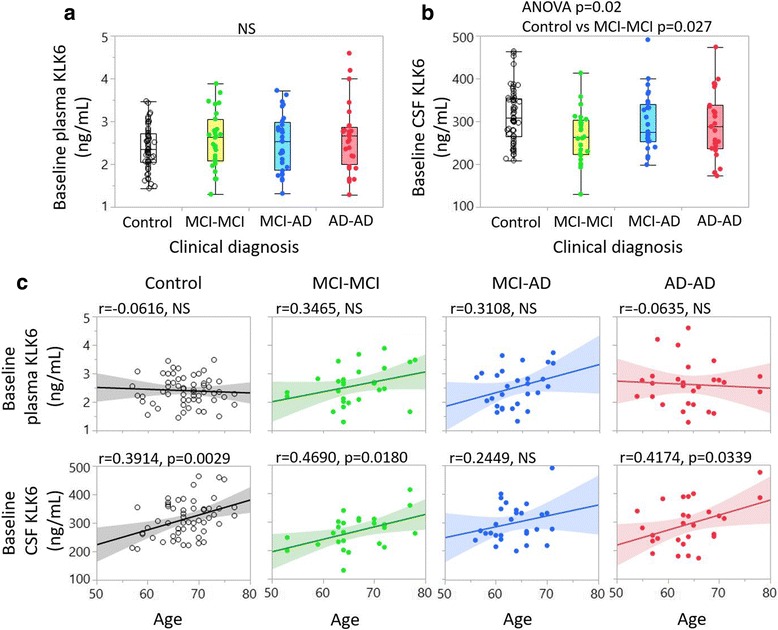
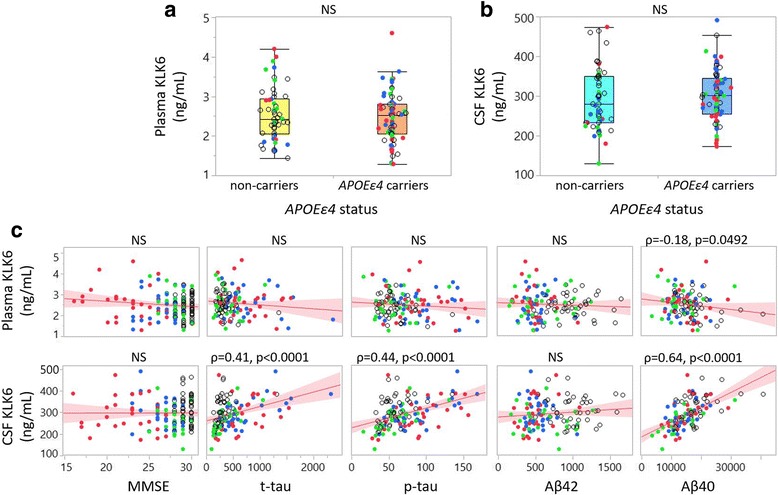
In the cross-sectional setting, KLK6 levels in plasma but not in CSF were significantly higher in the AD group than in control subjects. CSF but not plasma KLK6 levels were positively correlated with age in both the cross-sectional and longitudinal settings. In both cohorts, the CSF KLK6 levels were significantly and positively correlated with the CSF levels of core AD biomarkers. Total plasma and CSF apoE levels were positively associated with KLK6 in the cross-sectional study. Finally, during the 2-year monitoring period of the longitudinal cohort, CSF KLK6 levels increased with disease progression over time in the investigated patient groups.
In two separate cohorts we have confirmed the previously reported correlation between age and CSF levels of KLK6. Increased plasma KLK6 levels in patients with AD with a more advanced disease stage suggest KLK6 as a potential biomarker in patients with AD with more severe dementia. Significant correlations between KLK6 levels and core CSF AD biomarkers suggest molecular links between KLK6 and AD-related pathological processes.
激肽释放酶 6(KLK6)是一种与年龄相关的蛋白酶,在中枢神经系统中高水平表达。先前的研究表明,它参与了细胞外蛋白的水解,这些蛋白与阿尔茨海默病(AD)等神经退行性疾病有关,这促使 KLK6 被验证为疾病的潜在生物标志物。然而,对 AD 患者的血浆和脑脊液(CSF)中 KLK6 水平的分析尚无定论。我们在横断面和纵向临床环境中分别对两个独立队列的血浆和 CSF 中的 KLK6 进行了详细分析。
横断面队列包括无痴呆的对照组和 AD 患者,纵向队列包括 MCI 患者和 AD 患者,随访时间为 2 年。使用先前开发并验证的酶联免疫吸附测定法定量测定 KLK6 水平。进行统计分析以比较诊断组之间的 KLK6 水平,并确定 KLK6 水平与年龄、载脂蛋白 E(APOE)基因型、总 apoE 水平和经典 CSF AD 生物标志物之间的潜在关联。
在横断面研究中,与对照组相比,AD 组血浆中 KLK6 水平显著升高,但 CSF 中 KLK6 水平没有升高。在横断面和纵向研究中,CSF 和血浆 KLK6 水平均与年龄呈正相关。在两个队列中,CSF KLK6 水平与 CSF 核心 AD 生物标志物的水平呈显著正相关。在横断面研究中,总血浆和 CSF apoE 水平与 KLK6 呈正相关。最后,在纵向队列的 2 年监测期间,在研究的患者组中,CSF KLK6 水平随疾病进展而随时间增加。
在两个独立的队列中,我们证实了先前报道的年龄与 CSF KLK6 水平之间的相关性。AD 患者中更高级别疾病阶段的血浆 KLK6 水平升高表明 KLK6 可能是 AD 患者中痴呆程度更严重的潜在生物标志物。KLK6 水平与 CSF 核心 AD 生物标志物之间的显著相关性表明 KLK6 与 AD 相关病理过程之间存在分子联系。