Araclon Biotech, Vía Hispanidad 21, 50009, Zaragoza, Spain.
Institut de Diagnòstic per la Imatge, Hospital Universitari Germans Trias i Pujol, Badalona, Spain.
Alzheimers Res Ther. 2018 Jan 29;10(1):12. doi: 10.1186/s13195-018-0340-8.
Immunotherapy targeting the amyloid-β (Aβ) peptide is a promising strategy for the treatment of Alzheimer's disease (AD); however, none of the active or passive vaccines tested have been demonstrated to be effective to date. We have developed the first active vaccine against the C-terminal end of Aβ, ABvac40, and assessed its safety and tolerability in a phase I clinical trial.
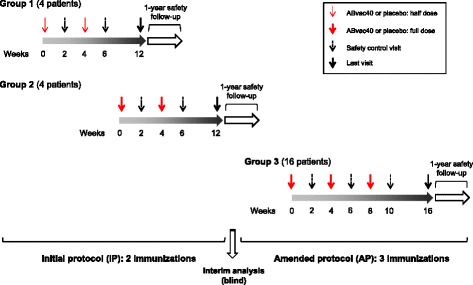
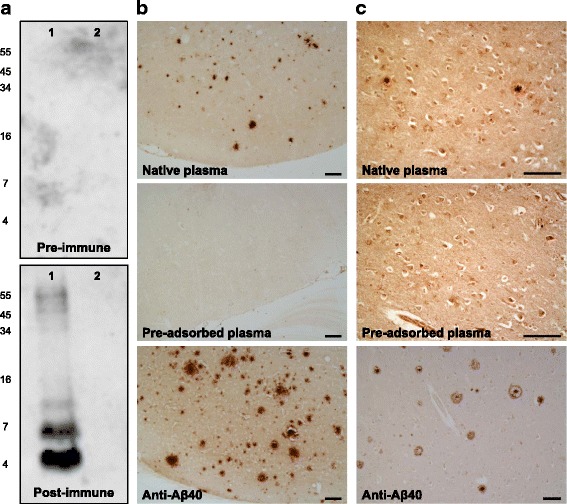
A randomised, double-blind, placebo-controlled, parallel-group, phase I study of ABvac40 was conducted with patients aged 50-85 years with mild to moderate AD. Participants were entered into three separate groups according to time of study entry and were randomly allocated to receive ABvac40 or placebo (overall ratio 2:1). The first group received two half-doses of ABvac40 or placebo, whereas the second and third groups received two and three full doses, respectively. All treatments were administered subcutaneously at 4-week intervals. Patients, carers and investigators were blind to treatment allocation throughout the study. The primary objective was to assess the safety and tolerability of ABvac40 by registering all adverse events (AEs). All patients who received at least one dose of treatment were included in the safety analysis. The secondary objective was to evaluate the immunogenicity of ABvac40 by titration of specific anti-Aβ antibodies in plasma.
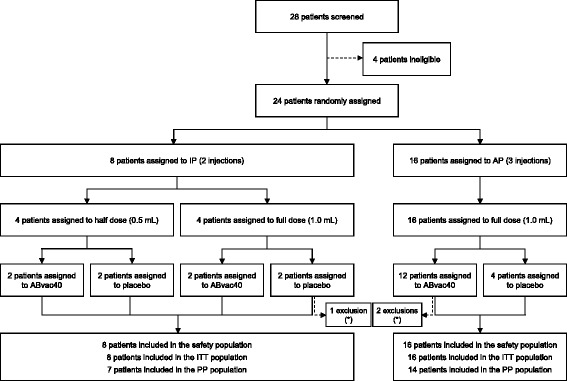
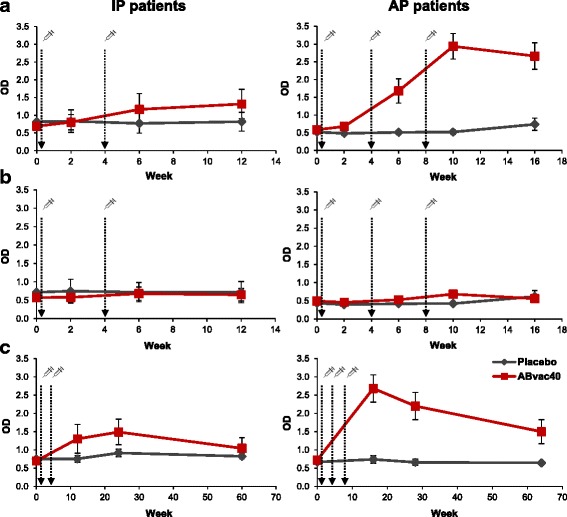
Twenty-four patients were randomly allocated: 16 patients to the ABvac40 group and 8 patients to the placebo group. All randomised patients completed the study, therefore the intention-to-treat and safety populations were identical. Overall, 71 AEs affecting 18 patients were recorded: 11 (69%) in the ABvac40 group and 7 (88%) in the placebo group (p = 0.6214). Neither incident vasogenic oedema nor sulcal effusion (amyloid-related imaging abnormalities corresponding to vasogenic oedema and sulcal effusions) nor microhaemorrhages (amyloid-related imaging abnormalities corresponding to microhaemorrhages and hemosiderin deposits) were detected throughout the study period in the ABvac40-treated patients. Eleven of 12 (~92%) individuals receiving three injections of ABvac40 developed specific anti-Aβ antibodies.
ABvac40 showed a favourable safety and tolerability profile while eliciting a consistent and specific immune response. An ongoing phase II clinical trial is needed to confirm these results and to explore the clinical efficacy of ABvac40.
ClinicalTrials.gov, NCT03113812 . Retrospectively registered on 14 April 2017.
针对淀粉样蛋白-β(Aβ)肽的免疫疗法是治疗阿尔茨海默病(AD)的一种很有前途的策略;然而,迄今为止,没有一种测试的主动或被动疫苗被证明是有效的。我们已经开发出针对 Aβ 端的第一个主动疫苗,ABvac40,并在 I 期临床试验中评估了其安全性和耐受性。
一项针对 ABvac40 的随机、双盲、安慰剂对照、平行组、I 期临床试验在年龄在 50-85 岁、有轻度至中度 AD 的患者中进行。根据研究开始时间,将参与者分为三组,并随机分配接受 ABvac40 或安慰剂(总体比例为 2:1)。第一组接受两次 ABvac40 或安慰剂的半剂量,第二组和第三组分别接受两次和三次全剂量。所有治疗均在 4 周间隔时皮下给药。整个研究过程中,患者、护理人员和研究人员均对治疗分配保持盲态。主要目的是通过记录所有不良事件(AE)来评估 ABvac40 的安全性和耐受性。所有接受至少一剂治疗的患者均纳入安全性分析。次要目的是通过测量血浆中特异性抗 Aβ 抗体来评估 ABvac40 的免疫原性。
24 名患者被随机分配:16 名患者接受 ABvac40 组,8 名患者接受安慰剂组。所有随机分配的患者均完成了研究,因此意向治疗和安全性人群相同。总体而言,记录了 18 名患者的 71 次 AE:ABvac40 组 11 次(69%),安慰剂组 7 次(88%)(p=0.6214)。在整个研究期间,ABvac40 治疗组未发现血管源性水肿或脑沟渗出(与血管源性水肿和脑沟渗出相对应的淀粉样蛋白相关成像异常)或微出血(与微出血和含铁血黄素沉积相对应的淀粉样蛋白相关成像异常)。接受 3 次 ABvac40 注射的 12 名个体中有 11 名(92%)产生了特异性抗 Aβ 抗体。
ABvac40 表现出良好的安全性和耐受性,同时引起一致和特异性的免疫反应。需要进行一项正在进行的 II 期临床试验来证实这些结果,并探索 ABvac40 的临床疗效。
ClinicalTrials.gov,NCT03113812。于 2017 年 4 月 14 日进行回顾性注册。