Center for Genetic Medicine Research, Children's Research Institute, Children's National Health System, Washington, DC, 20010, USA.
Department of Human Genetics, David Geffen School of Medicine, University of California, Los Angeles, CA, 90095, USA.
Biol Sex Differ. 2018 Jan 30;9(1):8. doi: 10.1186/s13293-018-0167-9.
Disorders of sex development (DSD) have an estimated frequency of 0.5% of live births encompassing a variety of urogenital anomalies ranging from mild hypospadias to a discrepancy between sex chromosomes and external genitalia. In order to identify the underlying genetic etiology, we had performed exome sequencing in a subset of DSD cases with 46,XY karyotype and were able to identify the causative genetic variant in 35% of cases. While the genetic etiology was not ascertained in more than half of the cases, a large number of variants of unknown clinical significance (VUS) were identified in those exomes.
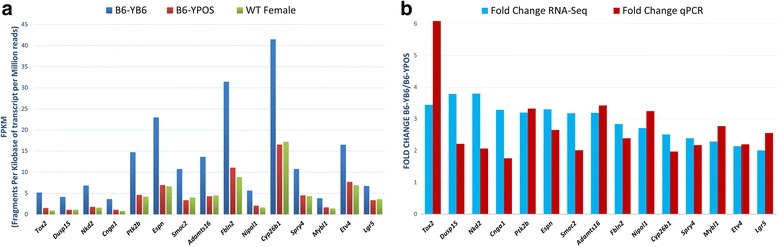
To investigate the relevance of these VUS in regards to the patient's phenotype, we utilized a mouse model in which the presence of a Y chromosome from the poschiavinus strain (Y ) on a C57BL/6J (B6) background results in XY undervirilization and sex reversal, a phenotype characteristic to a large subset of human 46,XY DSD cases. We assessed gene expression differences between B6-Y and undervirilized B6-Y gonads at E11.5 and identified 515 differentially expressed genes (308 underexpressed and 207 overexpressed in B6-Y males).
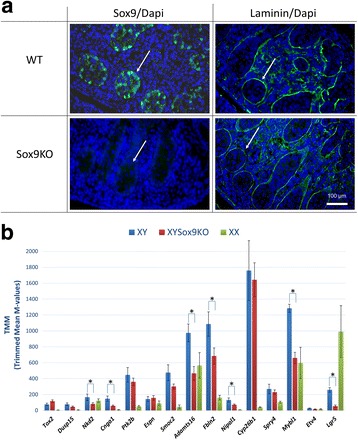
We identified 15 novel candidate genes potentially involved in 46,XY DSD pathogenesis by filtering the list of human VUS-carrying genes provided by exome sequencing with the list of differentially expressed genes from B6-Y mouse model. Additionally, we identified that 7 of the 15 candidate genes were significantly underexpressed in the XY gonads of mice with suppressed Sox9 expression in Sertoli cells suggesting that some of the candidate genes may be downstream of a well-known sex determining gene, Sox9.
The use of a DSD-specific animal model improves variant interpretation by correlating human sequence variants with transcriptome variation.
性发育障碍(DSD)的发病率估计为活产儿的 0.5%,包括各种尿生殖系统异常,从轻度尿道下裂到性染色体与外生殖器之间的差异。为了确定潜在的遗传病因,我们对 46,XY 核型的 DSD 病例亚组进行了外显子组测序,能够在 35%的病例中确定致病的遗传变异。虽然超过一半的病例无法确定遗传病因,但在这些外显子组中发现了大量的临床意义不明的变异(VUS)。
为了研究这些 VUS 与患者表型的相关性,我们利用了一种小鼠模型,即在 C57BL/6J(B6)背景下存在来自 poschiavinus 品系的 Y 染色体(Y ),导致 XY 发育不全和性别反转,这是一大类人类 46,XY DSD 病例的表型特征。我们评估了 E11.5 时 B6-Y 和发育不全的 B6-Y 睾丸之间的基因表达差异,并鉴定了 515 个差异表达基因(308 个在 B6-Y 雄性中表达下调,207 个表达上调)。
通过用外显子组测序提供的携带 VUS 的人类基因列表过滤 B6-Y 小鼠模型的差异表达基因列表,我们鉴定出 15 个可能参与 46,XY DSD 发病机制的新候选基因。此外,我们发现 15 个候选基因中的 7 个在 Sox9 表达在支持细胞中受到抑制的 XY 睾丸中表达显著下调,这表明一些候选基因可能是 Sox9 等已知性别决定基因的下游。
使用特定于 DSD 的动物模型通过将人类序列变异与转录组变异相关联,提高了变异的解释。