Department of Cognitive, Linguistic & Psychological Sciences, Brown University, Providence, RI 02906;
Department of Psychiatry, The University of Texas at Austin, Austin, TX 78712.
Proc Natl Acad Sci U S A. 2018 Feb 13;115(7):E1690-E1697. doi: 10.1073/pnas.1715227115. Epub 2018 Jan 29.
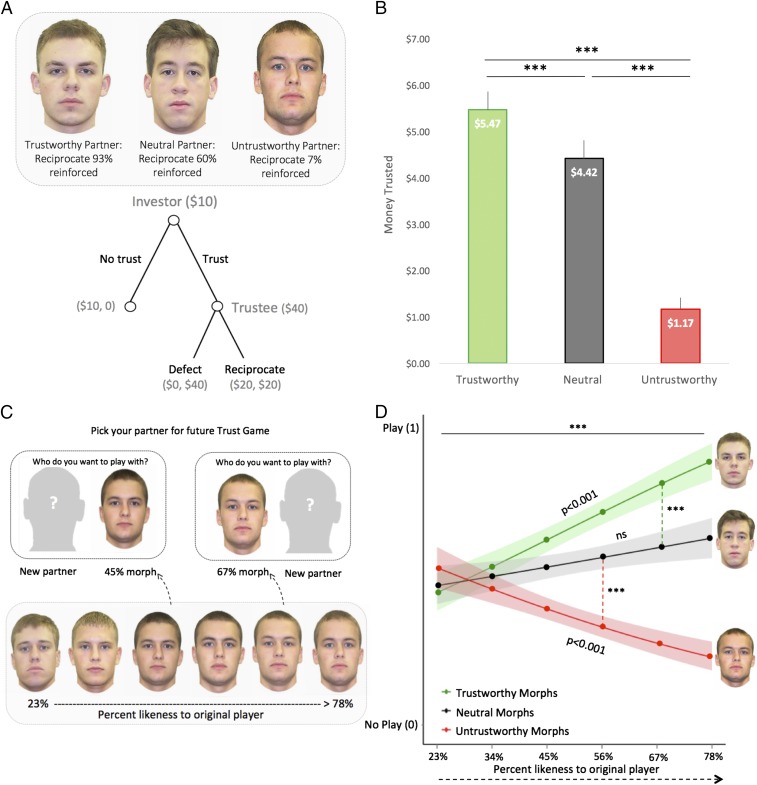
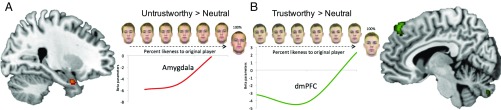
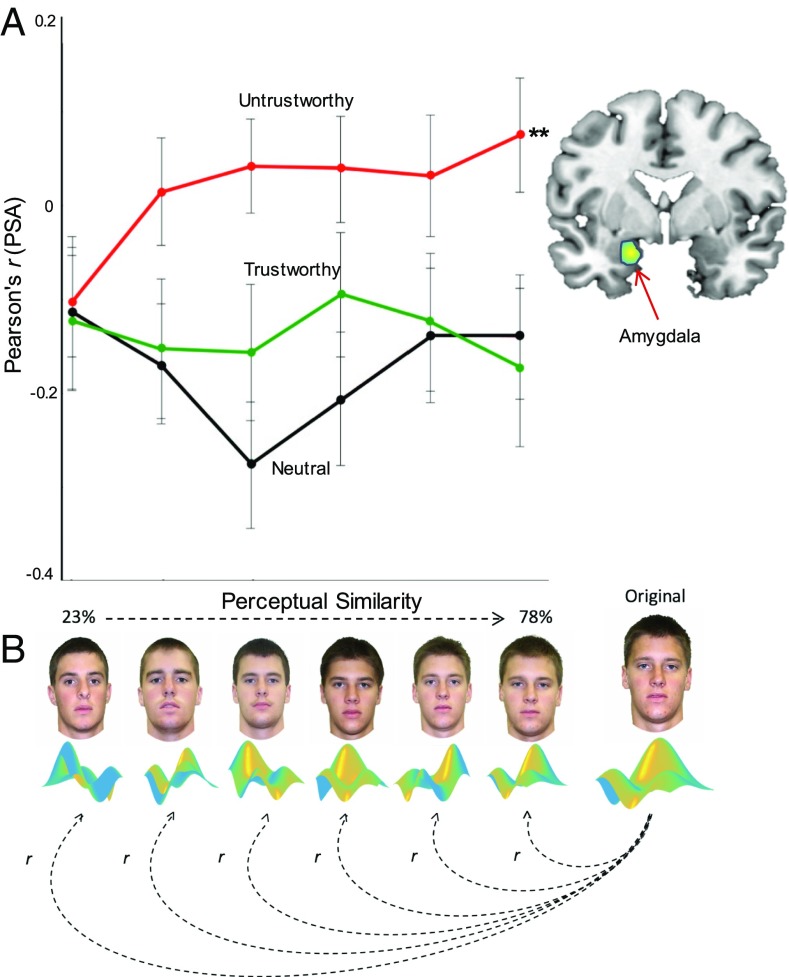
How do humans learn to trust unfamiliar others? Decisions in the absence of direct knowledge rely on our ability to generalize from past experiences and are often shaped by the degree of similarity between prior experience and novel situations. Here, we leverage a stimulus generalization framework to examine how perceptual similarity between known individuals and unfamiliar strangers shapes social learning. In a behavioral study, subjects play an iterative trust game with three partners who exhibit highly trustworthy, somewhat trustworthy, or highly untrustworthy behavior. After learning who can be trusted, subjects select new partners for a second game. Unbeknownst to subjects, each potential new partner was parametrically morphed with one of the three original players. Results reveal that subjects prefer to play with strangers who implicitly resemble the original player they previously learned was trustworthy and avoid playing with strangers resembling the untrustworthy player. These decisions to trust or distrust strangers formed a generalization gradient that converged toward baseline as perceptual similarity to the original player diminished. In a second imaging experiment we replicate these behavioral gradients and leverage multivariate pattern similarity analyses to reveal that a tuning profile of activation patterns in the amygdala selectively captures increasing perceptions of untrustworthiness. We additionally observe that within the caudate adaptive choices to trust rely on neural activation patterns similar to those elicited when learning about unrelated, but perceptually familiar, individuals. Together, these findings suggest an associative learning mechanism efficiently deploys moral information encoded from past experiences to guide future choice.
人类如何学会信任不熟悉的他人?在缺乏直接知识的情况下做出决策依赖于我们从过去的经验中进行概括的能力,并且通常受到先前经验与新情况之间相似程度的影响。在这里,我们利用刺激泛化框架来研究已知个体和陌生陌生人之间的感知相似性如何影响社会学习。在一项行为研究中,参与者与三个具有高度可信、有些可信或高度不可信行为的合作伙伴进行迭代信任游戏。在了解谁可以信任之后,参与者为第二个游戏选择新的合作伙伴。参与者不知道的是,每个潜在的新合作伙伴都与三个原始参与者之一进行参数变形。结果表明,参与者更喜欢与以前学习过的可信原始玩家具有隐含相似性的陌生陌生人玩游戏,而避免与不可信的玩家具有相似性的陌生陌生人玩游戏。这些对陌生人和不信任的人的信任或不信任的决定形成了一个泛化梯度,随着与原始玩家的感知相似性降低而趋同于基线。在第二个成像实验中,我们复制了这些行为梯度,并利用多元模式相似性分析来揭示杏仁核中的激活模式调谐图可以选择性地捕获对不可信的感知的增加。我们还观察到,在尾状核内,对信任的适应性选择依赖于与学习无关但感知上熟悉的个体时引起的类似的神经激活模式。总之,这些发现表明,一种联想学习机制可以有效地利用从过去经验中编码的道德信息来指导未来的选择。