Department of Cognitive Linguistic & Psychological Sciences, Brown University, Providence, United States.
Department of Neuroscience, Brown University, Providence, United States.
Elife. 2023 Jul 3;12:e84888. doi: 10.7554/eLife.84888.
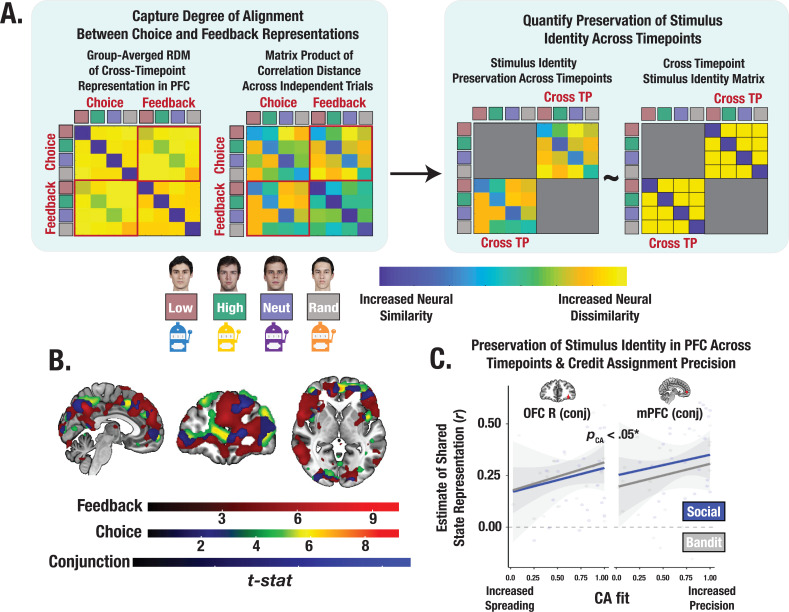
People learn adaptively from feedback, but the rate of such learning differs drastically across individuals and contexts. Here, we examine whether this variability reflects differences in is learned. Leveraging a neurocomputational approach that merges fMRI and an iterative reward learning task, we link the specificity of credit assignment-how well people are able to appropriately attribute outcomes to their causes-to the precision of neural codes in the prefrontal cortex (PFC). Participants credit task-relevant cues more precisely in social compared vto nonsocial contexts, a process that is mediated by high-fidelity (i.e., distinct and consistent) state representations in the PFC. Specifically, the medial PFC and orbitofrontal cortex work in concert to match the neural codes from feedback to those at choice, and the strength of these common neural codes predicts credit assignment precision. Together this work provides a window into how neural representations drive adaptive learning.
人们可以从反馈中进行适应性学习,但这种学习的速度在个体和环境之间有很大的差异。在这里,我们研究这种可变性是否反映了学习的差异。利用一种将 fMRI 和迭代奖励学习任务结合起来的神经计算方法,我们将信用分配的特异性(即人们能够将结果适当地归因于其原因的程度)与前额叶皮层(PFC)中的神经编码的精度联系起来。参与者在社会情境中比在非社会情境中更准确地将线索归因于奖励任务,这一过程是由 PFC 中高保真度(即独特且一致)的状态表示介导的。具体来说,内侧前额叶皮层和眶额皮层协同工作,将反馈中的神经编码与选择中的神经编码相匹配,而这些共同神经编码的强度可以预测信用分配的精度。这项工作为我们提供了一个了解神经表示如何驱动适应性学习的窗口。