Burnett School of Biomedical Sciences, College of Medicine, University of Central Florida, Orlando, FL, 32827, USA.
Sci Rep. 2018 Jan 29;8(1):1739. doi: 10.1038/s41598-018-20081-1.
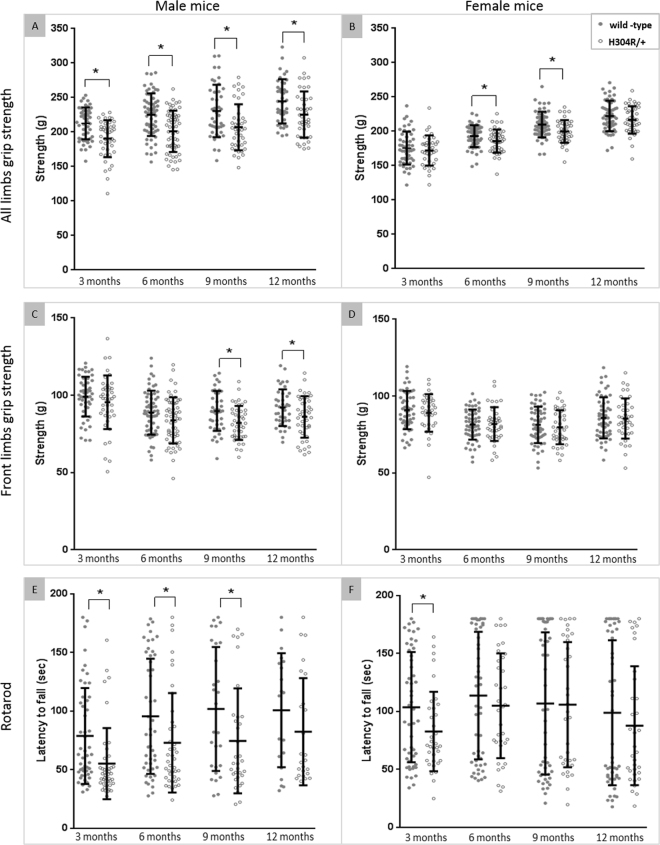
Charcot-Marie-Tooth disease (CMT) is a peripheral neuromuscular disorder in which axonal degeneration causes progressive loss of motor and sensory nerve function. The loss of motor nerve function leads to distal muscle weakness and atrophy, resulting in gait problems and difficulties with walking, running, and balance. A mutation in the cytoplasmic dynein heavy chain (DHC) gene was discovered to cause an autosomal dominant form of the disease designated Charcot-Marie-Tooth type 2 O disease (CMT2O) in 2011. The mutation is a single amino acid change of histidine into arginine at amino acid 306 (H306R) in DHC. In order to understand the onset and progression of CMT2, we generated a knock-in mouse carrying the corresponding CMT2O mutation (H304R/+). We examined H304R/+ mouse cohorts in a 12-month longitudinal study of grip strength, tail suspension, and rotarod assays. H304R/+ mice displayed distal muscle weakness and loss of motor coordination phenotypes consistent with those of individuals with CMT2. Analysis of the gastrocnemius of H304R/+ male mice showed prominent defects in neuromuscular junction (NMJ) morphology including reduced size, branching, and complexity. Based on these results, the H304R/+ mouse will be an important model for uncovering functions of dynein in complex organisms, especially related to CMT onset and progression.
腓骨肌萎缩症(CMT)是一种周围神经肌肉疾病,其中轴突变性导致运动和感觉神经功能进行性丧失。运动神经功能的丧失导致远端肌肉无力和萎缩,导致步态问题以及行走、跑步和平衡困难。2011 年,发现细胞质动力蛋白重链(DHC)基因突变会导致常染色体显性形式的疾病,称为腓骨肌萎缩症 2O 型(CMT2O)。该突变是 DHC 中第 306 位氨基酸由组氨酸突变为精氨酸(H306R)。为了了解 CMT2 的发病和进展,我们生成了携带相应 CMT2O 突变(H304R/+)的敲入小鼠。我们在为期 12 个月的握力、尾悬和转棒试验纵向研究中检查了 H304R/+小鼠队列。H304R/+小鼠表现出与 CMT2 个体一致的远端肌肉无力和运动协调表型丧失。对 H304R/+雄性小鼠腓肠肌的分析显示神经肌肉接头(NMJ)形态的明显缺陷,包括大小、分支和复杂性降低。基于这些结果,H304R/+小鼠将成为揭示动力蛋白在复杂生物中的功能的重要模型,特别是与 CMT 的发病和进展有关。