Gazon Hélène, Barbeau Benoit, Mesnard Jean-Michel, Peloponese Jean-Marie
Belgium Molecular and Cellular Epigenetics, Interdisciplinary Cluster for Applied Genoproteomics, University of Liège, Liège, Belgium.
Département des Sciences Biologiques and Centre de Recherche BioMed, Université du Québec à Montréal, Montréal, QC, Canada.
Front Microbiol. 2018 Jan 15;8:2686. doi: 10.3389/fmicb.2017.02686. eCollection 2017.
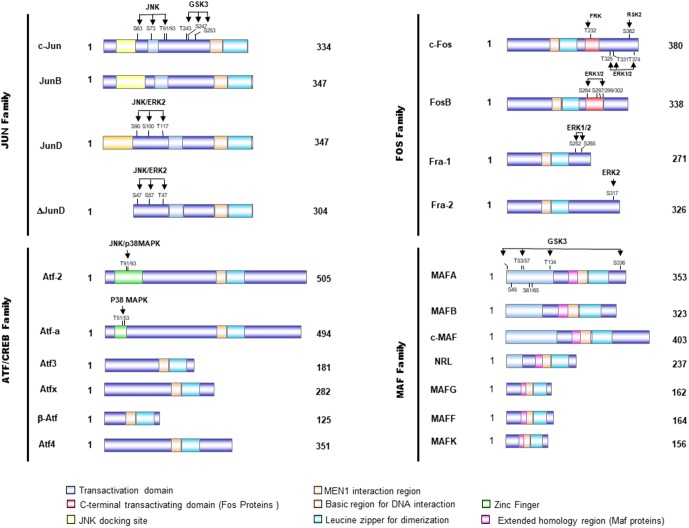
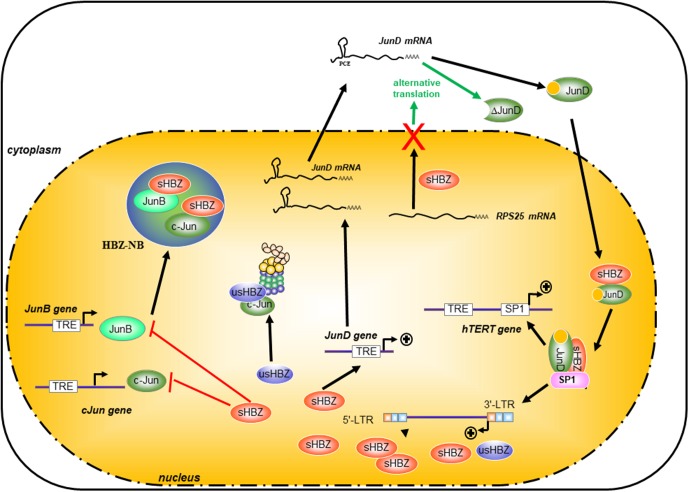
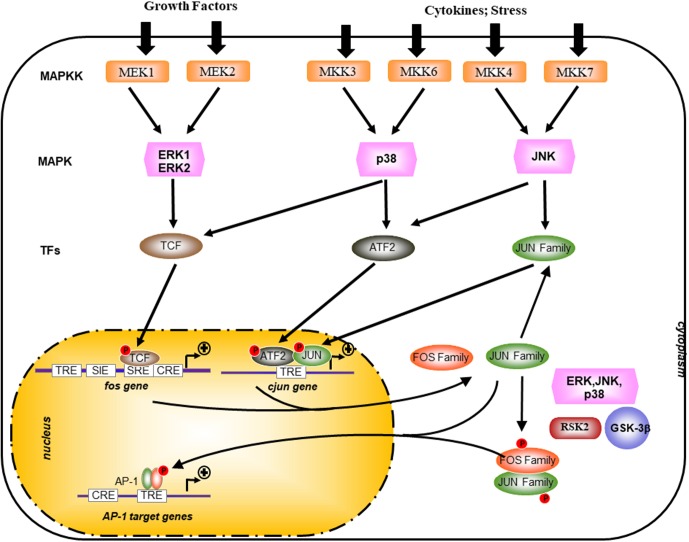
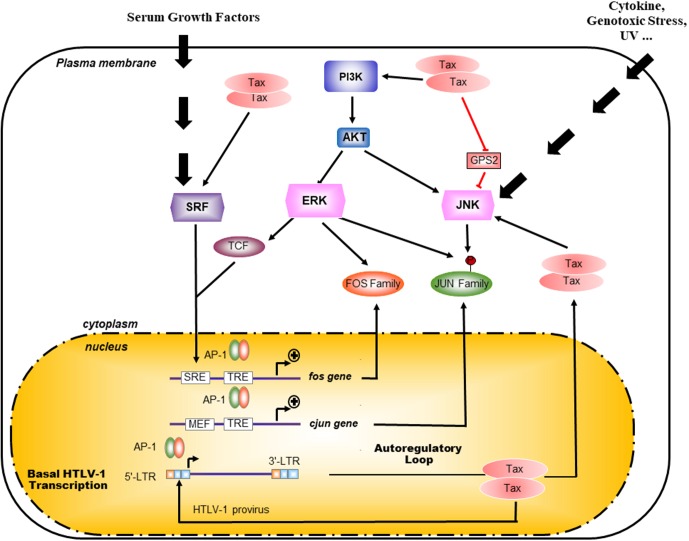
Human T-cell leukemia virus type 1 (HTLV-1) is the causative agent of a fatal malignancy known as adult T-cell leukemia (ATL). One way to address the pathology of the disease lies on conducting research with a molecular approach. In addition to the analysis of ATL-relevant signaling pathways, understanding the regulation of important and relevant transcription factors allows researchers to reach this fundamental objective. HTLV-1 encodes for two oncoproteins, Tax and HTLV-1 basic leucine-zipper factor, which play significant roles in the cellular transformation and the activation of the host's immune responses. Activating protein-1 (AP-1) transcription factor has been linked to cancer and neoplastic transformation ever since the first representative members of the Jun and Fos gene family were cloned and shown to be cellular homologs of viral oncogenes. AP-1 is a dimeric transcription factor composed of proteins belonging to the Jun (c-Jun, JunB, and JunD), Fos (c-Fos, FosB, Fra1, and Fra2), and activating transcription factor protein families. Activation of AP-1 transcription factor family by different stimuli, such as inflammatory cytokines, stress inducers, or pathogens, results in innate and adaptive immunity. AP-1 is also involved in various cellular events including differentiation, proliferation, survival, and apoptosis. Deregulated expression of AP-1 transcription factors is implicated in various lymphomas such as classical Hodgkin lymphomas, anaplastic large cell lymphomas, diffuse large B-cell lymphomas, and adult T-cell leukemia. Here, we review the current thinking behind deregulation of the AP-1 pathway and its contribution to HTLV-induced cellular transformation.
人类嗜T细胞病毒1型(HTLV-1)是一种致命恶性肿瘤——成人T细胞白血病(ATL)的病原体。解决该疾病病理学问题的一种方法是采用分子方法进行研究。除了分析与ATL相关的信号通路外,了解重要且相关转录因子的调控有助于研究人员实现这一基本目标。HTLV-1编码两种癌蛋白,Tax和HTLV-1碱性亮氨酸拉链因子,它们在细胞转化和宿主免疫反应激活中发挥重要作用。自Jun和Fos基因家族的首批代表性成员被克隆并被证明是病毒癌基因的细胞同源物以来,激活蛋白-1(AP-1)转录因子就一直与癌症和肿瘤转化相关联。AP-1是一种二聚体转录因子,由属于Jun(c-Jun、JunB和JunD)、Fos(c-Fos、FosB、Fra1和Fra2)以及激活转录因子蛋白家族的蛋白质组成。不同刺激(如炎性细胞因子、应激诱导剂或病原体)对AP-1转录因子家族的激活会导致先天性和适应性免疫。AP-1还参与各种细胞活动,包括分化、增殖、存活和凋亡。AP-1转录因子的表达失调与多种淋巴瘤有关,如经典霍奇金淋巴瘤、间变性大细胞淋巴瘤、弥漫性大B细胞淋巴瘤和成人T细胞白血病。在此,我们综述了AP-1信号通路失调背后的当前观点及其对HTLV诱导的细胞转化的作用。