Gross Christine, Thoma-Kress Andrea K
Institute of Clinical and Molecular Virology, Friedrich-Alexander-Universität Erlangen-Nürnberg (FAU), 91054 Erlangen, Germany.
Viruses. 2016 Mar 9;8(3):74. doi: 10.3390/v8030074.
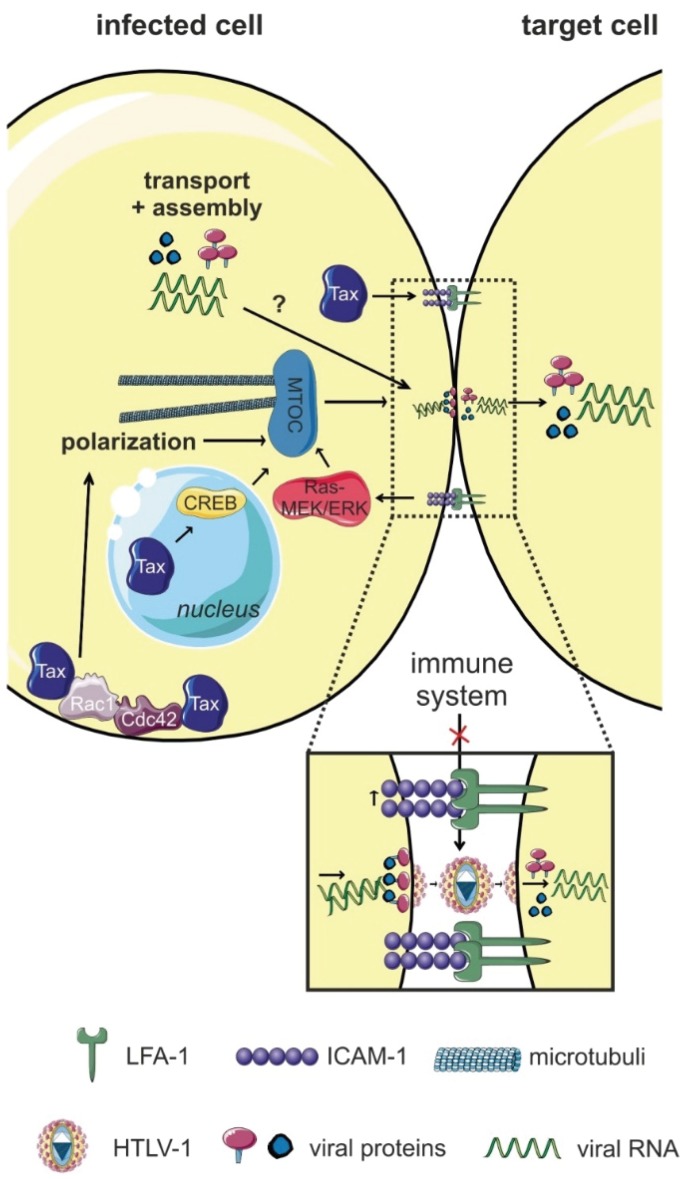
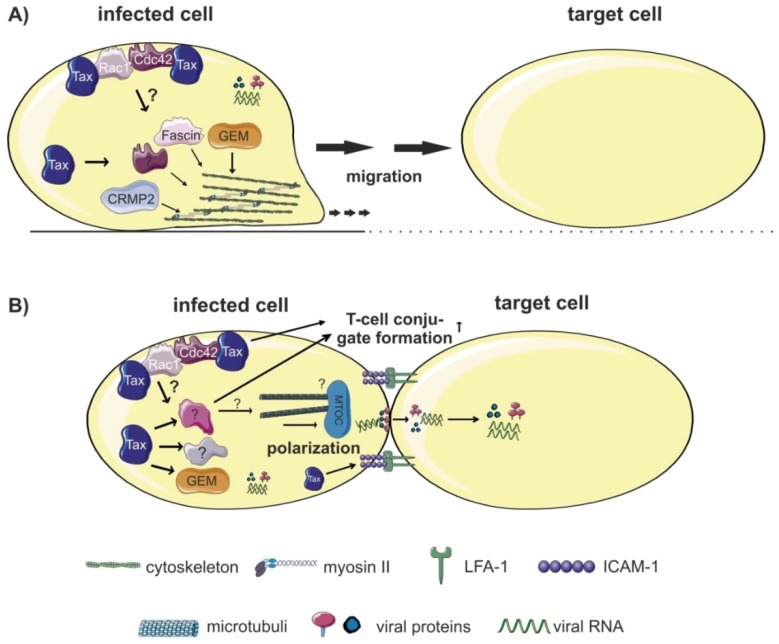
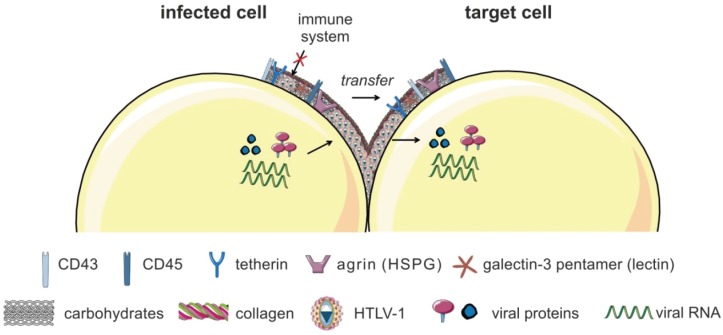
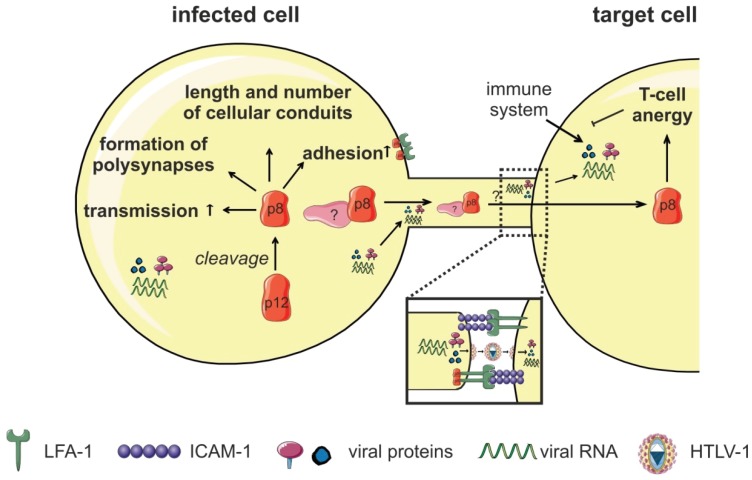
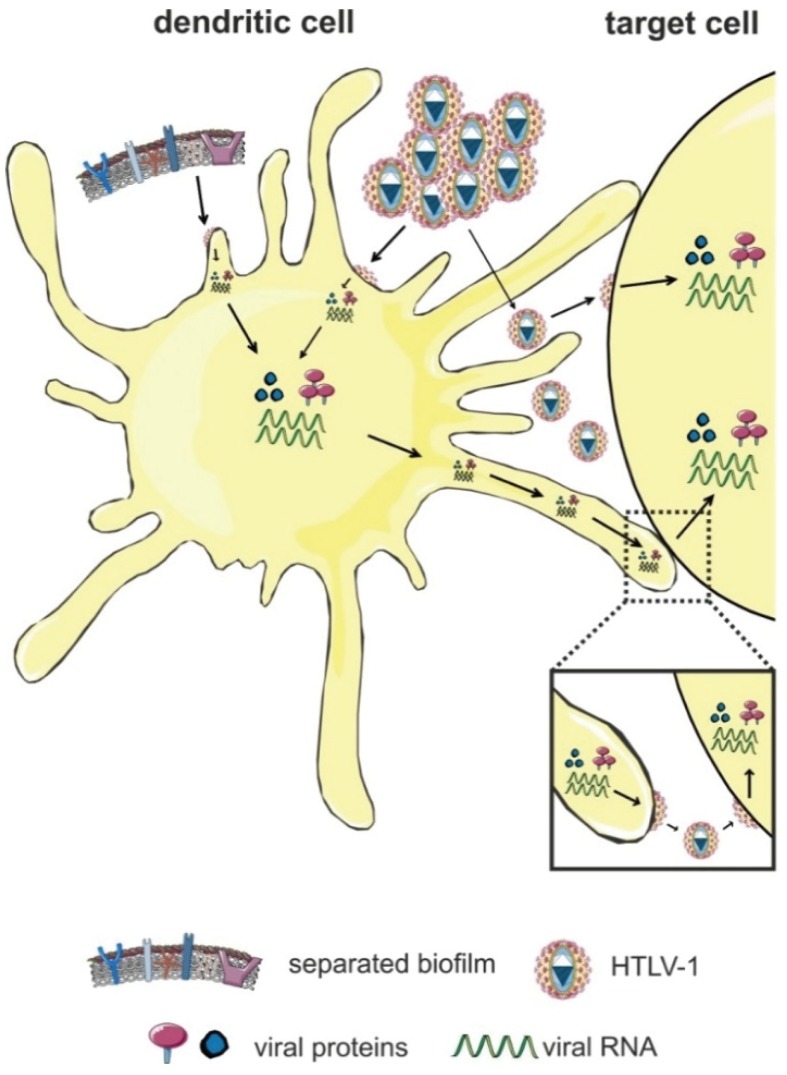
The tumorvirus human T-cell lymphotropic virus type 1 (HTLV-1), a member of the delta-retrovirus family, is transmitted via cell-containing body fluids such as blood products, semen, and breast milk. In vivo, HTLV-1 preferentially infects CD4⁺ T-cells, and to a lesser extent, CD8⁺ T-cells, dendritic cells, and monocytes. Efficient infection of CD4⁺ T-cells requires cell-cell contacts while cell-free virus transmission is inefficient. Two types of cell-cell contacts have been described to be critical for HTLV-1 transmission, tight junctions and cellular conduits. Further, two non-exclusive mechanisms of virus transmission at cell-cell contacts have been proposed: (1) polarized budding of HTLV-1 into synaptic clefts; and (2) cell surface transfer of viral biofilms at virological synapses. In contrast to CD4⁺ T-cells, dendritic cells can be infected cell-free and, to a greater extent, via viral biofilms in vitro. Cell-to-cell transmission of HTLV-1 requires a coordinated action of steps in the virus infectious cycle with events in the cell-cell adhesion process; therefore, virus propagation from cell-to-cell depends on specific interactions between cellular and viral proteins. Here, we review the molecular mechanisms of HTLV-1 transmission with a focus on the HTLV-1-encoded proteins Tax and p8, their impact on host cell factors mediating cell-cell contacts, cytoskeletal remodeling, and thus, virus propagation.
肿瘤病毒人类嗜T细胞病毒1型(HTLV-1)是δ逆转录病毒家族的成员,通过含细胞的体液如血液制品、精液和母乳传播。在体内,HTLV-1优先感染CD4⁺T细胞,在较小程度上感染CD8⁺T细胞、树突状细胞和单核细胞。CD4⁺T细胞的有效感染需要细胞间接触,而无细胞病毒传播效率低下。已描述两种类型的细胞间接触对HTLV-1传播至关重要,即紧密连接和细胞通道。此外,已提出两种在细胞间接触时病毒传播的非排他性机制:(1)HTLV-1向突触间隙的极化出芽;(2)病毒生物膜在病毒突触处的细胞表面转移。与CD4⁺T细胞不同,树突状细胞在体外可被无细胞感染,且在更大程度上可通过病毒生物膜感染。HTLV-1的细胞间传播需要病毒感染周期中的步骤与细胞间黏附过程中的事件协同作用;因此,病毒在细胞间的传播取决于细胞和病毒蛋白之间的特定相互作用。在此,我们综述HTLV-1传播的分子机制,重点关注HTLV-1编码的蛋白Tax和p8,它们对介导细胞间接触、细胞骨架重塑从而影响病毒传播的宿主细胞因子的影响。