SMT Kanuri Santhamma Retina Vitreous Centre, L V Prasad Eye Institute, Hyderabad, Telangana, India.
Gullapalli Prathibha Rao International Center for Advancement of Rural Eye Care, L V Prasad Eye Institute, Hyderabad, Telangana, India.
Indian J Ophthalmol. 2018 Feb;66(2):233-237. doi: 10.4103/ijo.IJO_500_17.
The aim of this study is to analyze the yield of retinal images obtained in a rural diabetes eye care model.
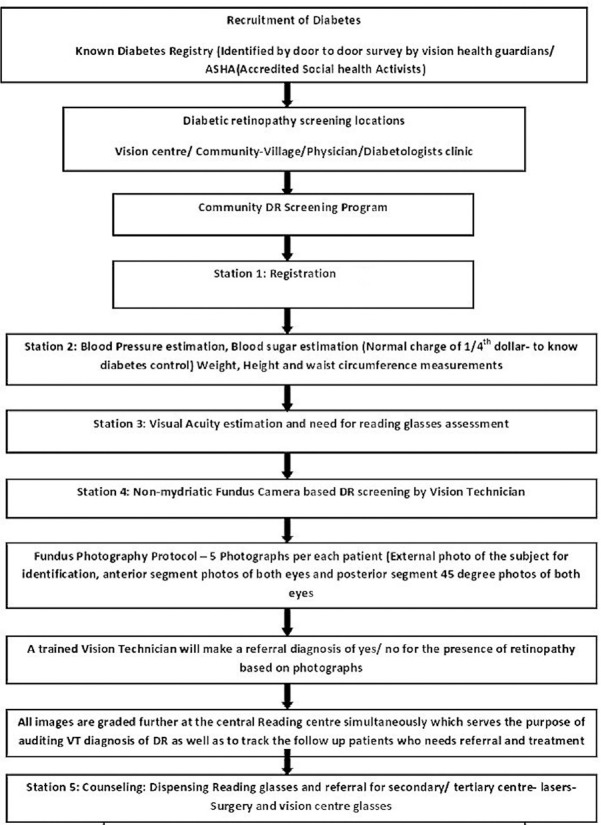
An analysis of a sample of nonmydriatic fundus photography (NMFP) of posterior segment ophthalmic images, obtained by an indigenous equipment (3 nethra-Forus Royal), was done in a district-wide rural diabetic retinopathy (DR) screening program; a trained optometrist did the initial image grading. DR and diabetic macular edema (DME) were classified based on international DR and DME severity scale. The agreement between the optometrist and retina specialist was very good (κ = 0.932; standard error = 0.030; 95% confidence interval = 0.874-0.991).
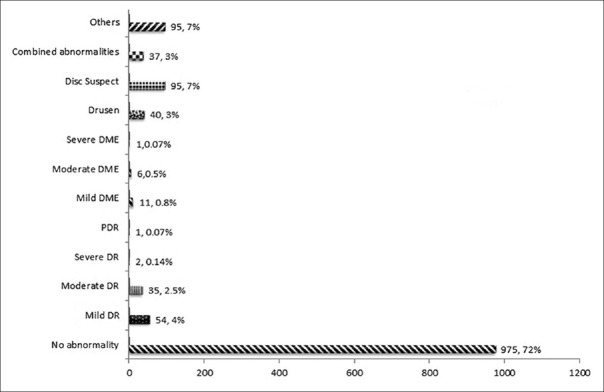
Posterior segment images of 2000 eyes of 1000 people with diabetes mellitus (DM) were graded. The mean age of the participants was 55.7 ± 11.5 standard deviation years. Nearly 42% of the screened participants (n = 420/1000) needed referral. The most common referable posterior segment abnormality was DR (8.2%). The proportion of people with any form of DR was seen in 110/1225 eyes, and sight-threatening DR was seen in 35/1225 eyes. About 62% of posterior segment images were gradable. The reasons for ungradable posterior segment images (34%) were small pupil, unfocused/partially available field of images, and cataract.
A NMFP model was able to detect referable posterior segment abnormalities in a rural diabetes eye care program. Reasons found for ungradability of images in the present study can be addressed while designing future DR screening programs in the rural areas.
本研究旨在分析农村糖尿病眼病护理模式中获得的视网膜图像的产量。
对一个地区性农村糖尿病视网膜病变(DR)筛查计划中使用本地设备(3 nethra-Forus Royal)获得的非散瞳眼底照相术(NMFP)后眼部图像的样本进行分析;一名经过培训的验光师进行了初始图像分级。根据国际 DR 和 DME 严重程度分级标准对 DR 和糖尿病性黄斑水肿(DME)进行分类。验光师和视网膜专家之间的一致性非常好(κ=0.932;标准误差=0.030;95%置信区间=0.874-0.991)。
对 1000 名糖尿病患者的 2000 只眼的后段图像进行了分级。参与者的平均年龄为 55.7±11.5 标准差年。近 42%(n=420/1000)的筛查参与者需要转诊。最常见的可转诊后段异常是 DR(8.2%)。在 1225 只眼中,有 110 只眼出现任何形式的 DR,35 只眼出现威胁视力的 DR。约 62%的后段图像可分级。无法分级的后段图像的原因(34%)是瞳孔小、图像焦点不清晰/部分视野缺失和白内障。
NMFP 模型能够在农村糖尿病眼病护理计划中检测到可转诊的后段异常。本研究中发现的图像不可分级的原因可在设计农村地区未来的 DR 筛查计划时加以解决。