Department of Anesthesiology and Center for Consciousness Science, University of Michigan, Ann Arbor, Michigan 48109 and
Department of Radiology, Medical College of Wisconsin, Milwaukee, Wisconsin 53226.
J Neurosci. 2018 Feb 28;38(9):2304-2317. doi: 10.1523/JNEUROSCI.2545-17.2018. Epub 2018 Jan 31.
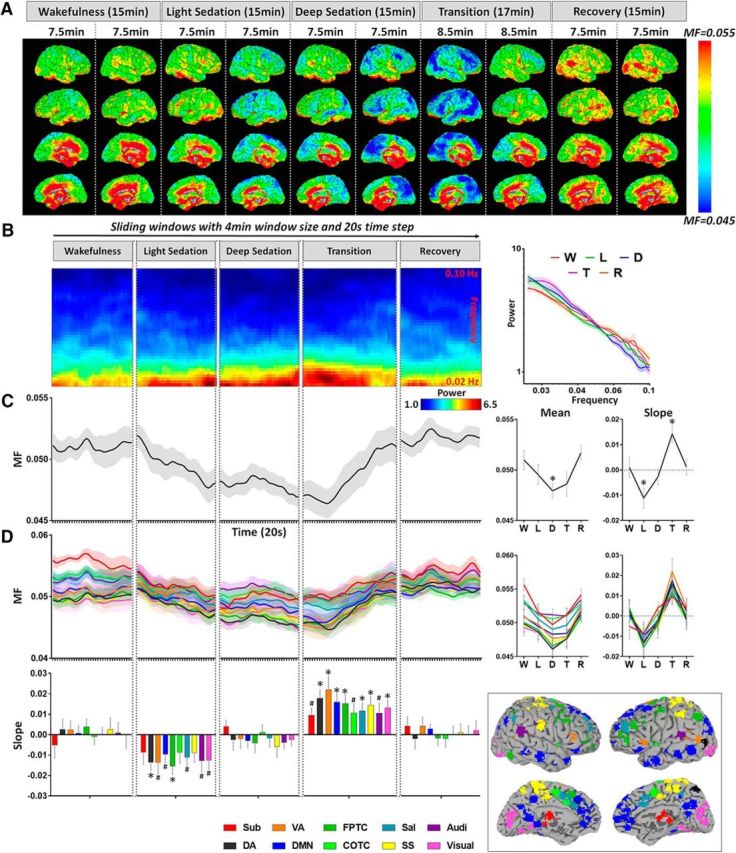
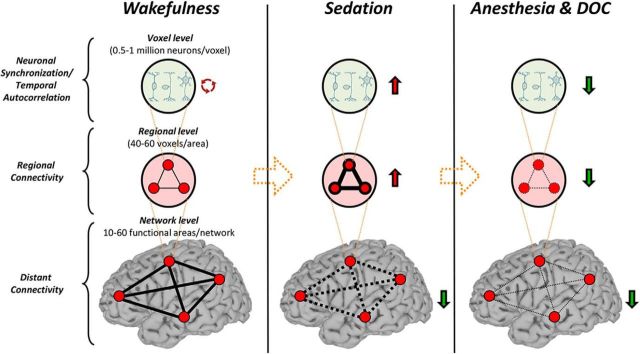
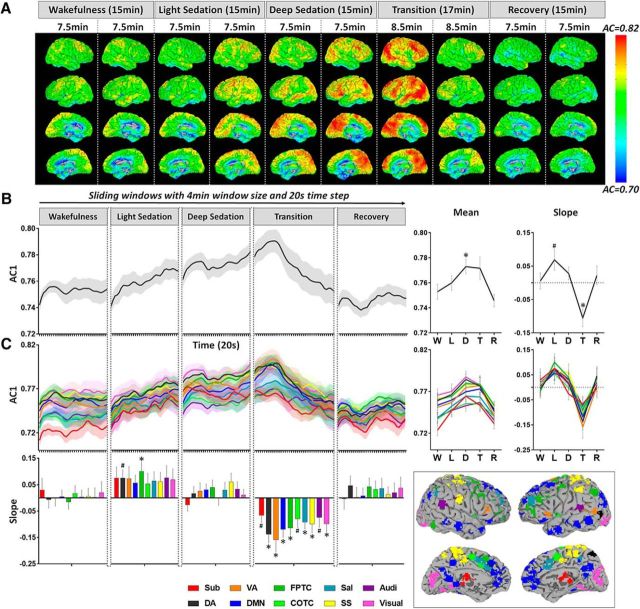
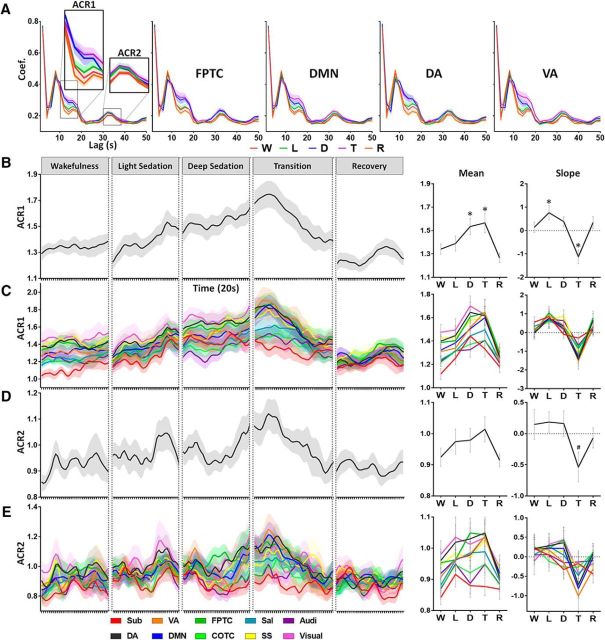
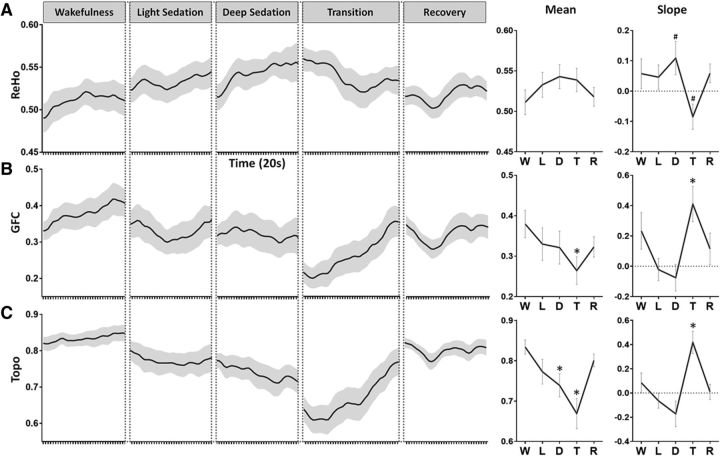
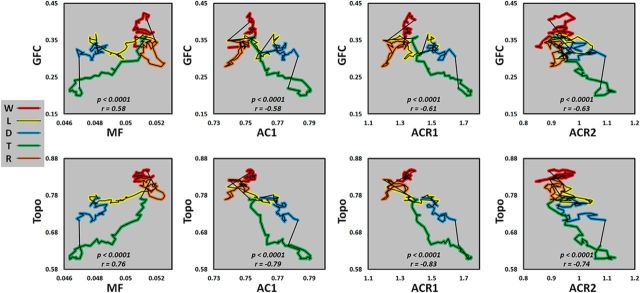
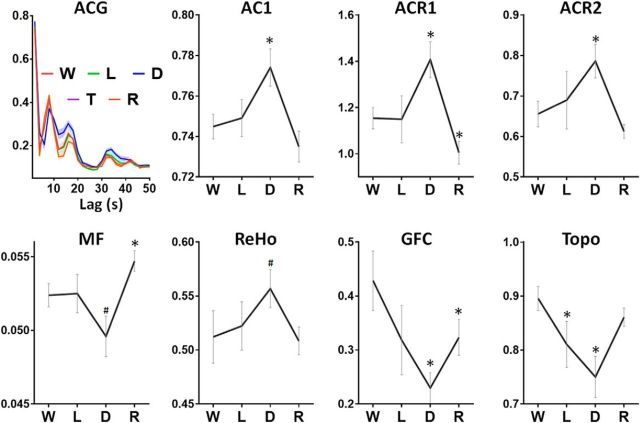
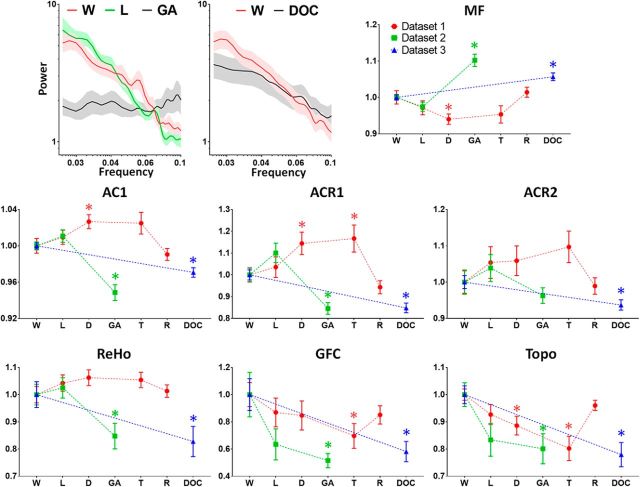
Environmental events are processed on multiple timescales via hierarchical organization of temporal receptive windows (TRWs) in the brain. The dependence of neural timescales and TRWs on altered states of consciousness is unclear. States of reduced consciousness are marked by a shift toward slowing of neural dynamics (<1 Hz) in EEG/ECoG signals. We hypothesize that such prolongation of intrinsic timescales are also seen in blood-oxygen-level-dependent (BOLD) signals. To test this hypothesis, we measured the timescales of intrinsic BOLD signals using mean frequency (MF) and temporal autocorrelation (AC) in healthy volunteers ( = 23; male/female 14/9) during graded sedation with propofol. We further examined the relationship between the intrinsic timescales (local/voxel level) and its regional connectivity (across neighboring voxels; regional homogeneity, ReHo), global (whole-brain level) functional connectivity (GFC), and topographical similarity (Topo). Additional results were obtained from patients undergoing deep general anesthesia ( = 12; male/female: 5/7) and in patients with disorders of consciousness (DOC) ( = 21; male/female: 14/7). We found that MF, AC, and ReHo increased, whereas GFC and Topo decreased, during propofol sedation. The local alterations occur before changes of distant connectivity. Conversely, all of these parameters decreased in deep anesthesia and in patients with DOC. We conclude that propofol synchronizes local neuronal interactions and prolongs the timescales of intrinsic BOLD signals. These effects may impede communication among distant brain regions. Furthermore, the intrinsic timescales exhibit distinct dynamic signatures in sedation, deep anesthesia, and DOC. These results improve our understanding of the neural mechanisms of unconsciousness in pharmacologic and neuropathologic states. Information processing in the brain occurs through a hierarchy of temporal receptive windows (TRWs) in multiple timescales. Anesthetic drugs induce a reversible suppression of consciousness and thus offer a unique opportunity to investigate the state dependence of neural timescales. Here, we demonstrate for the first time that sedation with propofol is accompanied by the prolongation of the timescales of intrinsic BOLD signals presumably reflecting enlarged TRWs. We show that this is accomplished by an increase of local and regional signal synchronization, effects that may disrupt information exchange among distant brain regions. Furthermore, we show that the timescales of intrinsic BOLD signals exhibit distinct dynamic signatures in sedation, deep anesthesia, and disorders of consciousness.
环境事件通过大脑中时间接收窗口 (TRW) 的层次组织在多个时间尺度上进行处理。神经时间尺度和 TRW 对意识改变状态的依赖性尚不清楚。意识状态降低的标志是脑电图/脑磁图 (EEG/ECoG) 信号中神经动力学的减慢(<1 Hz)。我们假设这种内在时间尺度的延长也可以在血氧水平依赖 (BOLD) 信号中看到。为了验证这一假设,我们使用健康志愿者(= 23;男/女 14/9)在异丙酚镇静分级过程中使用平均频率 (MF) 和时间自相关 (AC) 测量内在 BOLD 信号的时间尺度。我们进一步研究了内在时间尺度(局部/体素水平)与其区域连接(跨越相邻体素;局部同质性,ReHo)、全局(全脑水平)功能连接(GFC)和拓扑相似性(Topo)之间的关系。还从接受深度全身麻醉的患者(= 12;男/女:5/7)和意识障碍患者(= 21;男/女:14/7)中获得了其他结果。我们发现,在异丙酚镇静过程中,MF、AC 和 ReHo 增加,而 GFC 和 Topo 减少。局部变化先于远距离连接的变化。相反,在深度麻醉和意识障碍患者中,所有这些参数都降低了。我们得出的结论是,异丙酚同步局部神经元相互作用并延长内在 BOLD 信号的时间尺度。这些影响可能会阻碍大脑区域之间的通信。此外,内在时间尺度在镇静、深度麻醉和意识障碍中表现出独特的动态特征。这些结果提高了我们对药理学和神经病理学状态下无意识的神经机制的理解。大脑中的信息处理是通过多个时间尺度的时间接收窗口 (TRW) 的层次结构进行的。麻醉药物可诱导意识可逆性抑制,因此为研究神经时间尺度的状态依赖性提供了独特的机会。在这里,我们首次证明异丙酚镇静伴随着内在 BOLD 信号时间尺度的延长,这可能反映了 TRW 的扩大。我们表明,这是通过增加局部和区域信号同步来实现的,这些效应可能会破坏大脑区域之间的信息交换。此外,我们表明,内在 BOLD 信号的时间尺度在镇静、深度麻醉和意识障碍中表现出独特的动态特征。