Moon Kun, Lee Hyun-Gyo, Baek Won-Ki, Lee Youngkyun, Kim Kwang Soo, Jun Jong Hwa, Kim Jae-Young, Joo Choun-Ki
Balgeunsesang Eye clinic, Seoul, South Korea.
Department of Ophthalmology, Keimyung University School of Medicine, Dongsan Medical Center, Daegu, South Korea.
Mol Vis. 2017 Dec 29;23:1029-1038. eCollection 2017.
Nuclear factor kappa B (NF-κB) plays an important role in the epithelial-mesenchymal transition (EMT) of RPE cells. We investigated the effects of a proteasome inhibitor, bortezomib, on the EMT in RPE cells. In addition, we assessed the influence of bortezomib on regulation of the NF-κB pathway during this process.
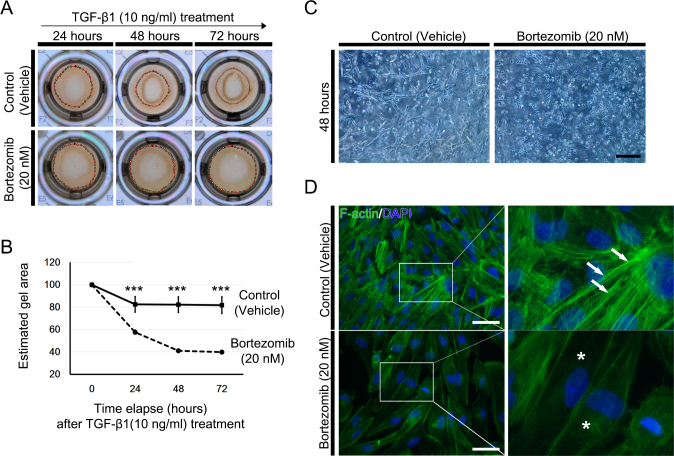
After treatment with various concentrations of bortezomib, cell viability was analyzed with the water-soluble tetrazolium salt-8 assay, cell-cycle regulation was evaluated with flow cytometry, and cell migration was monitored with in vitro wound healing and Transwell migration assays. To induce fibroblastoid transformation, the RPE cells were treated with recombinant human transforming growth factor (TGF)-β1 (10 ng/ml), and western blot and immunocytochemical analyses were performed to evaluate altered expression of EMT markers after treatment with bortezomib. To verify the effect of bortezomib on shrinkage by myofibroblastic transformation, a contraction assay of the RPE-collagen gel lattice was performed.
Treatment with bortezomib decreased RPE viability in a dose-dependent manner, and flow cytometry revealed that these effects were due to arrest of the G2/M phase cell-cycle. In the in vitro wound healing and Transwell migration assays, treatment with 20 nM bortezomib significantly impeded RPE migration. Treatment with bortezomib also significantly inhibited TGF-β1-induced transdifferentiation of the RPE cells. The effects on proliferation, migration, and the EMT were mediated by regulation of the NF-κB signaling pathway. In addition, bortezomib inhibited contraction of the RPE-collagen gel lattices.
Bortezomib inhibits myofibroblastic transformation of RPE cells by downregulating NF-κB expression and prevents contraction of the RPE-collagen gel matrix. Thus, bortezomib represents a candidate putative therapeutic agent for management of retinal fibrotic diseases.
核因子κB(NF-κB)在视网膜色素上皮(RPE)细胞的上皮-间质转化(EMT)中起重要作用。我们研究了蛋白酶体抑制剂硼替佐米对RPE细胞EMT的影响。此外,我们评估了硼替佐米在此过程中对NF-κB信号通路调节的影响。
用不同浓度的硼替佐米处理后,采用水溶性四氮唑盐-8法分析细胞活力,用流式细胞术评估细胞周期调控,并用体外伤口愈合和Transwell迁移试验监测细胞迁移。为诱导成纤维样转化,用重组人转化生长因子(TGF)-β1(10 ng/ml)处理RPE细胞,并用蛋白质印迹法和免疫细胞化学分析法评估硼替佐米处理后EMT标志物表达的变化。为验证硼替佐米对肌成纤维细胞转化引起的收缩的影响,进行了RPE-胶原凝胶晶格收缩试验。
硼替佐米处理以剂量依赖性方式降低RPE细胞活力,流式细胞术显示这些作用是由于G2/M期细胞周期停滞所致。在体外伤口愈合和Transwell迁移试验中,20 nM硼替佐米处理显著阻碍RPE细胞迁移。硼替佐米处理也显著抑制TGF-β1诱导的RPE细胞转分化。对增殖、迁移和EMT的影响是由NF-κB信号通路的调节介导的。此外,硼替佐米抑制RPE-胶原凝胶晶格的收缩。
硼替佐米通过下调NF-κB表达抑制RPE细胞的肌成纤维细胞转化,并防止RPE-胶原凝胶基质的收缩。因此,硼替佐米是治疗视网膜纤维化疾病的一种潜在候选治疗药物。