Blazer Cassandra, Prata Ndola
Bixby Center for Population, Health, and Sustainability, School of Public Health, University of California, Berkeley, CA, USA.
Open Access J Contracept. 2016 Apr 11;7:53-67. doi: 10.2147/OAJC.S98817. eCollection 2016.
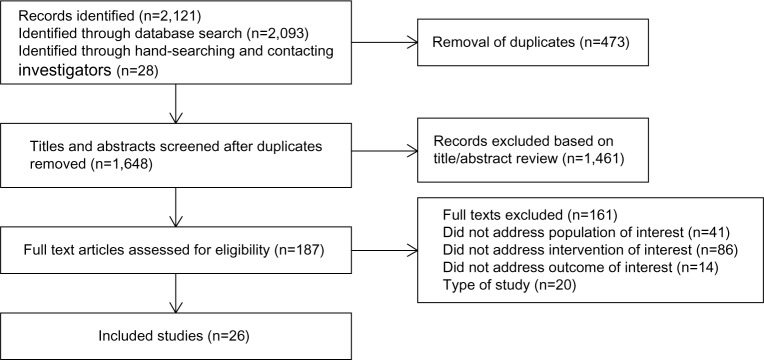
We reviewed existing evidence of the efficacy of postpartum family planning interventions targeting women in the 12 months postpartum period in low- and middle-income countries. We searched for studies from January 1, 2004 to September 19, 2015, using the US Preventive Services Task Force recommendations to assess evidence quality. Our search resulted in 26 studies: 11 based in sub-Saharan Africa, six in the Middle East and North Africa, and nine in Asia. Twenty of the included studies assessed health facility-based interventions. Three were focused on community interventions, two had community and facility components, and one was a workplace program. Overall quality of the evidence was moderate, including evidence for counseling interventions. Male partner involvement, integration with other service delivery platforms, such as prevention of mother-to-child transmission of HIV and immunization, and innovative product delivery programs may increase knowledge and use during the postpartum period. Community-based and workplace strategies need a much stronger base of evidence to prompt recommendations.
我们回顾了中低收入国家针对产后12个月内妇女的产后计划生育干预措施有效性的现有证据。我们检索了2004年1月1日至2015年9月19日期间的研究,使用美国预防服务工作组的建议来评估证据质量。我们的检索结果有26项研究:11项来自撒哈拉以南非洲,6项来自中东和北非,9项来自亚洲。纳入的20项研究评估了基于医疗机构的干预措施。3项侧重于社区干预,2项有社区和医疗机构组成部分,1项是工作场所项目。证据的总体质量为中等,包括咨询干预的证据。男性伴侣的参与、与其他服务提供平台(如预防母婴传播艾滋病毒和免疫接种)的整合以及创新的产品提供项目可能会增加产后期间的知识和使用率。基于社区和工作场所的策略需要更有力的证据基础才能提出建议。