Department of Oral Pathology, Faculty of Dentistry, Gazi University, Ankara, Turkey.
Cologne Institute of Pathology, University Hospital Cologne, Kerpener Straße 62, 50937, Cologne, Germany.
Virchows Arch. 2018 May;472(5):807-814. doi: 10.1007/s00428-018-2305-5. Epub 2018 Feb 1.
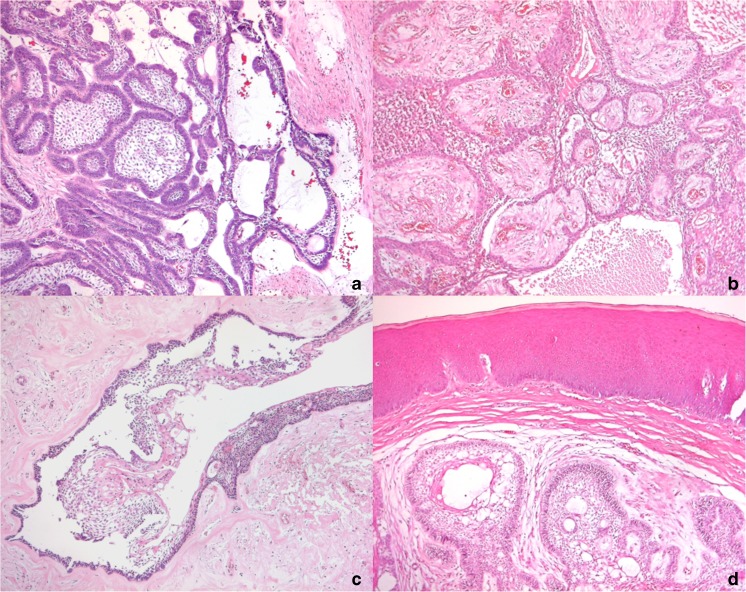
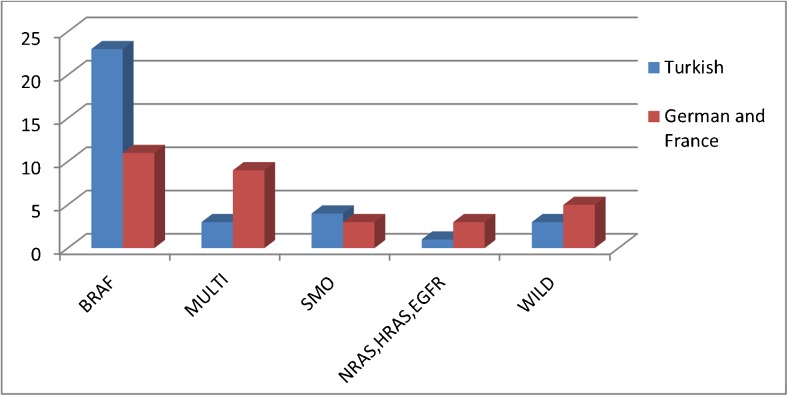
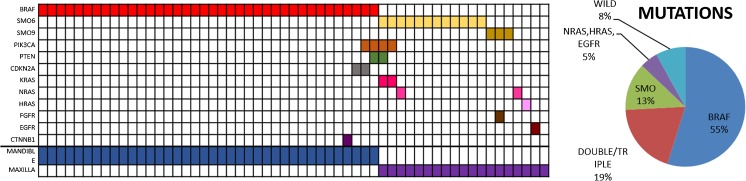
Ameloblastoma is a mostly benign, but locally invasive odontogenic tumor eliciting frequent relapses and significant morbidity. Recently, mutually exclusive mutations in BRAF and SMO were identified causing constitutive activation of MAPK and hedgehog signaling pathways. To explore further such clinically relevant genotype-phenotype correlations, we here comprehensively analyzed a large series of ameloblastomas (98 paraffin block of 76 patients) with respect to genomic alterations, clinical presentation, and histological features collected from the archives of three different pathology centers in France, Germany, and Turkey. In good agreement with previously published data, we observed BRAF mutations almost exclusively in mandibular tumors, SMO mutations predominantly in maxillary tumors, and single mutations in EGFR, KRAS, and NRAS. KRAS, NRAS, PIK3CA, PTEN, CDKN2A, FGFR, and CTNNB1 mutations co-occurred in the background of either BRAF or SMO mutations. Strikingly, multiple mutations were exclusively observed in European patients, in solid ameloblastomas and were associated with a very high risk for recurrence. In contrast, tumors with a single BRAF mutation revealed a lower risk for relapse. We here establish a comprehensive landscape of mutations in the MAPK and hedgehog signaling pathways relating to clinical features of ameloblastoma. Our data suggest that ameloblastomas harboring single BRAF mutations are excellent candidates for neo-adjuvant therapies with combined BRAF/MEK inhibitors and that the risk of recurrence maybe stratified based on the mutational spectrum.
成釉细胞瘤是一种主要为良性但局部侵袭性的牙源性肿瘤,常导致频繁复发和严重的发病率。最近,BRAF 和 SMO 之间相互排斥的突变被鉴定出来,导致 MAPK 和 Hedgehog 信号通路的组成性激活。为了进一步探索这种与临床相关的基因型-表型相关性,我们在此综合分析了来自法国、德国和土耳其的三个不同病理中心的档案中收集的大量成釉细胞瘤(76 名患者的 98 个石蜡块),涉及基因组改变、临床表现和组织学特征。与先前发表的数据非常一致,我们观察到 BRAF 突变几乎仅在下颌肿瘤中,SMO 突变主要在上颌肿瘤中,而 EGFR、KRAS 和 NRAS 中的单突变。KRAS、NRAS、PIK3CA、PTEN、CDKN2A、FGFR 和 CTNNB1 突变共同发生在 BRAF 或 SMO 突变的背景下。引人注目的是,多种突变仅在欧洲患者中观察到,在实体成釉细胞瘤中,与极高的复发风险相关。相比之下,具有单一 BRAF 突变的肿瘤复发风险较低。我们在此建立了与成釉细胞瘤临床特征相关的 MAPK 和 Hedgehog 信号通路突变的综合图谱。我们的数据表明,携带单一 BRAF 突变的成釉细胞瘤是联合使用 BRAF/MEK 抑制剂的新辅助治疗的理想候选者,并且可以根据突变谱对复发风险进行分层。