Guo Rong, Petibon Yoann, Ma Yixin, El Fakhri Georges, Ying Kui, Ouyang Jinsong
Department of Engineering Physics, Tsinghua University, Beijing, 10084, China.
Key Laboratory of Particle and Radiation Imaging, Ministry of Education, Beijing, 10084, China.
EJNMMI Phys. 2018 Feb 1;5(1):3. doi: 10.1186/s40658-017-0200-9.
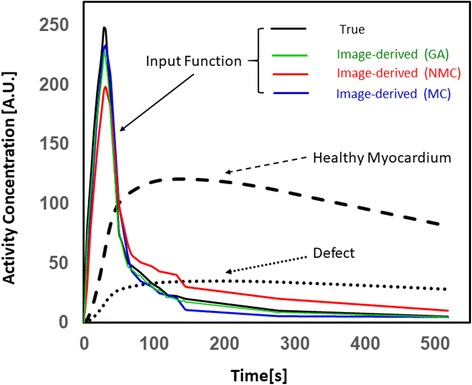
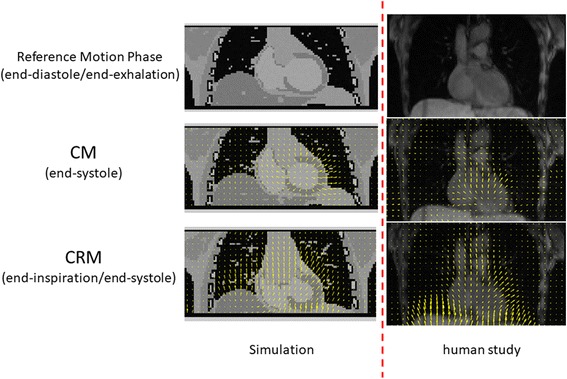
Both cardiac and respiratory motions bias the kinetic parameters measured by dynamic PET. The aim of this study was to perform a realistic positron emission tomography-magnetic resonance (PET-MR) simulation study using 4D XCAT to evaluate the impact of MR-based motion correction on the estimation of PET myocardial kinetic parameters using PET-MR. Dynamic activity distributions were obtained based on a one-tissue compartment model with realistic kinetic parameters and an arterial input function. Realistic proton density/T1/T2 values were also defined for the MRI simulation. Two types of motion patterns, cardiac motion only (CM) and both cardiac and respiratory motions (CRM), were generated. PET sinograms were obtained by the projection of the activity distributions. PET image for each time frame was obtained using static (ST), gated (GA), non-motion-corrected (NMC), and motion-corrected (MC) methods. Voxel-wise unweighted least squares fitting of the dynamic PET data was then performed to obtain K values for each study. For each study, the mean and standard deviation of K values were computed for four regions of interest in the myocardium across 25 noise realizations.
Both cardiac and respiratory motions introduce blurring in the PET parametric images if the motion is not corrected. Conventional cardiac gating is limited by high noise level on parametric images. Dual cardiac and respiratory gating further increases the noise level. In contrast to GA, the MR-based MC method reduces motion blurring in parametric images without increasing noise level. It also improves the myocardial defect delineation as compared to NMC method. Finally, the MR-based MC method yields lower bias and variance in K values than NMC and GA, respectively. The reductions of K bias by MR-based MC are 7.7, 5.1, 15.7, and 29.9% in four selected 0.18-mL myocardial regions of interest, respectively, as compared to NMC for CRM. MR-based MC yields 85.9, 75.3, 71.8, and 95.2% less K standard deviation in the four regions, respectively, as compared to GA for CRM.
This simulation study suggests that the MR-based motion-correction method using PET-MR greatly reduces motion blurring on parametric images and yields less K bias without increasing noise level.
心脏和呼吸运动均会使动态正电子发射断层扫描(PET)测量的动力学参数产生偏差。本研究的目的是使用4D XCAT进行一项逼真的正电子发射断层扫描 - 磁共振(PET - MR)模拟研究,以评估基于磁共振的运动校正对使用PET - MR估计PET心肌动力学参数的影响。基于具有逼真动力学参数的单组织隔室模型和动脉输入函数获得动态活度分布。还为MRI模拟定义了逼真的质子密度/T1/T2值。生成了两种运动模式,即仅心脏运动(CM)和心脏与呼吸运动两者(CRM)。通过活度分布的投影获得PET正弦图。使用静态(ST)、门控(GA)、非运动校正(NMC)和运动校正(MC)方法获得每个时间帧的PET图像。然后对动态PET数据进行体素级无加权最小二乘拟合,以获得每项研究的K值。对于每项研究,在25次噪声实现的情况下,计算心肌四个感兴趣区域的K值的平均值和标准差。
如果不校正运动,心脏和呼吸运动都会在PET参数图像中引入模糊。传统的心脏门控受到参数图像上高噪声水平的限制。心脏和呼吸双重门控会进一步增加噪声水平。与GA相比,基于MR的MC方法可减少参数图像中的运动模糊,且不会增加噪声水平。与NMC方法相比,它还改善了心肌缺损的描绘。最后,基于MR的MC方法在K值中产生的偏差和方差分别低于NMC和GA。与CRM的NMC相比,基于MR的MC在四个选定的0.18 mL心肌感兴趣区域中K偏差的降低分别为7.7%、5.1%、15.7%和29.9%。与CRM的GA相比,基于MR的MC在四个区域中K标准差分别降低了85.9%、75.3%、71.8%和95.2%。
该模拟研究表明,使用PET - MR的基于MR的运动校正方法可大大减少参数图像上的运动模糊,并在不增加噪声水平的情况下产生较小的K偏差。