Department of neurosurgery, Suzhou Kowloon Hospital, Shanghai Jiaotong University School of Medcine, Wan'sheng Road 118, Suzhou, 215006, China.
Department of the Soochow University, Suzhou, 215004, China.
BMC Immunol. 2018 Feb 2;19(1):7. doi: 10.1186/s12865-018-0246-z.
As a factor contributing to the tumor cell drug resistance, tumor microenvironment (TME) is being paid increasingly attention. However, the drug resistance of malignantly transformed cells in TME has rarely been revealed. This paper is designed to investigate the sensitivity of malignantly transformed cell line (ihDCTC) induced by glioma stem cells (GSCs) in TME to chemotherapeutic drugs.
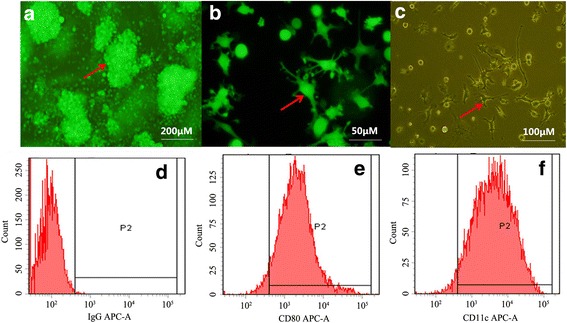
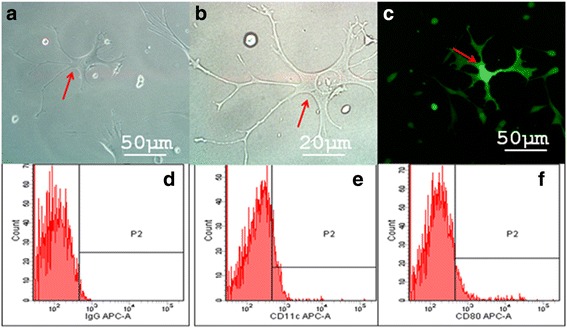
(1) Establishment of ihDCTC cell line,The bone marrow cells from enhanced green fluorescent protein (EGFP) transgenic nude mice were employed to culture the dendritic cells (DCs) in vitro, which were then co-cultured with red fluorescence protein (RFP) transgenic GSCs (SU3) to obtain ihDCTC (2) Res and Cis were used to intervene in the growth of abovemetioned cell lines in vitro and Res treated in bearing ihDCTC tumor mice, followed by evaluating their drug sensitivity and changes in key signaling proteins via half maximal inhibitory concentration (IC), tumor mass and immunostaining method.
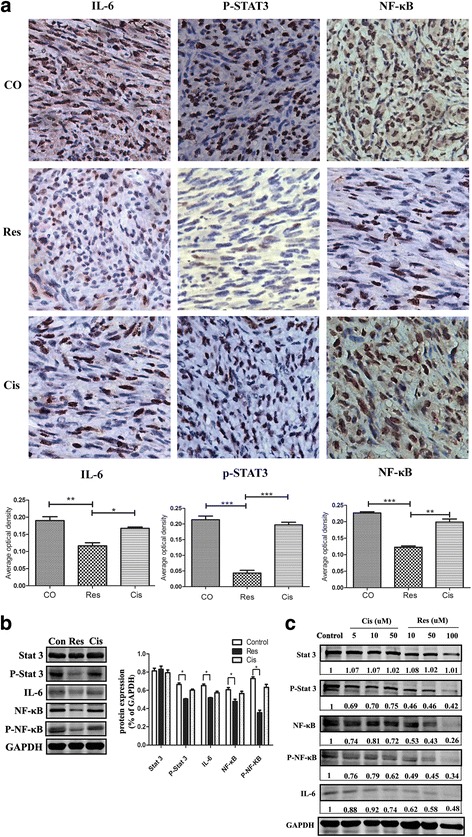
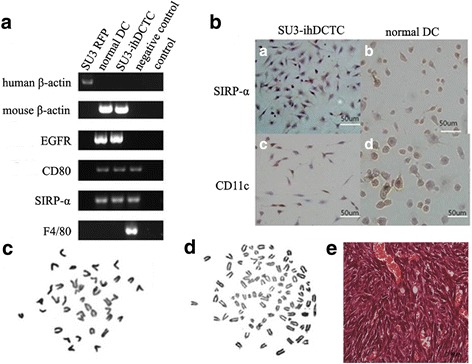
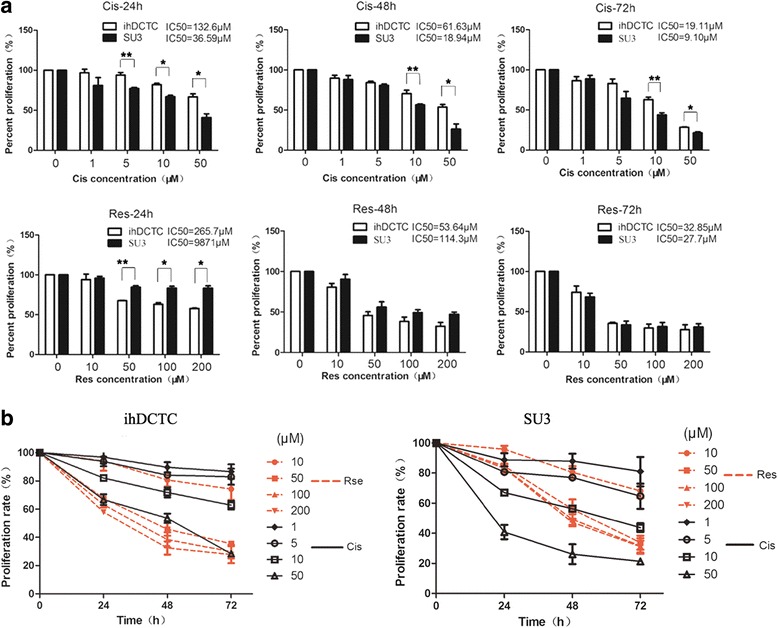
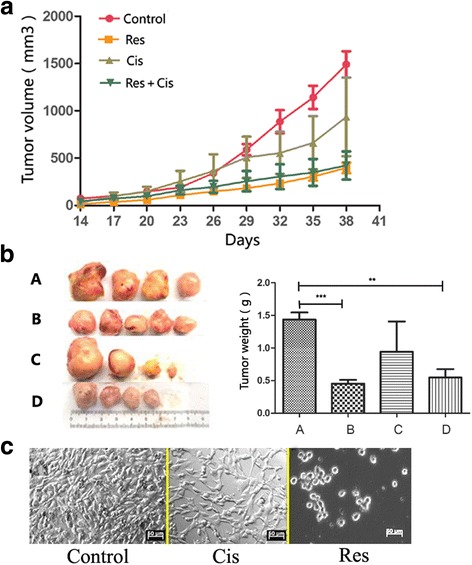
(1) ihDCTC could express CD11c and CD80 as well as possessed immortalized potential, heteroploid chromosomes and high tumorigenicity in nude mice in vivo. (2) At 24 h, 48 h and 72 h, the IC value of ihDCTC treated with Cis was 3.62, 3.25 and 2.10 times higher than that of SU3, while the IC value of ihDCTC treated with Res was 0.03, 0.47 and 1.19 times as much as that of SU3; (3) The xenograft mass (g) in vivo in the control, Res, Cis and Res + Cis groups were 1.44 ± 0.19, 0.45 ± 0.12, 0.94 ± 0.80 and 0.68 ± 0.35(x ± s) respectively. The expression levels of IL-6, p-STAT3 and NF-κB proteins in the xenograft tissue were significantly reduced only in the Res treatment group.
In vitro co-culture with GSC can induce the malignant transformation of bone marrow derived dendritic cells, on the one hand, ihDCTC shows higher drug resistance to the traditional chemotherapeutic drug Cis than GSCs, but, on the other hand, appears to be more sensitive to Res than GSCs. Therefore, our findings provide a broader vision not only for the further study on the correlation between TME and tumor drug resistance but also for the exploration of Res anti-cancer value.
肿瘤微环境(TME)作为肿瘤细胞药物耐药的一个因素,越来越受到重视。然而,TME 中恶性转化细胞的耐药性很少被揭示。本文旨在研究胶质瘤干细胞(GSCs)诱导的恶性转化细胞系(ihDCTC)对化疗药物的敏感性。
(1)ihDCTC 细胞系的建立:采用增强型绿色荧光蛋白(EGFP)转基因裸鼠骨髓细胞体外培养树突状细胞(DC),然后与红色荧光蛋白(RFP)转基因 GSCs(SU3)共培养,获得 ihDCTC;(2)Res 和 Cis 用于体外干预上述细胞系的生长,并用 Res 处理携带 ihDCTC 肿瘤的小鼠,然后通过半最大抑制浓度(IC)、肿瘤质量和免疫组化方法评估它们的药物敏感性和关键信号蛋白的变化。
(1)ihDCTC 可表达 CD11c 和 CD80,具有永生化潜能、非整倍体染色体和高体内致瘤性。(2)在 24、48 和 72 h,ihDCTC 处理的 Cis IC 值分别是 SU3 的 3.62、3.25 和 2.10 倍,而 ihDCTC 处理的 Res IC 值分别是 SU3 的 0.03、0.47 和 1.19 倍;(3)体内对照组、Res 组、Cis 组和 Res+Cis 组的异种移植瘤质量(g)分别为 1.44±0.19、0.45±0.12、0.94±0.80 和 0.68±0.35(x±s)。只有在 Res 治疗组,异种移植组织中 IL-6、p-STAT3 和 NF-κB 蛋白的表达水平显著降低。
体外与 GSC 共培养可诱导骨髓来源树突状细胞恶性转化,一方面,ihDCTC 对传统化疗药物 Cis 的耐药性高于 GSCs,但另一方面,对 Res 的敏感性高于 GSCs。因此,我们的发现不仅为进一步研究 TME 与肿瘤耐药性的相关性提供了更广阔的视野,也为 Res 抗癌价值的探索提供了依据。