CR-CHUM, Université de Montréal, Montréal, QC, Canada.
Scripps CHAVI-ID, La Jolla, CA, USA.
Retrovirology. 2018 Feb 2;15(1):18. doi: 10.1186/s12977-018-0392-7.
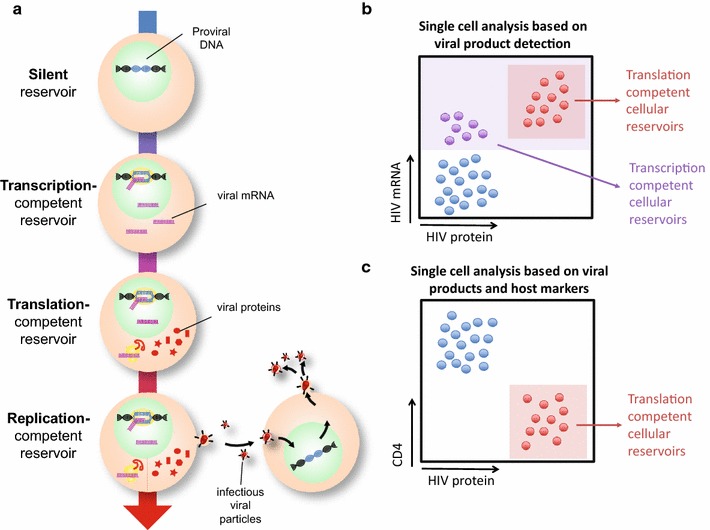
Recent years have seen a substantial increase in the number of tools available to monitor and study HIV reservoirs. Here, we discuss recent technological advances that enable an understanding of reservoir dynamics beyond classical assays to measure the frequency of cells containing provirus able to propagate a spreading infection (replication-competent reservoir). Specifically, we focus on the characterization of cellular reservoirs containing proviruses able to transcribe viral mRNAs (so called transcription-competent) and translate viral proteins (translation-competent). We suggest that the study of these alternative reservoirs provides complementary information to classical approaches, crucially at a single-cell level. This enables an in-depth characterization of the cellular reservoir, both following reactivation from latency and, importantly, directly ex vivo at baseline. Furthermore, we propose that the study of cellular reservoirs that may not contain fully replication-competent virus, but are able to produce HIV mRNAs and proteins, is of biological importance. Lastly, we detail some of the key contributions that the study of these transcription and translation-competent reservoirs has made thus far to investigations into HIV persistence, and outline where these approaches may take the field next.
近年来,可用于监测和研究 HIV 储存库的工具数量显著增加。在这里,我们讨论了最近的技术进步,这些进步使我们能够超越传统检测方法来理解储存库动态,从而测量能够传播扩散性感染的含前病毒细胞的频率(复制能力储存库)。具体而言,我们专注于能够转录病毒 mRNA(所谓的转录能力)和翻译病毒蛋白(翻译能力)的前病毒的细胞储存库的特征描述。我们认为,这些替代储存库的研究为经典方法提供了互补信息,特别是在单细胞水平上。这使得对细胞储存库进行深入的特征描述成为可能,包括从潜伏期重新激活后,以及更重要的是在基线时直接在体外进行的特征描述。此外,我们提出,研究那些可能不包含完全复制能力病毒但能够产生 HIV mRNA 和蛋白的细胞储存库具有生物学意义。最后,我们详细介绍了迄今为止对这些转录和翻译能力储存库的研究对 HIV 持久性研究的一些重要贡献,并概述了这些方法可能将该领域推向何方。