Laboratoire Psychologie de la Perception, Université Paris Descartes, Centre Universitaire des Saints-Pères, 45 rue des Saints Pères, 75006 Paris, France.
Laboratoire Psychologie de la Perception, Université Paris Descartes, Centre Universitaire des Saints-Pères, 45 rue des Saints Pères, 75006 Paris, France; Laboratoire Psychologie de la Perception, CNRS UMR 8242, Centre Universitaire des Saints-Pères, 45 rue des Saints Pères, 75006 Paris, France.
Dev Cogn Neurosci. 2018 Oct;33:182-193. doi: 10.1016/j.dcn.2018.01.009. Epub 2018 Feb 4.
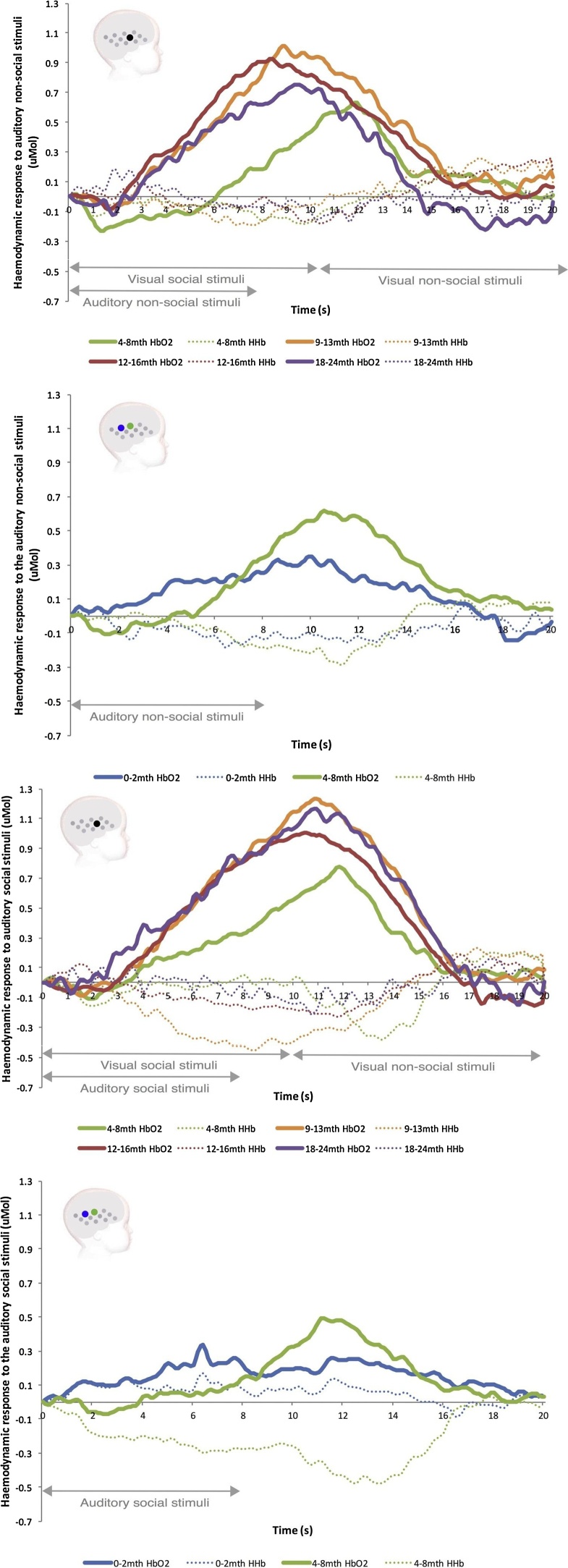
Measuring brain activity in developmental populations remains a major challenge despite great technological advances. Among the numerous available methods, functional near-infrared spectroscopy (fNIRS), an imaging modality that probes the hemodynamic response, is a powerful tool for recording brain activity in a great variety of situations and populations. Neurocognitive studies with infants have often reported inverted hemodynamic responses, i.e. a decrease instead of an increase in regional blood oxygenation, but the exact physiological explanation and cognitive interpretation of this response remain unclear. Here, we first provide an overview of the basic principles of NIRS and its use in cognitive developmental neuroscience. We then review the infant fNIRS literature to show that the hemodynamic response is modulated by experimental design and stimulus complexity, sometimes leading to hemodynamic responses with non-canonical shapes. We also argue that this effect is further modulated by the age of participants, the cortical regions involved, and the developmental stage of the tested cognitive process. We argue that this variability needs to be taken into account when designing and interpreting developmental studies measuring the hemodynamic response.
尽管技术有了很大的进步,但测量发育中的人群的大脑活动仍然是一个主要挑战。在众多可用的方法中,功能近红外光谱 (fNIRS) 是一种探测血液动力学反应的成像方式,是记录各种情况下和各种人群的大脑活动的有力工具。对婴儿进行的神经认知研究经常报告倒置的血液动力学反应,即区域血氧的减少而不是增加,但这种反应的确切生理解释和认知解释仍不清楚。在这里,我们首先提供了 NIRS 的基本原理及其在认知发展神经科学中的应用概述。然后,我们回顾了婴儿 fNIRS 的文献,以表明血液动力学反应受到实验设计和刺激复杂性的调节,有时会导致非典型形状的血液动力学反应。我们还认为,这种效应进一步受到参与者年龄、涉及的皮质区域和所测试认知过程的发育阶段的调节。我们认为,在设计和解释测量血液动力学反应的发展研究时,需要考虑到这种可变性。