Serretti Alessandro
Department of Biomedical and NeuroMotor Sciences, University of Bologna, Bologna, Italy.
Clin Psychopharmacol Neurosci. 2018 Feb 28;16(1):1-6. doi: 10.9758/cpn.2018.16.1.1.
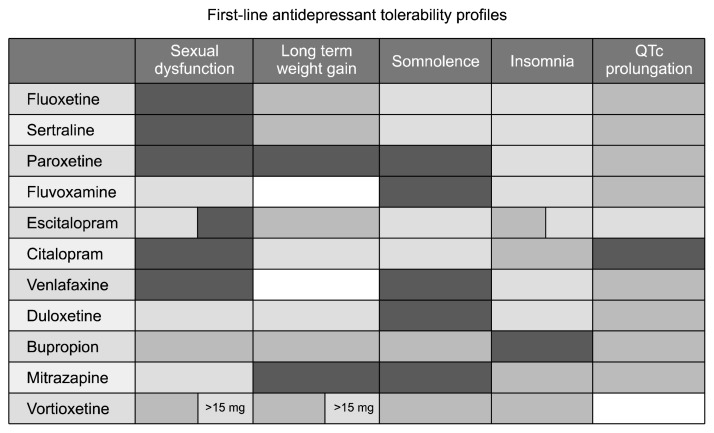
Precision medicine is a concept which is recently gaining momentum in all branches of medicine. In particular in psychiatry it is greatly needed given the huge societal costs of psychiatric disorders and given the long time needed to observe benefit from treatments and the response variability. The future will be based on biological determinants, however until such an interesting but still futuristic aim will be reached, at present we may only rely on clinical features to guide our individualized prescription which is currently still frequently based on personal opinion and subjective previous experiences. The aim of this review is to offer an overview of the main aspects to take into consideration when prescribing an antidepressant treatment to reach the best precision medicine using clinical information. More than 40 compounds are available for treating depression and a similar amount of compounds for other psychiatric disorders. The process of matching the profile of the patient with all different profiles of available compounds is therefore quite complex. Our everyday prescribing procedure should take into consideration a number of factors such as the knowledge of the profile of available compounds versus the symptomatology profile of the subject, previous efficacy, medical comorbidities, tolerability profile, individual preferences, and family history. While we are waiting more complex algorithms including biological or genetic measures, it is possible to optimize our current prescription practice by using all available information in order to obtain as much as possible an evidence based precision medicine prescription.
精准医学是一个最近在医学各个分支中势头渐盛的概念。特别是在精神病学领域,鉴于精神疾病巨大的社会成本,以及观察治疗效果所需的漫长时间和反应变异性,精准医学的需求尤为迫切。未来将基于生物学决定因素,然而在实现这一有趣但仍属未来愿景的目标之前,目前我们只能依靠临床特征来指导个体化处方,而目前这种处方仍常常基于个人观点和主观既往经验。本综述的目的是概述在开具抗抑郁治疗处方时,利用临床信息实现最佳精准医学所需考虑的主要方面。有40多种化合物可用于治疗抑郁症,用于其他精神疾病的化合物数量也大致相同。因此,将患者的特征与所有可用化合物的不同特征进行匹配的过程相当复杂。我们日常的处方程序应考虑诸多因素,如对可用化合物特征与患者症状特征的了解、既往疗效、合并症、耐受性特征、个人偏好以及家族史。在等待包括生物学或遗传学指标在内的更复杂算法时,利用所有可用信息优化我们当前的处方实践,以便尽可能获得基于证据的精准医学处方是可行的。