Ferrari Pamela, Parisi Mariana Migliorini, Colombo Rafael, Becker Matheus, Fries Gabriel, Ascoli Bruna Maria, Géa Luiza Paul, Anna Márcia Kauer-Sant, Kapczinski Flávio, Klamt Fábio, Guma Fátima T C R, Rosa Adriane Ribeiro, Barbé-Tuana Florencia M
Laboratory of Molecular Psychiatry, Hospital de Clínicas de Porto Alegre, Porto Alegre, Brazil.
Postgraduate Program: Psychiatry and Behavioral Science, Universidade Federal do Rio Grande do Sul (UFRGS), Porto Alegre, Brazil.
Clin Psychopharmacol Neurosci. 2018 Feb 28;16(1):103-108. doi: 10.9758/cpn.2018.16.1.103.
Evidence has suggested that immune imbalance is involved with bipolar disorder (BD); however, its precise mechanism is poorly understood. This study investigated whether biochemical changes in the serum from BD patients could modulate the phenotype of cultured macrophages.
Eighteen subjects with BD and five healthy individuals were included in this study. The human monocyte cell line U-937 was activated with phorbol 12-myristate 13-acetate (PMA) and polarization was induced with RPMI-1640 media supplemented with 10% serum from each patient for 24 hours. Gene expression of selected M1 and M2 markers was assessed by quantitative PCR.
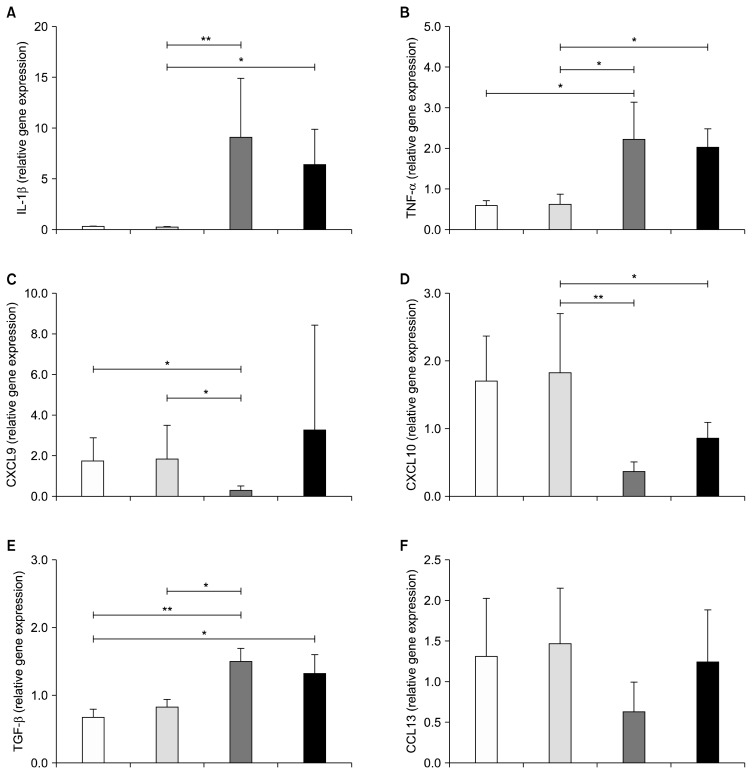
Macrophages exposed to serum of manic and depressive BD patients displayed an increase of interleukin-1β (6.40±3.47 and 9.04±5.84 vs. 0.23±0.11; <0.05) and tumor necrosis factor-α (2.23±0.91 and 2.03±0.45 vs. 0.62±0.24; =0.002 and =0.004, respectively) compared to euthymic group (there was no difference between euthymic and controls). In parallel, U-937 macrophages treated with serum of patients in acute episode displayed a down-regulation of CXCL9 (0.29±0.20 vs. 1.86±1.61; =0.006) and CXCL10 expression (0.36±0.15 and 0.86±0.24 vs. 1.83±0.88; <0.000 and =0.04) compared to the euthymia group.
Our results are consistent with previous studies showing that changes in peripheral blood markers could modulate M1/M2 polarization in BD. The evidence of macrophages as source of inflammatory cytokines might be helpful to unravel how the mononuclear phagocyte system is involved in the etiology of BD.
有证据表明免疫失衡与双相情感障碍(BD)有关;然而,其确切机制尚不清楚。本研究调查了BD患者血清中的生化变化是否能调节培养巨噬细胞的表型。
本研究纳入了18名BD患者和5名健康个体。用人单核细胞系U-937用佛波醇12-肉豆蔻酸酯13-乙酸酯(PMA)激活,并用补充有每位患者10%血清的RPMI-1640培养基诱导极化24小时。通过定量PCR评估选定的M1和M2标志物的基因表达。
与心境正常组相比(心境正常组与对照组之间无差异),暴露于躁狂和抑郁BD患者血清的巨噬细胞中白细胞介素-1β(分别为6.40±3.47和9.04±5.84,对比0.23±0.11;<0.05)和肿瘤坏死因子-α(分别为2.23±0.91和2.03±0.45,对比0.62±0.24;=0.002和=0.004)增加。同时,与心境正常组相比,用急性发作期患者血清处理的U-937巨噬细胞中CXCL9(0.29±0.20对比1.86±1.61;=0.006)和CXCL10表达(分别为0.36±0.15和0.86±0.24对比1.83±0.88;<0.000和=0.04)下调。
我们的结果与先前的研究一致,表明外周血标志物的变化可调节BD中的M1/M2极化。巨噬细胞作为炎性细胞因子来源的证据可能有助于阐明单核吞噬细胞系统如何参与BD的病因。