Ascoli Bruna M, Parisi Mariana M, Bristot Giovana, Antqueviezc Bárbara, Géa Luiza P, Colombo Rafael, Kapczinski Flávio, Guma Fátima Theresinha Costa Rodrigues, Brietzke Elisa, Barbé-Tuana Florencia M, Rosa Adriane R
Laboratory of Molecular Psychiatry, Hospital de Clínicas de Porto Alegre (HCPA), Rua Ramiro Barcelos, 2350, Porto Alegre, RS, Brazil.
Postgraduate Program in Psychiatry and Behavioral Sciences, Universidade Federal do Rio Grande do Sul (UFRGS), Rua Ramiro Barcelos, 2400, Porto Alegre, RS, Brazil.
Int J Bipolar Disord. 2019 Jun 1;7(1):13. doi: 10.1186/s40345-019-0148-x.
Innate immune system dysfunction has been recognized as an important element in the pathophysiology of bipolar disorder (BD). We aimed to investigate whether there are differences in the response of macrophages derived from patients in the early stages and late stages of BD and healthy subjects.
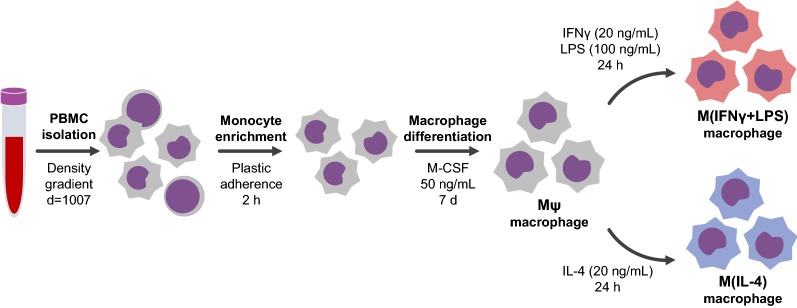
Human monocytes purified from peripheral blood mononuclear cells (PBMCs) of patients with BD type I (n = 18)-further classified into early- and late stage BD patients according to their functioning- and from healthy individuals (n = 10) were differentiated into macrophages in vitro. Monocyte-derived macrophages (M) were exposed to IFNγ plus LPS-M(IFNγ + LPS)- or IL-4-M(IL-4)-to induce their polarization into the classical (also called M1) or alternative (also called M2) activation phenotypes, respectively; or either Mψ were not exposed to any stimuli characterizing the resting state (denominated M0). In vitro secretion of cytokines, such as IL-1β, IL-6, IL-10, and TNF-α, was used as an index of macrophage activity.
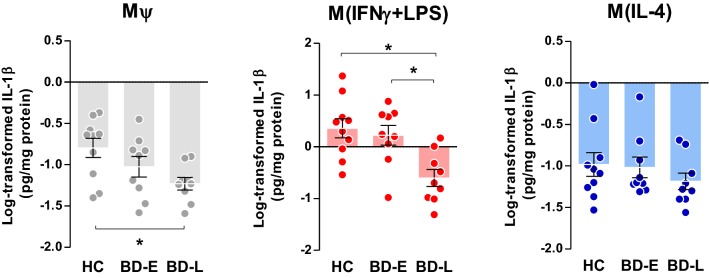
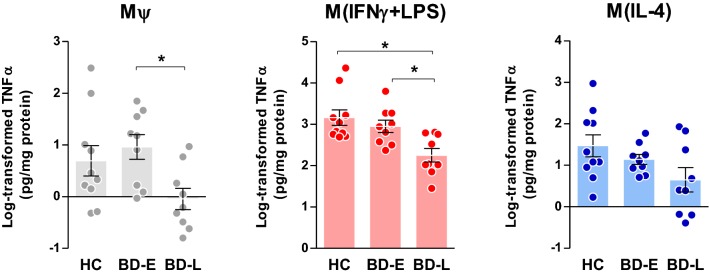
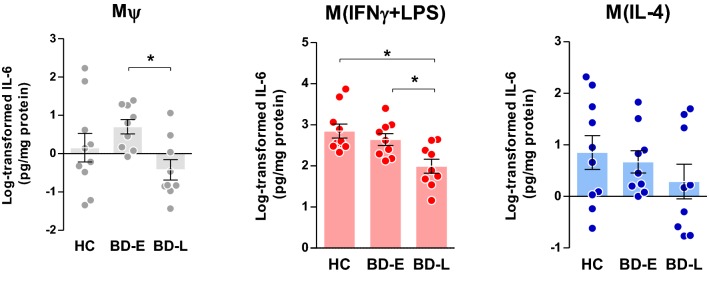
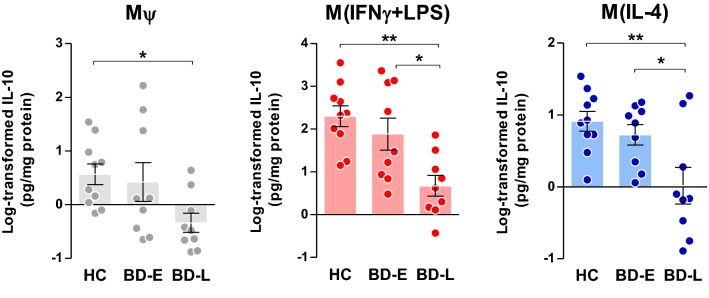
M(IFNγ + LPS) from late-stage BD patients produced less amount of IL-1β, IL-6, and IL-10 when compared to early-stage BD patients and healthy controls. Following alternative activation, M(IL-4) derived from late-stage patients secreted less IL-6 compared to the other groups. TNFα was less secreted by all macrophage phenotypes derived from late-stage patients when compared to healthy controls only (p < 0.005). Mψ from late-stage patients exhibited lower production of IL-1β and IL-10 compared to macrophages from healthy subjects and early-stage patients respectively. Interestingly, cytokines secretion from M(IFNγ + LPS), M(IL-4) and Mψ were similar between early-stage patients and healthy controls.
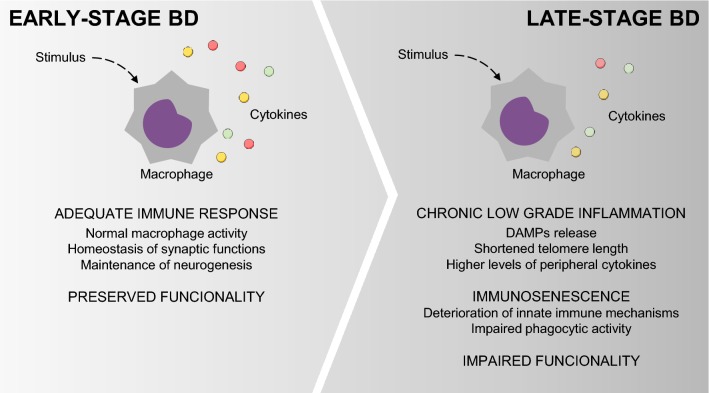
Our results suggest a progressive dysfunction in the response of peripheral innate immune cells of BD patients in the late stages of the illness. This failure in the regulation of the immune system function may be implicated in the multisystemic progression of BD.
先天免疫系统功能障碍已被认为是双相情感障碍(BD)病理生理学中的一个重要因素。我们旨在研究BD早期和晚期患者以及健康受试者来源的巨噬细胞反应是否存在差异。
从I型BD患者(n = 18)的外周血单核细胞(PBMC)中纯化的人类单核细胞——根据其功能进一步分为BD早期和晚期患者——以及健康个体(n = 10)的单核细胞在体外分化为巨噬细胞。将单核细胞衍生的巨噬细胞(M)暴露于IFNγ加LPS——M(IFNγ + LPS)——或IL-4——M(IL-4)——分别诱导其极化为经典(也称为M1)或替代(也称为M2)激活表型;或者Mψ不暴露于任何表征静息状态的刺激(称为M0)。细胞因子如IL-1β、IL-6、IL-10和TNF-α的体外分泌用作巨噬细胞活性的指标。
与BD早期患者和健康对照相比,晚期BD患者的M(IFNγ + LPS)产生的IL-1β、IL-6和IL-10量较少。在替代激活后,晚期患者来源的M(IL-4)分泌的IL-6比其他组少。与仅健康对照相比,晚期患者来源的所有巨噬细胞表型分泌的TNFα较少(p < 0.005)。晚期患者的Mψ分别与健康受试者和早期患者的巨噬细胞相比,IL-1β和IL-10的产生较低。有趣的是,早期患者和健康对照之间M(IFNγ + LPS)、M(IL-4)和Mψ的细胞因子分泌相似。
我们的结果表明,BD患者在疾病晚期外周先天免疫细胞反应存在进行性功能障碍。免疫系统功能调节的这种失败可能与BD的多系统进展有关。