Chahrour Maria, Kleiman Robin J, Manzini M Chiara
Eugene McDermott Center for Human Growth and Development, Departments of Neuroscience and Psychiatry, University of Texas Southwestern Medical Center, Dallas, Texas, USA.
Research and Early Development, Biogen, Cambridge MA, USA.
Dialogues Clin Neurosci. 2017 Dec;19(4):335-343. doi: 10.31887/DCNS.2017.19.4/cmanzini.
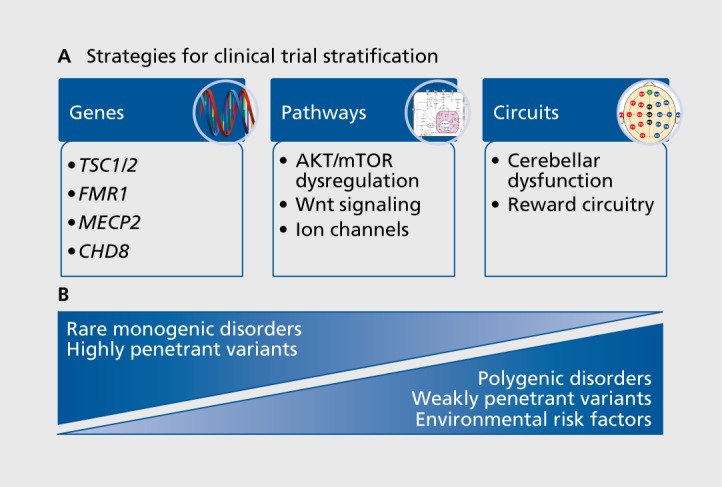
Autism spectrum disorder (ASD) is a complex neurodevelopmental disorder characterized by social deficits and repetitive/restrictive interests. ASD is associated with multiple comorbidities, including intellectual disability, anxiety, and epilepsy. Evidence that ASD is highly heritable has spurred major efforts to unravel its genetics, revealing possible contributions from hundreds of genes through rare and common variation and through copy-number changes. In this perspective, we provide an overview of the current state of ASD genetics and of how genetic research has spurred the development of in vivo and in vitro models using animals and patient cells to evaluate the impact of genetic mutations on cellular function leading to disease. Efforts to translate these findings into successful therapies have yet to bear fruit. We discuss how the valuable insight into the disorder provided by these new models can be used to better understand ASD and develop future clinical trials.
自闭症谱系障碍(ASD)是一种复杂的神经发育障碍,其特征为社交缺陷和重复/受限兴趣。ASD与多种共病相关,包括智力残疾、焦虑和癫痫。ASD具有高度遗传性的证据促使人们大力开展遗传学研究,通过罕见和常见变异以及拷贝数变化揭示了数百个基因可能发挥的作用。在此观点中,我们概述了ASD遗传学的现状,以及基因研究如何推动了利用动物和患者细胞的体内和体外模型的发展,以评估基因突变对导致疾病的细胞功能的影响。将这些发现转化为成功疗法的努力尚未取得成果。我们讨论了如何利用这些新模型对该疾病提供的宝贵见解来更好地理解ASD并开展未来的临床试验。