Department of Laboratory Medicine, National Health Insurance Service Ilsan Hospital, Goyang, Korea.
Department of Laboratory Medicine, Inha University College of Medicine, Incheon, Korea.
Ann Lab Med. 2018 May;38(3):266-270. doi: 10.3343/alm.2018.38.3.266.
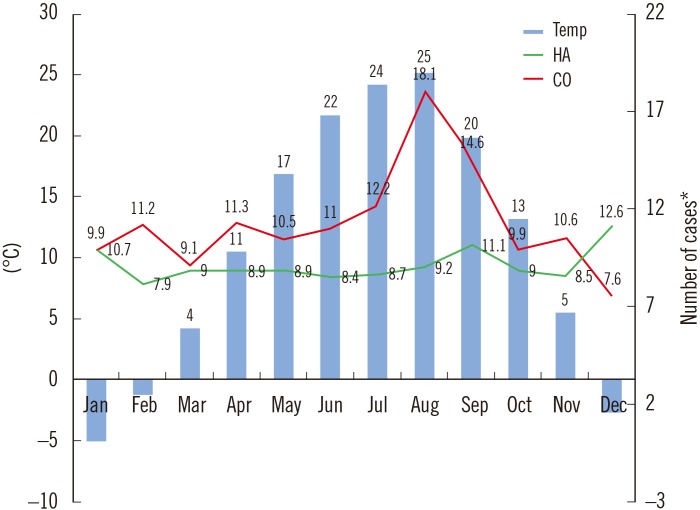
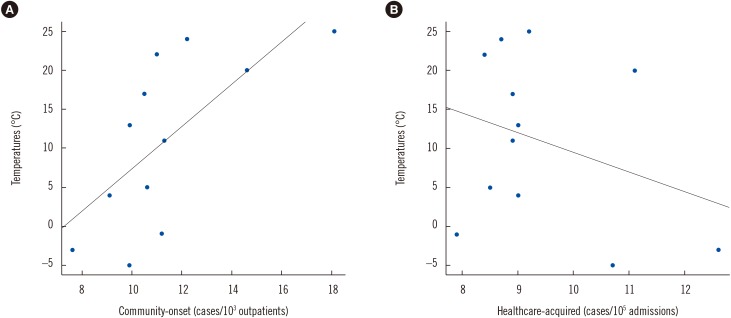
Identifying the trends in community-onset Acinetobacter baumannii complex isolation and diversity according to temperature could help provide insight into the behavior of the A. baumannii complex. We performed a retrospective analysis of A. baumannii complex (Acinetobacter baumannii, Acinetobacter nosocomialis, Acinetobacter pittii, and Acinetobacter calcoaceticus) isolates obtained from patients at a Korean community hospital from 2006 to 2015 with reference to seasonal temperatures. The incidence rates were compared between warm (June-September) and cold (November-March) months, defined as an average mean temperature ≥20°C and ≤5°C, respectively. Incidence rate was calculated as the number of cases per month, converted to cases/10⁵ admissions for healthcare-acquired isolates and cases/10³ outpatients for community-onset isolates. Approximately 3,500 A. baumannii complex cases were identified, and 26.2% of them were community-onset cases. The median (interquartile range) number of community-onset A. baumannii complex cases was significantly higher (P=0.0002) in warm months at 13.8 (9.5-17.6) than in cold months at 10.1 (6.3-13.2). There was a strong correlation between community-onset A. baumannii complex cases and temperature (Pearson's r=0.6805, P=0.0149). Thus, we identified a seasonality pattern for community-onset A. baumannii complex colonization or infection, but not for healthcare-acquired cases.
根据温度确定社区获得性鲍曼不动杆菌复合体分离株和多样性的趋势有助于深入了解鲍曼不动杆菌复合体的行为。我们对 2006 年至 2015 年期间韩国社区医院患者的鲍曼不动杆菌复合体(鲍曼不动杆菌、医院不动杆菌、皮氏不动杆菌和醋酸钙不动杆菌)分离株进行了回顾性分析,并参考了季节性温度。将温暖(6 月至 9 月)和寒冷(11 月至 3 月)月份的发病率进行了比较,平均平均温度分别≥20°C 和≤5°C。发病率计算为每月的病例数,转换为每 10⁵例医疗保健获得性分离株和每 10³例社区获得性分离株的病例数。大约有 3500 例鲍曼不动杆菌复合体病例,其中 26.2%为社区获得性病例。温暖月份(中位数(四分位距)13.8(9.5-17.6))的社区获得性鲍曼不动杆菌复合体病例数明显高于寒冷月份(10.1(6.3-13.2))(P=0.0002)。社区获得性鲍曼不动杆菌复合体病例数与温度之间存在很强的相关性(Pearson r=0.6805,P=0.0149)。因此,我们确定了社区获得性鲍曼不动杆菌复合体定植或感染的季节性模式,但不是医疗保健获得性病例。