Department of Internal Medicine, Federal University of Ceará, Fortaleza, CE, Brazil.
Clinical Research Unit, Federal University of Ceará, Fortaleza, CE, Brazil.
BMC Cancer. 2018 Feb 5;18(1):131. doi: 10.1186/s12885-018-3995-4.
It has been suggested that distal gastric carcinoma (GC) in younger patients has a more aggressive outcome than in older patients, however this is a controversial issue. The aim of this study was to compare clinicopathological features between younger and older patients with GC in Northeastern Brazil.
A total of 207 patients with distal GC (41 patients ≤45 years, considered younger group, and 166 > 45 years, considered older group) were evaluated prospectively during a 6 year period.
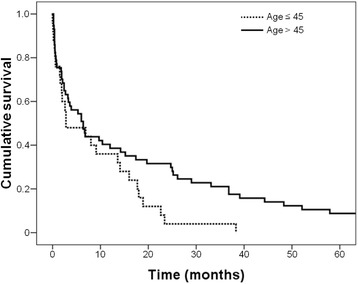
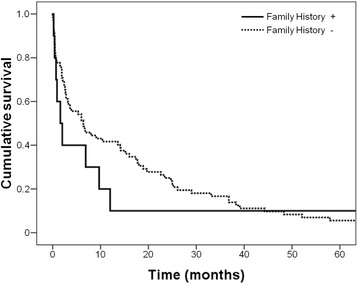
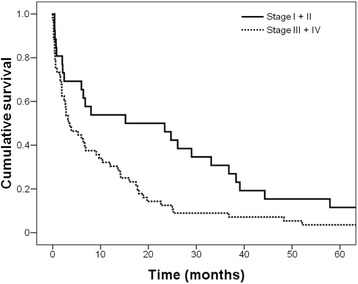
The mean patient age in the young group was 37.41 years old and 64.43 years in the older group. No significant difference was found regarding gender, area of residence, history of alcohol consumption, chronic tobacco smoking. Prevalence of first-degree GC history was 12.5% (7.3% in younger group vs. 13.9% in older; p < 0.46). The most frequent symptom was gastric pain and weight loss. Diffuse infiltrative cancer was more frequently seen in younger patients (70.70% vs. 33.70%, respectively; p < 0.01), as was histologically less differentiated tumors (63.40% vs. 33.10%; p < 0.01) and stage IV of GC (48.80% vs. 30.70%; p < 0.015). Five-year survival, evaluated in 82 patients, was lower in younger patients (p = 0.045); however, after adjusting for stage of GC in the multivariate analysis, this association did not remain significant. Family history of GC and gender had no impact on survival.
Younger patients showed higher prevalence of diffuse type of Lauren and lower survival that was attributed to higher rate of advanced stage of GC. Gastric cancer screening strategies should also be considered in younger individuals, especially in areas of high prevalence. Further studies are warranted to determine risk factors associated with gastric cancer in young adults.
有研究表明,年轻患者的远端胃癌(GC)比老年患者具有更具侵袭性的结局,但这是一个有争议的问题。本研究旨在比较巴西东北部年轻和老年 GC 患者的临床病理特征。
在 6 年期间,前瞻性评估了 207 例远端 GC 患者(41 例≤45 岁,视为年轻组,166 例>45 岁,视为老年组)。
年轻组患者的平均年龄为 37.41 岁,老年组为 64.43 岁。两组间在性别、居住区域、酒精摄入史、慢性吸烟史等方面无显著差异。一级 GC 病史的发生率为 12.5%(年轻组为 7.3%,老年组为 13.9%;p<0.46)。最常见的症状是胃痛和体重减轻。弥漫浸润性癌症在年轻患者中更为常见(分别为 70.70%和 33.70%;p<0.01),组织学上分化程度较低的肿瘤(分别为 63.40%和 33.10%;p<0.01)和 GC Ⅳ期(分别为 48.80%和 30.70%;p<0.015)也更为常见。对 82 例患者进行了 5 年生存率评估,年轻患者的生存率较低(p=0.045);然而,在校正 GC 分期的多变量分析后,这种相关性不再显著。GC 家族史和性别对生存无影响。
年轻患者弥漫型 Lauren 型比例较高,生存率较低,这归因于 GC 晚期比例较高。在胃癌高发地区,也应考虑对年轻个体进行胃癌筛查策略。需要进一步研究以确定与年轻成年人胃癌相关的危险因素。