School of Water Conservancy and Hydropower, Hebei University of Engineering, Handan, 056038, China.
Key Laboratory of Ecosystem Network Observation and Modeling, Institute of Geographic Sciences and Natural Resources Research, Chinese Academy of Sciences, 11A Datun Road, Beijing, 100101, China.
BMC Plant Biol. 2018 Feb 5;18(1):27. doi: 10.1186/s12870-018-1243-3.
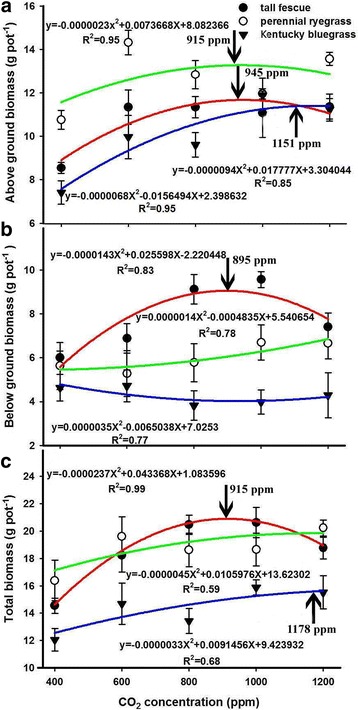
Grasslands are one of the most representative vegetation types accounting for about 20% of the global land area and thus the response of grasslands to climate change plays a pivotal role in terrestrial carbon balance. However, many current climate change models, based on earlier results of the doubling-CO experiments, may overestimate the CO fertilization effect, and as a result underestimate the potentially effects of future climate change on global grasslands when the atmospheric CO concentration goes beyond the optimal level. Here, we examined the optimal atmospheric CO concentration effect on CO fertilization and further on the growth of three perennial grasses in growth chambers with the CO concentration at 400, 600, 800, 1000, and 1200 ppm, respectively.
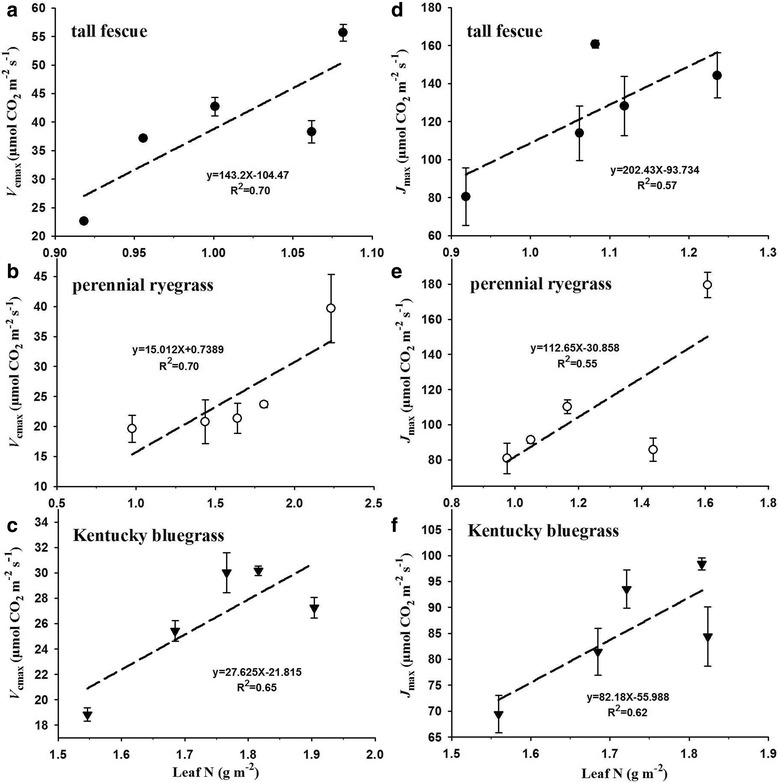
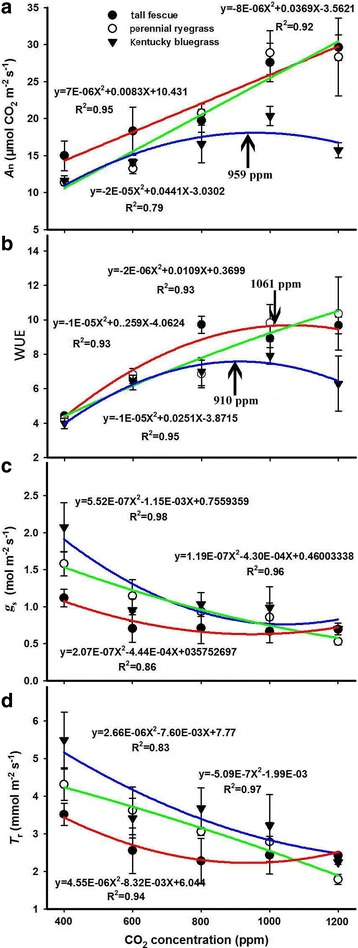
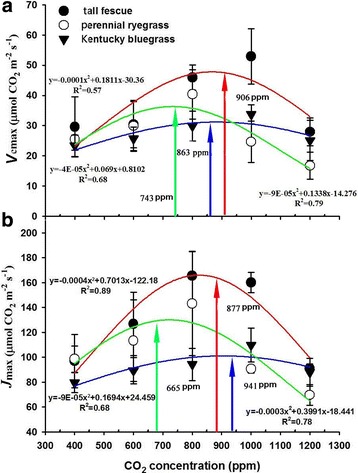
All three perennial grasses featured an apparent optimal CO concentration for growth. Initial increases in atmospheric CO concentration substantially enhanced the plant biomass of the three perennial grasses through the CO fertilization effect, but this CO fertilization effect was dramatically compromised with further rising atmospheric CO concentration beyond the optimum. The optimal CO concentration for the growth of tall fescue was lower than those of perennial ryegrass and Kentucky bluegrass, and thus the CO fertilization effect on tall fescue disappeared earlier than the other two species. By contrast, the weaker CO fertilization effect on the growth of perennial ryegrass and Kentucky bluegrass was sustained for a longer period due to their higher optimal CO concentrations than tall fescue. The limiting effects of excessively high CO concentrations may not only associate with changes in the biochemical and photochemical processes of photosynthesis, but also attribute to the declines in stomatal conductance and nitrogen availability.
In this study, we found apparent differences in the optimal CO concentrations for the growth of three grasses. These results suggest that the growth of different types of grasses may respond differently to future elevated CO concentrations through the CO fertilization effect, and thus potentially alter the community composition and structure of grasslands. Meanwhile, our results may also be helpful for improving current process-based ecological models to more accurately predict the structure and function of grassland ecosystems under future rising atmospheric CO concentration and climate change scenarios.
草原是最具代表性的植被类型之一,约占全球陆地面积的 20%,因此草原对气候变化的响应在陆地碳平衡中起着关键作用。然而,许多基于早期 CO2 倍增实验结果的当前气候变化模型可能高估了 CO2 施肥效应,从而低估了未来大气 CO2 浓度超过最佳水平时气候变化对全球草原的潜在影响。在这里,我们研究了大气 CO2 浓度对 CO2 施肥效应以及进一步对三种多年生草本植物生长的最佳影响,在生长室中分别将 CO2 浓度控制在 400、600、800、1000 和 1200 ppm。
三种多年生草本植物的生长都表现出明显的最佳 CO2 浓度。大气 CO2 浓度的初始升高通过 CO2 施肥效应显著提高了三种多年生草本植物的生物量,但随着大气 CO2 浓度超过最佳水平进一步升高,这种 CO2 施肥效应显著降低。高羊茅的最佳 CO2 浓度低于黑麦草和肯塔基蓝草,因此高羊茅的 CO2 施肥效应比其他两种植物更早消失。相比之下,由于黑麦草和肯塔基蓝草的最佳 CO2 浓度高于高羊茅,因此对它们生长的较弱 CO2 施肥效应持续时间更长。过高 CO2 浓度的限制效应不仅可能与光合作用的生化和光化学过程的变化有关,还可能归因于气孔导度和氮供应的下降。
在这项研究中,我们发现三种草的最佳 CO2 浓度生长存在明显差异。这些结果表明,不同类型的草可能通过 CO2 施肥效应对未来升高的 CO2 浓度做出不同的反应,从而可能改变草原的群落组成和结构。同时,我们的结果也可能有助于改进基于过程的生态模型,以更准确地预测未来大气 CO2 浓度升高和气候变化情景下草原生态系统的结构和功能。