Wang Qin, Ferreira Diana L Santos, Nelson Scott M, Sattar Naveed, Ala-Korpela Mika, Lawlor Debbie A
Computational Medicine, Faculty of Medicine, University of Oulu and Biocenter Oulu, Oulu, Finland.
MRC Integrative Epidemiology Unit at the University of Bristol, Oakfield House, Oakfield Grove, Bristol, BS8 2BN, UK.
BMC Med. 2018 Feb 6;16(1):17. doi: 10.1186/s12916-018-1008-8.
Women who experience menopause are at higher cardiometabolic risk and often display adverse changes in metabolic biomarkers compared with pre-menopausal women. It remains elusive whether the changes in cardiometabolic biomarkers during the menopausal transition are due to ovarian aging or chronological aging. Well-conducted longitudinal studies are required to determine this. The aim of this study was to explore the cross-sectional and longitudinal associations of reproductive status, defined according to the 2012 Stages of Reproductive Aging Workshop criteria, with 74 metabolic biomarkers, and establish whether any associations are independent of age-related changes.
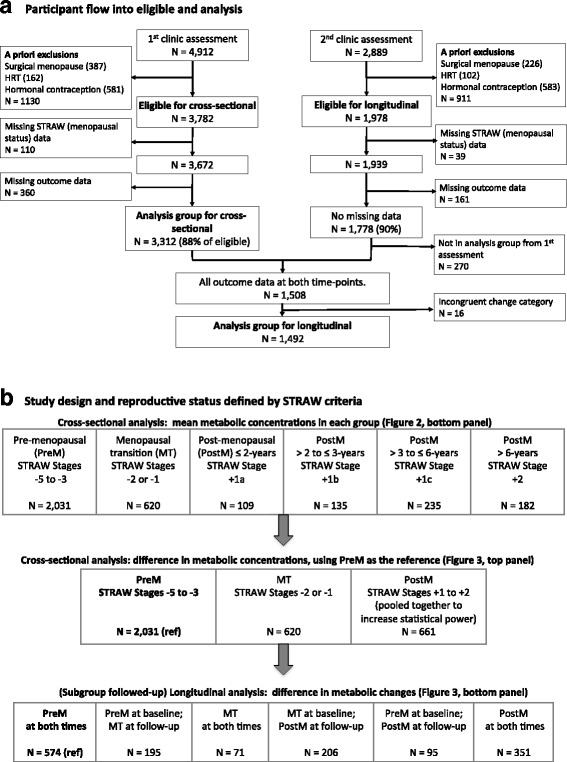
We determined cross-sectional associations of reproductive status with metabolic profiling in 3,312 UK midlife women. In a subgroup of 1,492 women who had repeat assessments after 2.5 years, we assessed how the change in reproductive status was associated with the changes in metabolic biomarkers. Metabolic profiles were measured by high-throughput quantitative nuclear magnetic resonance metabolomics. In longitudinal analyses, we compared the change in metabolic biomarkers for each reproductive-status category change to that of the reference of being pre-menopausal at both time points. As all women aged by a similar amount during follow-up, these analyses contribute to distinguishing age-related changes from those related to change in reproductive status.
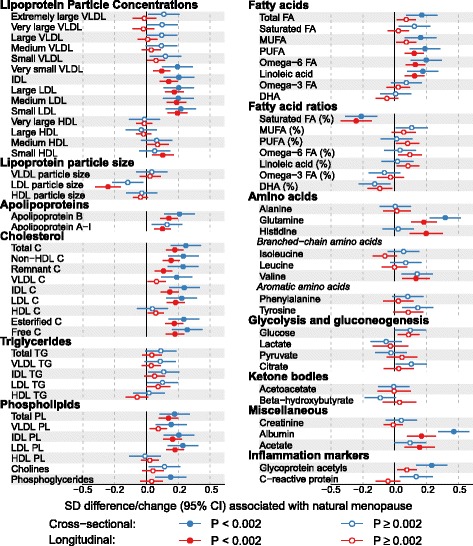
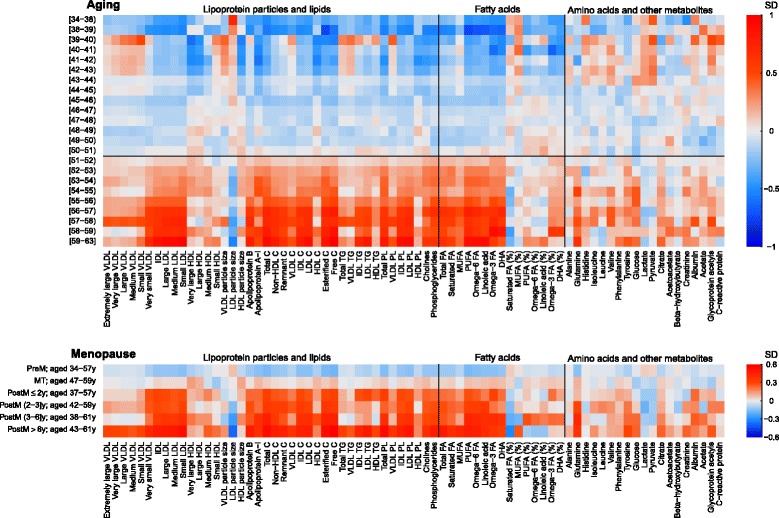
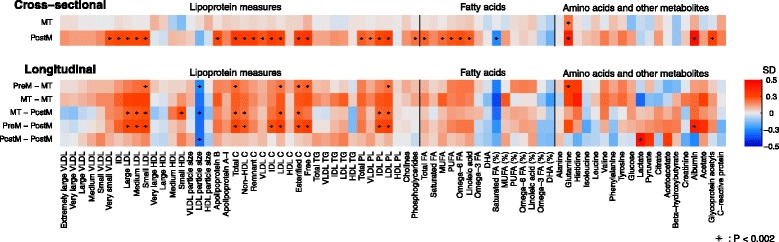
Consistent cross-sectional and longitudinal associations of menopause with a wide range of metabolic biomarkers were observed, suggesting the transition to menopause induces multiple metabolic changes independent of chronological aging. The metabolic changes included increased concentrations of very small very low-density lipoproteins, intermediate-density lipoproteins, low-density lipoproteins (LDLs), remnant, and LDL cholesterol, and reduced LDL particle size, all toward an atherogenic lipoprotein profile. Increased inflammation was suggested via an inflammatory biomarker, glycoprotein acetyls, but not via C-reactive protein. Also, levels of glutamine and albumin increased during the transition. Most of these metabolic changes seen at the time of becoming post-menopausal remained or became slightly stronger during the post-menopausal years.
The transition to post-menopause has effects on multiple circulating metabolic biomarkers, over and above the underlying age trajectory. The adverse changes in multiple apolipoprotein-B-containing lipoprotein subclasses and increased inflammation may underlie women's increased cardiometabolic risk in their post-menopausal years.
与绝经前女性相比,经历绝经的女性心血管代谢风险更高,且代谢生物标志物常出现不良变化。绝经过渡期间心血管代谢生物标志物的变化是由于卵巢衰老还是自然衰老仍不清楚。需要进行良好的纵向研究来确定这一点。本研究的目的是探讨根据2012年生殖衰老研讨会标准定义的生殖状态与74种代谢生物标志物之间的横断面和纵向关联,并确定这些关联是否独立于与年龄相关的变化。
我们确定了3312名英国中年女性生殖状态与代谢谱的横断面关联。在1492名在2.5年后进行重复评估的女性亚组中,我们评估了生殖状态的变化与代谢生物标志物变化之间的关联。代谢谱通过高通量定量核磁共振代谢组学进行测量。在纵向分析中,我们将每个生殖状态类别变化的代谢生物标志物变化与两个时间点均为绝经前的参考组进行比较。由于所有女性在随访期间年龄增长幅度相似,这些分析有助于区分与年龄相关的变化和与生殖状态变化相关的变化。
观察到绝经与多种代谢生物标志物之间存在一致的横断面和纵向关联,表明向绝经的过渡会引发多种独立于自然衰老的代谢变化。代谢变化包括极低密度脂蛋白、中间密度脂蛋白、低密度脂蛋白(LDL)、残余颗粒和LDL胆固醇浓度升高,LDL颗粒大小减小,所有这些都趋向于致动脉粥样硬化脂蛋白谱。通过炎症生物标志物糖蛋白乙酰化物提示炎症增加,但通过C反应蛋白未提示炎症增加。此外,谷氨酰胺和白蛋白水平在过渡期间升高。绝经后出现的这些代谢变化大多在绝经后几年持续存在或变得稍强。
向绝经后的过渡对多种循环代谢生物标志物有影响,超出了潜在的年龄轨迹。多种含载脂蛋白B的脂蛋白亚类的不良变化和炎症增加可能是女性绝经后心血管代谢风险增加的基础。