Department of Cell, Developmental, and Integrative Biology, University of Alabama at Birmingham, 350 McCallum Building, 1918 University Blvd, Birmingham, AL, 35294, USA.
Department of Radiation Oncology, University of Alabama at Birmingham, 1700 6th Avenue South, Birmingham, AL, 35233, USA.
J Ovarian Res. 2018 Feb 5;11(1):12. doi: 10.1186/s13048-018-0385-0.
The ST6Gal-I sialyltransferase is upregulated in numerous cancers, and high expression of this enzyme correlates with poor patient prognosis in various malignancies, including ovarian cancer. Through its sialylation of a select cohort of cell surface receptors, ST6Gal-I modulates cell signaling to promote tumor cell survival. The goal of the present study was to investigate the influence of ST6Gal-I on another important receptor that controls cancer cell behavior, EGFR. Additionally, the effect of ST6Gal-I on cancer cells treated with the common EGFR inhibitor, gefitinib, was evaluated.
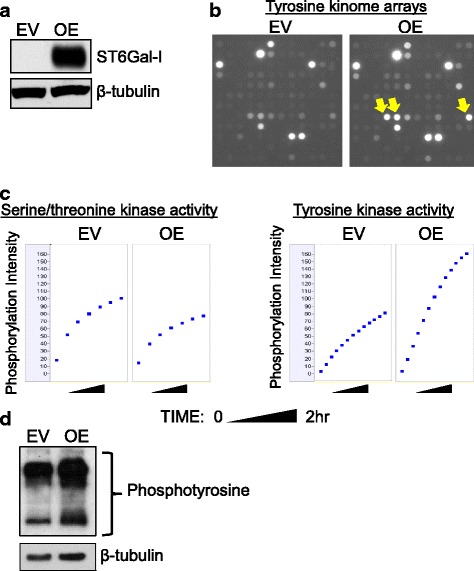
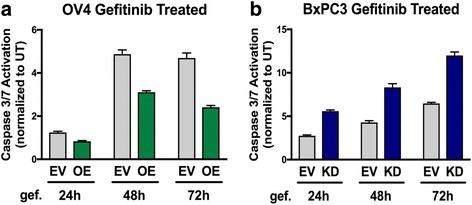
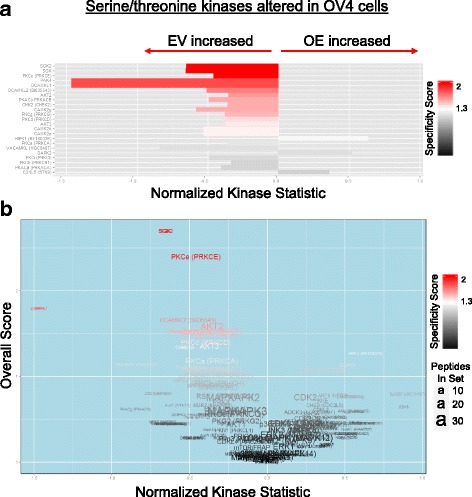
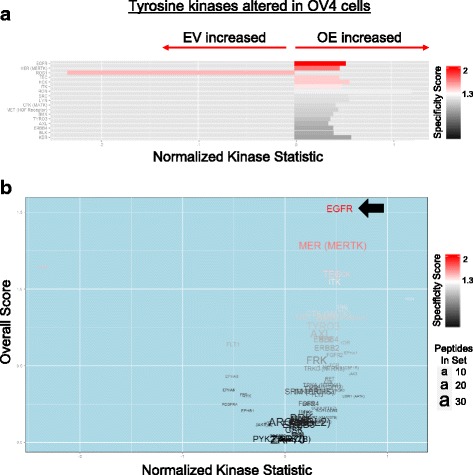
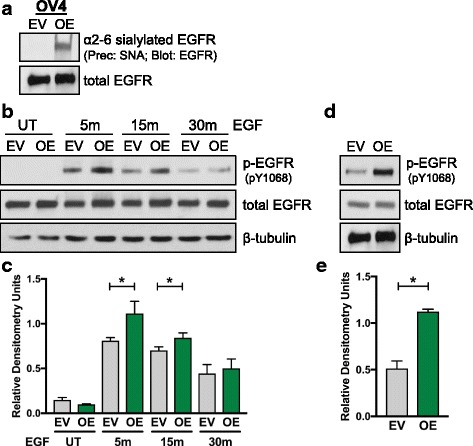
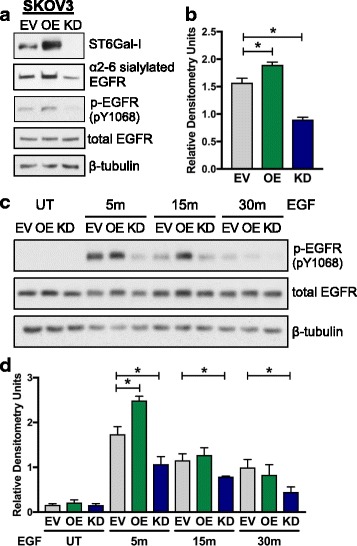
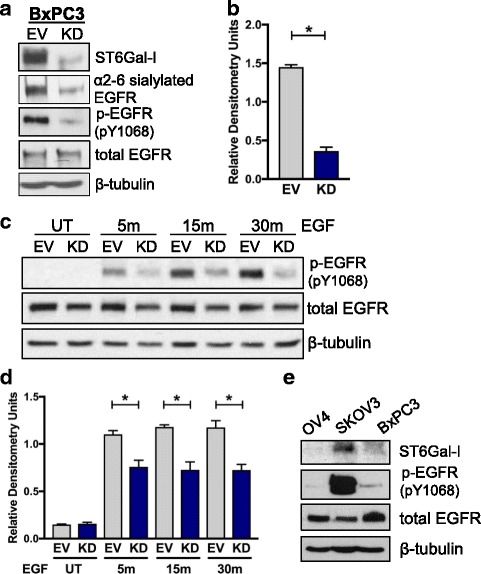
Using the OV4 ovarian cancer cell line, which lacks endogenous ST6Gal-I expression, a kinomics assay revealed that cells with forced overexpression of ST6Gal-I exhibited increased global tyrosine kinase activity, a finding confirmed by immunoblotting whole cell lysates with an anti-phosphotyrosine antibody. Interestingly, the kinomics assay suggested that one of the most highly activated tyrosine kinases in ST6Gal-I-overexpressing OV4 cells was EGFR. Based on these findings, additional analyses were performed to investigate the effect of ST6Gal-I on EGFR activation. To this end, we utilized, in addition to OV4 cells, the SKOV3 ovarian cancer cell line, engineered with both ST6Gal-I overexpression and knockdown, as well as the BxPC3 pancreatic cancer cell line with knockdown of ST6Gal-I. In all three cell lines, we determined that EGFR is a substrate of ST6Gal-I, and that the sialylation status of EGFR directly correlates with ST6Gal-I expression. Cells with differential ST6Gal-I expression were subsequently evaluated for EGFR tyrosine phosphorylation. Cells with high ST6Gal-I expression were found to have elevated levels of basal and EGF-induced EGFR activation. Conversely, knockdown of ST6Gal-I greatly attenuated EGFR activation, both basally and post EGF treatment. Finally, to illustrate the functional importance of ST6Gal-I in regulating EGFR-dependent survival, cells were treated with gefitinib, an EGFR inhibitor widely used for cancer therapy. These studies showed that ST6Gal-I promotes resistance to gefitinib-mediated apoptosis, as measured by caspase activity assays.
Results herein indicate that ST6Gal-I promotes EGFR activation and protects against gefitinib-mediated cell death. Establishing the tumor-associated ST6Gal-I sialyltransferase as a regulator of EGFR provides novel insight into the role of glycosylation in growth factor signaling and chemoresistance.
ST6Gal-I 唾液酸转移酶在许多癌症中上调,这种酶的高表达与各种恶性肿瘤(包括卵巢癌)患者的预后不良相关。通过对一组特定的细胞表面受体进行唾液酸化,ST6Gal-I 调节细胞信号转导,促进肿瘤细胞存活。本研究的目的是研究 ST6Gal-I 对另一个控制癌细胞行为的重要受体 EGFR 的影响。此外,还评估了 ST6Gal-I 对常用 EGFR 抑制剂吉非替尼处理的癌细胞的影响。
使用缺乏内源性 ST6Gal-I 表达的 OV4 卵巢癌细胞系,通过激酶组学分析发现,强制过表达 ST6Gal-I 的细胞表现出更高的全局酪氨酸激酶活性,这一发现通过用抗磷酸酪氨酸抗体免疫印迹整个细胞裂解物得到证实。有趣的是,激酶组学分析表明,在 ST6Gal-I 过表达的 OV4 细胞中,最活跃的酪氨酸激酶之一是 EGFR。基于这些发现,进行了进一步的分析以研究 ST6Gal-I 对 EGFR 激活的影响。为此,除了 OV4 细胞外,我们还使用了同时过表达和敲低 ST6Gal-I 的 SKOV3 卵巢癌细胞系,以及敲低 ST6Gal-I 的 BxPC3 胰腺癌细胞系。在所有三种细胞系中,我们确定 EGFR 是 ST6Gal-I 的底物,并且 EGFR 的唾液酸化状态与 ST6Gal-I 表达直接相关。具有不同 ST6Gal-I 表达的细胞随后被评估 EGFR 酪氨酸磷酸化。发现高 ST6Gal-I 表达的细胞具有更高水平的基础和 EGF 诱导的 EGFR 激活。相反,敲低 ST6Gal-I 则大大减弱了基础和 EGF 处理后的 EGFR 激活。最后,为了说明 ST6Gal-I 在调节 EGFR 依赖性存活中的功能重要性,用 EGFR 抑制剂吉非替尼处理细胞,吉非替尼广泛用于癌症治疗。这些研究表明,ST6Gal-I 促进了对吉非替尼介导的细胞凋亡的抵抗,如 caspase 活性测定所示。
本文的研究结果表明,ST6Gal-I 促进了 EGFR 的激活,并防止了吉非替尼介导的细胞死亡。确定肿瘤相关的 ST6Gal-I 唾液酸转移酶是 EGFR 的调节剂,为糖基化在生长因子信号转导和化疗耐药中的作用提供了新的见解。