Public Health Foundation of India, Plot 47, Sector 44, Institutional Area, Gurugram 122 002, National Capital Region, India.
Centre for Longitudinal Studies, UCL Institute of Education, London, England.
Bull World Health Organ. 2018 Jan 1;96(1):18-28. doi: 10.2471/BLT.17.191759. Epub 2017 Nov 30.
To investigate trends in out-of-pocket health-care payments and catastrophic health expenditure in India by household age composition.
We obtained data from four national consumer expenditure surveys and three health-care utilization surveys conducted between 1993 and 2014. Households were divided into five groups by age composition. We defined catastrophic health expenditure as out-of-pocket payments equalling or exceeding 10% of household expenditure. Factors associated with catastrophic expenditure were identified by multivariable analysis.
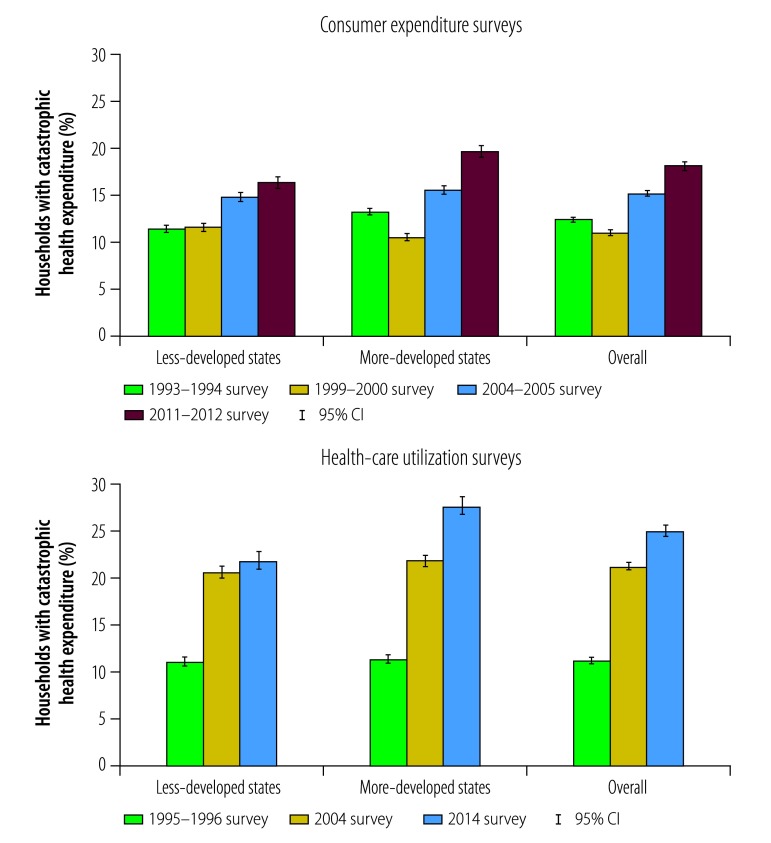
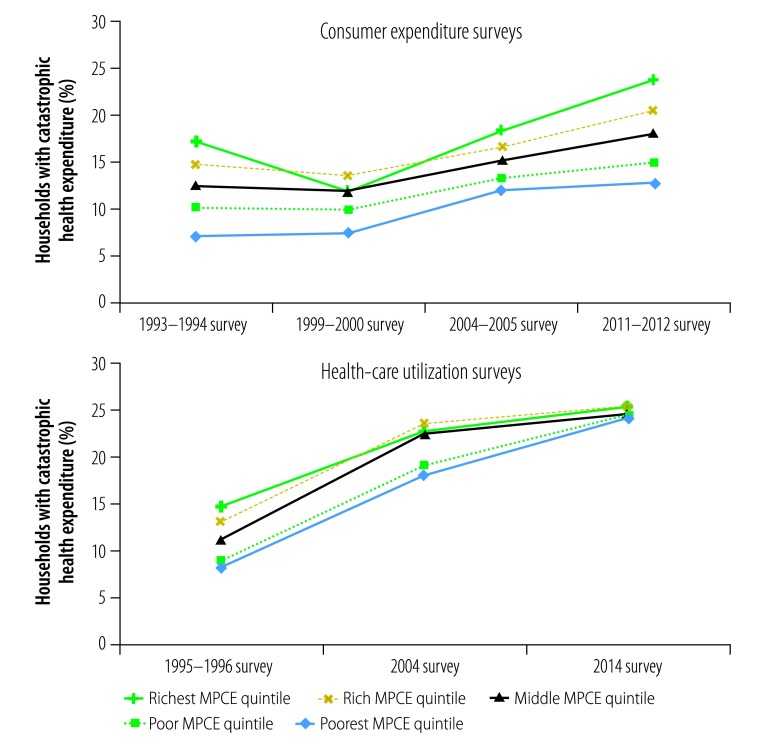
Overall, the proportion of catastrophic health expenditure increased 1.47-fold between the 1993-1994 expenditure survey (12.4%) and the 2011-2012 expenditure survey (18.2%) and 2.24-fold between the 1995-1996 utilization survey (11.1%) and the 2014 utilization survey (24.9%). The proportion increased more in the poorest than the richest quintile: 3.00-fold versus 1.74-fold, respectively, across the utilization surveys. Catastrophic expenditure was commonest among households comprising only people aged 60 years or older: the adjusted odds ratio (aOR) was 3.26 (95% confidence interval, CI: 2.76-3.84) compared with households with no older people or children younger than 5 years. The risk was also increased among households with both older people and children (aOR: 2.58; 95% CI: 2.31-2.89), with a female head (aOR: 1.32; 95% CI: 1.19-1.47) and with a rural location (aOR: 1.27; 95% CI: 1.20-1.35).
The proportion of households experiencing catastrophic health expenditure in India increased over the past two decades. Such expenditure was highest among households with older people. Financial protection mechanisms are needed for population groups at risk for catastrophic health expenditure.
按家庭年龄构成调查印度自付医疗保健支出和灾难性卫生支出的趋势。
我们从 1993 年至 2014 年进行的四次国家消费者支出调查和三次卫生保健利用调查中获取数据。家庭按年龄构成分为五组。我们将灾难性卫生支出定义为自付支出等于或超过家庭支出的 10%。通过多变量分析确定与灾难性支出相关的因素。
总体而言,1993-1994 年支出调查(12.4%)和 2011-2012 年支出调查(18.2%)之间灾难性卫生支出的比例增加了 1.47 倍,1995-1996 年利用调查(11.1%)和 2014 年利用调查(24.9%)之间增加了 2.24 倍。最贫穷的五分之一家庭增加的比例高于最富有的五分之一家庭:利用调查中分别为 3.00 倍和 1.74 倍。仅由 60 岁或以上的人组成的家庭中灾难性支出最为常见:调整后的优势比(aOR)为 3.26(95%置信区间,CI:2.76-3.84),而没有老年人或 5 岁以下儿童的家庭。家中既有老年人又有儿童(aOR:2.58;95%CI:2.31-2.89)、女性户主(aOR:1.32;95%CI:1.19-1.47)和农村地区(aOR:1.27;95%CI:1.20-1.35)的家庭,风险也有所增加。
在过去二十年中,印度经历灾难性卫生支出的家庭比例有所增加。这种支出在有老年人的家庭中最高。需要为有灾难性卫生支出风险的人群建立财务保护机制。