• 文献检索
  • 文档翻译
  • 深度研究
  • 学术资讯
  • Suppr Zotero 插件Zotero 插件
  • 邀请有礼
  • 套餐&价格
  • 历史记录
应用&插件
Suppr Zotero 插件Zotero 插件浏览器插件Mac 客户端Windows 客户端微信小程序
定价
高级版会员购买积分包购买API积分包
服务
文献检索文档翻译深度研究API 文档MCP 服务
关于我们
关于 Suppr公司介绍联系我们用户协议隐私条款
关注我们

Suppr 超能文献

核心技术专利:CN118964589B侵权必究
粤ICP备2023148730 号-1Suppr @ 2026

文献检索

告别复杂PubMed语法,用中文像聊天一样搜索,搜遍4000万医学文献。AI智能推荐,让科研检索更轻松。

立即免费搜索

文件翻译

保留排版,准确专业,支持PDF/Word/PPT等文件格式,支持 12+语言互译。

免费翻译文档

深度研究

AI帮你快速写综述,25分钟生成高质量综述,智能提取关键信息,辅助科研写作。

立即免费体验

印度住院治疗的特定疾病自付费用和灾难性卫生支出:印度家庭面临困境性卫生筹资吗?

Disease-specific out-of-pocket and catastrophic health expenditure on hospitalization in India: Do Indian households face distress health financing?

机构信息

Department of Fertility Studies, International Institute for Population Sciences (IIPS), Deonar, Mumbai, India.

出版信息

PLoS One. 2018 May 10;13(5):e0196106. doi: 10.1371/journal.pone.0196106. eCollection 2018.

DOI:10.1371/journal.pone.0196106
PMID:29746481
原文链接:https://pmc.ncbi.nlm.nih.gov/articles/PMC5945043/
Abstract

BACKGROUND

Rising non-communicable diseases (NCDs) coupled with increasing injuries have resulted in a significant increase in health spending in India. While out-of-pocket expenditure remains the major source of health care financing in India (two-thirds of the total health spending), the financial burden varies enormously across diseases and by the economic well-being of the households. Though prior studies have examined the variation in disease pattern, little is known about the financial risk to the families by type of diseases in India. In this context, the present study examines disease-specific out-of-pocket expenditure (OOPE), catastrophic health expenditure (CHE) and distress health financing.

METHODS AND MATERIALS

Unit data from the 71st round of the National Sample Survey Organization (2014) was used for this study. OOPE is defined as health spending on hospitalization net of reimbursement, and CHE is defined as household health spending exceeding 10% of household consumption expenditure. Distress health financing is defined as a situation when a household has to borrow money or sell their property/assets or when it gets contributions from friends/relatives to meet its health care expenses. OOPE was estimated for 16 selected diseases and across three broad categories- communicable diseases, NCDs and injuries. Multivariate logistic regression was used to understand the determinants of distress financing and CHE.

RESULTS

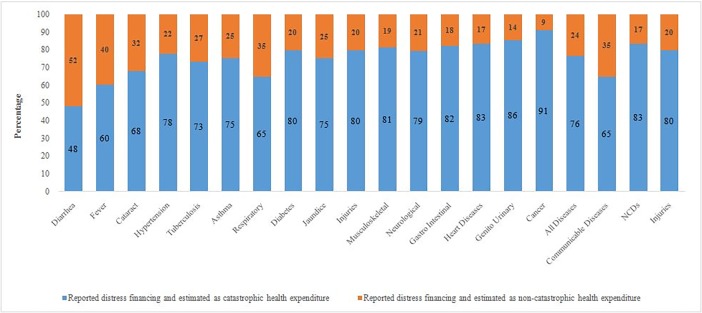
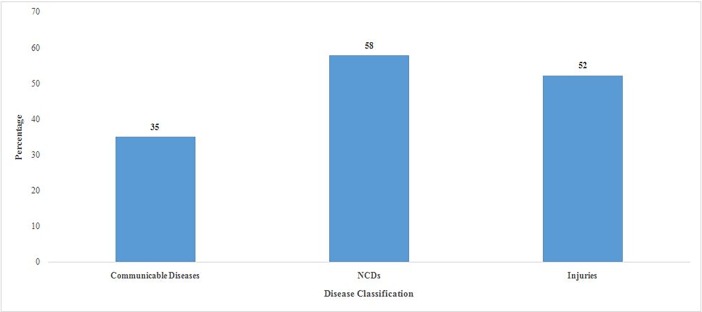
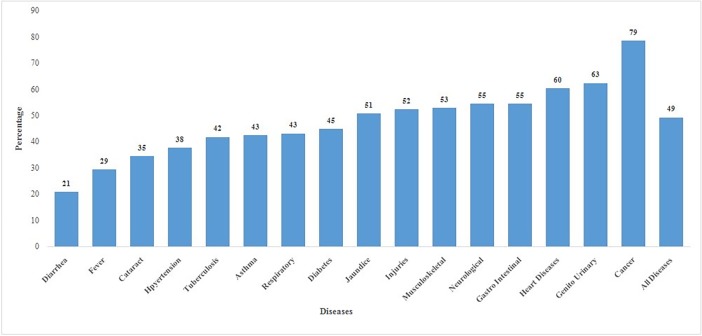
Mean OOPE on hospitalization was INR 19,210 and was the highest for cancer (INR 57,232) followed by heart diseases (INR 40,947). About 28% of the households incurred CHE and faced distress financing. Among all the diseases, cancer caused the highest CHE (79%) and distress financing (43%). More than one-third of the inpatients reported distressed financing for heart diseases, neurological disorders, genito urinary problems, musculoskeletal diseases, gastro-intestinal problems and injuries. The likelihood of incurring distress financing was 3.2 times higher for those hospitalized for cancer (OR 3.23; 95% CI: 2.62-3.99) and 2.6 times for tuberculosis patients (OR 2.61; 95% CI: 2.06-3.31). A large proportion of households who had reported distress financing also incurred CHE.

RECOMMENDATIONS

Free treatment for cancer and heart diseases is recommended for the vulnerable sections of the society. Risk-pooling and social security mechanisms based on contributions from both households as well as the central and state governments can reduce the financial burden of diseases and avert households from distress health financing.

摘要

背景

不断增加的非传染性疾病(NCDs)和意外伤害导致印度的医疗保健支出大幅增加。虽然自付支出仍然是印度医疗保健融资的主要来源(占总医疗支出的三分之二),但家庭的经济状况不同,疾病的经济负担也有很大差异。尽管先前的研究已经检查了疾病模式的变化,但对于印度特定疾病类型对家庭的财务风险知之甚少。在这种情况下,本研究考察了特定疾病的自付支出(OOPE)、灾难性医疗支出(CHE)和困难的医疗融资。

方法和材料

本研究使用了第 71 轮国家抽样调查组织(2014 年)的单位数据。OOPE 定义为住院治疗的净医疗费用减去报销,而 CHE 定义为家庭医疗支出超过家庭消费支出的 10%。困难的医疗融资定义为家庭不得不借钱或出售财产/资产,或者从朋友/亲戚那里获得捐款以支付其医疗费用的情况。对 16 种选定的疾病和传染病、非传染性疾病和伤害这三个广泛类别进行了 OOPE 估计。使用多元逻辑回归来了解困难融资和 CHE 的决定因素。

结果

住院治疗的平均 OOPE 为 19210 卢比,癌症(57232 卢比)和心脏病(40947 卢比)的 OOPE 最高。约 28%的家庭发生 CHE 并面临困难的融资。在所有疾病中,癌症导致的 CHE(79%)和困难融资(43%)最高。超过三分之一的住院患者因心脏病、神经系统疾病、生殖泌尿系统问题、肌肉骨骼疾病、胃肠道问题和伤害而报告困难融资。因癌症住院的患者发生困难融资的可能性是因其他疾病住院的患者的 3.2 倍(OR 3.23;95%CI:2.62-3.99),结核病患者的可能性是因其他疾病住院的患者的 2.6 倍(OR 2.61;95%CI:2.06-3.31)。报告困难融资的家庭中,很大一部分也发生了 CHE。

建议

建议为社会弱势群体提供癌症和心脏病的免费治疗。基于家庭以及中央和邦政府的缴款的风险分担和社会保障机制可以减轻疾病的经济负担,并避免家庭陷入困难的医疗融资。
https://cdn.ncbi.nlm.nih.gov/pmc/blobs/7851/5945043/9268c73b2703/pone.0196106.g003.jpg
https://cdn.ncbi.nlm.nih.gov/pmc/blobs/7851/5945043/966bb6cd1910/pone.0196106.g001.jpg
https://cdn.ncbi.nlm.nih.gov/pmc/blobs/7851/5945043/9ea84e225555/pone.0196106.g002.jpg
https://cdn.ncbi.nlm.nih.gov/pmc/blobs/7851/5945043/9268c73b2703/pone.0196106.g003.jpg
https://cdn.ncbi.nlm.nih.gov/pmc/blobs/7851/5945043/966bb6cd1910/pone.0196106.g001.jpg
https://cdn.ncbi.nlm.nih.gov/pmc/blobs/7851/5945043/9ea84e225555/pone.0196106.g002.jpg
https://cdn.ncbi.nlm.nih.gov/pmc/blobs/7851/5945043/9268c73b2703/pone.0196106.g003.jpg

相似文献

1
Disease-specific out-of-pocket and catastrophic health expenditure on hospitalization in India: Do Indian households face distress health financing?印度住院治疗的特定疾病自付费用和灾难性卫生支出:印度家庭面临困境性卫生筹资吗?
PLoS One. 2018 May 10;13(5):e0196106. doi: 10.1371/journal.pone.0196106. eCollection 2018.
2
Disease-specific distress healthcare financing and catastrophic out-of-pocket expenditure for hospitalization in Bangladesh.孟加拉国特定疾病困扰、医疗保健融资以及住院灾难性自付支出
Int J Equity Health. 2022 Aug 20;21(1):114. doi: 10.1186/s12939-022-01712-6.
3
Out-of-Pocket, Catastrophic Health Expenditure and Distress Financing on Non-Communicable Diseases in India: A Systematic Review with Meta-Analysis.印度非传染性疾病自付、灾难性卫生支出和困境融资的系统评价与荟萃分析。
Asian Pac J Cancer Prev. 2021 Mar 1;22(3):671-680. doi: 10.31557/APJCP.2021.22.3.671.
4
Variations in out-of-pocket spending and factors influencing catastrophic health expenditure of households with patients suffering from chronic conditions in four districts in Sri Lanka.斯里兰卡四个地区慢性病患者家庭自付支出的差异及导致灾难性卫生支出的因素。
BMC Health Serv Res. 2024 Sep 12;24(1):1055. doi: 10.1186/s12913-024-11553-4.
5
Geographic Variation in Household and Catastrophic Health Spending in India: Assessing the Relative Importance of Villages, Districts, and States, 2011-2012.印度家庭和灾难性卫生支出的地域差异:评估村庄、地区和邦的相对重要性,2011-2012 年。
Milbank Q. 2018 Mar;96(1):167-206. doi: 10.1111/1468-0009.12315.
6
Assessing the household economic burden of non-communicable diseases in India: evidence from repeated cross-sectional surveys.评估印度非传染性疾病的家庭经济负担:来自重复横断面调查的证据。
BMC Public Health. 2021 May 7;21(1):881. doi: 10.1186/s12889-021-10828-3.
7
Uneven economic burden of non-communicable diseases among Indian households: A comparative analysis.印度家庭的非传染性疾病经济负担不均衡:比较分析。
PLoS One. 2021 Dec 10;16(12):e0260628. doi: 10.1371/journal.pone.0260628. eCollection 2021.
8
A comprehensive examination of the economic impact of out-of-pocket health expenditures in India.印度自付医疗支出经济影响的综合考察。
Health Policy Plan. 2023 Sep 18;38(8):926-938. doi: 10.1093/heapol/czad050.
9
Cumulative incidence, distribution, and determinants of catastrophic health expenditure in Nepal: results from the living standards survey.尼泊尔灾难性卫生支出的累积发生率、分布和决定因素:来自生活水平调查的结果。
Int J Equity Health. 2018 Feb 14;17(1):23. doi: 10.1186/s12939-018-0736-x.
10
Multidimensional poverty and catastrophic health spending in the mountainous regions of Myanmar, Nepal and India.缅甸、尼泊尔和印度山区的多维贫困与灾难性医疗支出。
Int J Equity Health. 2017 Jan 18;16(1):21. doi: 10.1186/s12939-016-0514-6.

引用本文的文献

1
Oncology Treatment in India: A Narrative Exploration of Patient Engagement and Care Strategies.印度的肿瘤治疗:患者参与及护理策略的叙事性探究
Cureus. 2025 Jul 5;17(7):e87329. doi: 10.7759/cureus.87329. eCollection 2025 Jul.
2
Cost of type 2 diabetes mellitus management for households in Northern India - an econometric analysis.印度北部家庭2型糖尿病管理成本——一项计量经济学分析
BMC Health Serv Res. 2025 Jul 22;25(1):965. doi: 10.1186/s12913-025-13040-w.
3
Understanding out-of-pocket expenditure in India: a systematic review.

本文引用的文献

1
Extending health insurance to the poor in India: An impact evaluation of Rashtriya Swasthya Bima Yojana on out of pocket spending for healthcare.将健康保险覆盖到印度的贫困人口:对国家健康保险计划在医疗保健自费支出方面影响的评估。
Soc Sci Med. 2017 May;181:83-92. doi: 10.1016/j.socscimed.2017.03.053. Epub 2017 Mar 27.
2
High Spending on Maternity Care in India: What Are the Factors Explaining It?印度在孕产妇护理方面的高支出:其背后的影响因素有哪些?
PLoS One. 2016 Jun 24;11(6):e0156437. doi: 10.1371/journal.pone.0156437. eCollection 2016.
3
Cost of hospitalisation for non-communicable diseases in India: are we pro-poor?
了解印度的自付费用:一项系统综述。
Front Public Health. 2025 Jun 9;13:1594542. doi: 10.3389/fpubh.2025.1594542. eCollection 2025.
4
Are oncologists and their patients on the same page? - Exploring clinician-patient agreement in performance status reporting.肿瘤学家和他们的患者意见一致吗?——探索临床医生与患者在报告体能状态方面的一致性。
Support Care Cancer. 2025 Jun 21;33(7):607. doi: 10.1007/s00520-025-09656-7.
5
Determinants of distress financing for healthcare service utilization: a convergent mixed-method study at a tertiary hospital in Malaysia.医疗服务利用的困境融资决定因素:马来西亚一家三级医院的整合性混合方法研究
Health Policy Plan. 2025 Aug 18;40(7):737-752. doi: 10.1093/heapol/czaf034.
6
Healthcare utilisation and economic burden of cancer on Indian households.印度家庭癌症的医疗保健利用情况及经济负担。
Sci Rep. 2025 May 14;15(1):16780. doi: 10.1038/s41598-025-01279-6.
7
Factors affecting out-of-pocket expenditures for chronic and acute illnesses in Bangladesh.影响孟加拉国慢性病和急性病自付费用的因素。
PLoS One. 2025 Apr 9;20(4):e0320429. doi: 10.1371/journal.pone.0320429. eCollection 2025.
8
The economic burden of scrub typhus disease among the tribal ethnic groups (Mizo) of Mizoram State, Northeast India.印度东北部米佐拉姆邦部落民族(米佐族)中恙虫病的经济负担。
BMC Public Health. 2025 Mar 19;25(1):1067. doi: 10.1186/s12889-025-22302-5.
9
Exploring financial toxicity and its impact on health-related quality of life of cancer patients.探索经济毒性及其对癌症患者健康相关生活质量的影响。
Support Care Cancer. 2025 Mar 18;33(4):294. doi: 10.1007/s00520-025-09357-1.
10
Assessment of out-of-pocket (OOP) expenditures on essential medicines for acute and chronic illness: a comparative study across regional and socioeconomic groups in India.印度急性和慢性病基本药物自付费用评估:跨地区和社会经济群体的比较研究
BMC Public Health. 2025 Jan 29;25(1):373. doi: 10.1186/s12889-025-21312-7.
印度非传染性疾病的住院费用:我们是有利于穷人的吗?
Trop Med Int Health. 2016 Aug;21(8):1019-1028. doi: 10.1111/tmi.12732. Epub 2016 Jun 22.
4
The financial burden of out-of-pocket expenses in the United States and Canada: How different is the United States?美国和加拿大自付费用的经济负担:美国有多大不同?
SAGE Open Med. 2016 Jan 25;4:2050312115623792. doi: 10.1177/2050312115623792. eCollection 2016.
5
Out of Pocket Expenditure for Hospitalization among Below Poverty Line Households in District Solan, Himachal Pradesh, India, 2013.2013年印度喜马偕尔邦索兰地区贫困线以下家庭的住院自付费用
PLoS One. 2016 Feb 19;11(2):e0149824. doi: 10.1371/journal.pone.0149824. eCollection 2016.
6
Coverage and Financial Risk Protection for Institutional Delivery: How Universal Is Provision of Maternal Health Care in India?机构分娩的覆盖范围与经济风险保护:印度孕产妇保健服务的普及程度如何?
PLoS One. 2015 Sep 8;10(9):e0137315. doi: 10.1371/journal.pone.0137315. eCollection 2015.
7
Socio-Economic Differentials in Impoverishment Effects of Out-of-Pocket Health Expenditure in China and India: Evidence from WHO SAGE.中国和印度自费医疗支出致贫效应中的社会经济差异:来自世界卫生组织全球成人健康调查(WHO SAGE)的证据
PLoS One. 2015 Aug 13;10(8):e0135051. doi: 10.1371/journal.pone.0135051. eCollection 2015.
8
Association between chronic disease and catastrophic health expenditure in Korea.韩国慢性病与灾难性卫生支出之间的关联。
BMC Health Serv Res. 2015 Jan 22;15:26. doi: 10.1186/s12913-014-0675-1.
9
Out-of-pocket expenditure on chronic non-communicable diseases in sub-Saharan Africa: the case of rural Malawi.撒哈拉以南非洲地区慢性非传染性疾病的自付费用:以马拉维农村地区为例。
PLoS One. 2015 Jan 13;10(1):e0116897. doi: 10.1371/journal.pone.0116897. eCollection 2015.
10
The economic burden of diabetes in India: a review of the literature.印度糖尿病的经济负担:文献综述
Global Health. 2014 Dec 2;10:80. doi: 10.1186/s12992-014-0080-x.