Chemistry and Drug Metabolism Section, Clinical Pharmacology and Therapeutics Branch, Intramural Research Program, National Institute on Drug Abuse, National Institutes of Health, 251 Bayview Blvd, Suite 200 Room 05A727, Baltimore, MD 21224, USA.
National Board of Forensic Medicine, Linköping, Sweden. Division of Drug Research, Department of Medical and Health Sciences, Linköping University, Linköping, Sweden.
Curr Neuropharmacol. 2017 Jul;15(5):682-691. doi: 10.2174/1570159X15666161108123419.
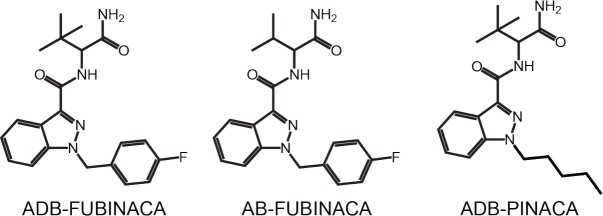
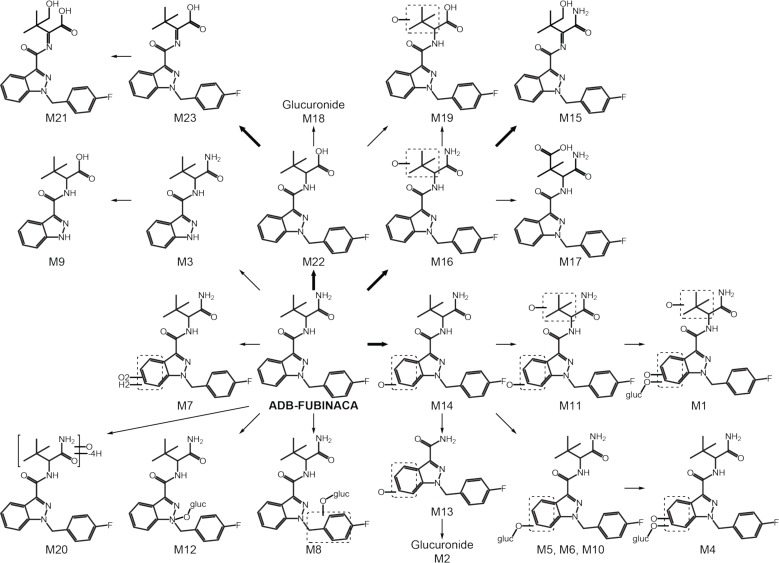
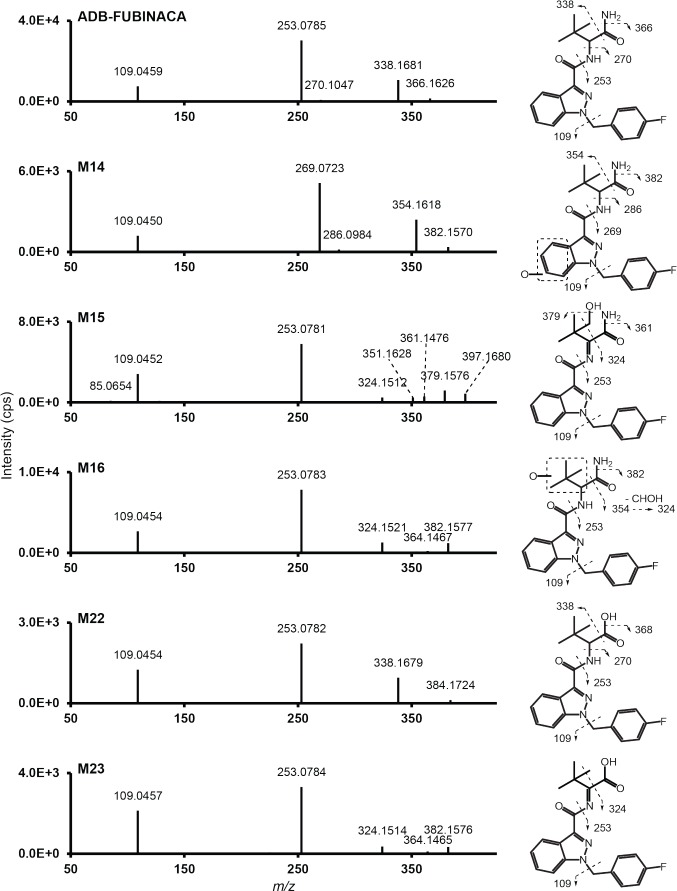
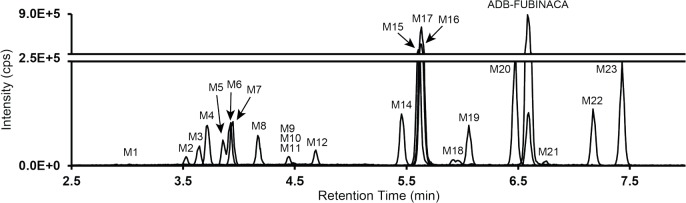
Metabolite profiling of novel psychoactive substances (NPS) is critical for documenting drug consumption. N-(1-amino-3,3-dimethyl-1-oxobutan-2-yl)-1-(4-fluorobenzyl)-1H-indazole-3-carboxamide (ADB-FUBINACA) is an emerging synthetic cannabinoid whose toxicological and metabolic data are currently unavailable. We aimed to determine optimal markers for identifying ADB-FUBINACA intake. Metabolic stability was evaluated with human liver microsome incubations. Metabolites were identified after 1 and 3 h incubation with pooled human hepatocytes, liquid chromatography- high resolution mass spectrometry in positive-ion mode (5600+ TripleTOF®, Sciex) and several data mining approaches (MetabolitePilot™, Sciex). Metabolite separation was achieved on an Ultra Biphenyl column (Restek®); full-scan TOF-MS and information-dependent acquisition MS/MS data were acquired. ADB-FUBINACA microsomal half-life was 39.7 min, with a predicted hepatic clearance of 9.0 mL/min/kg and a 0.5 extraction ratio (intermediate-clearance drug). Twenty-three metabolites were identified. Major metabolic pathways were alkyl and indazole hydroxylation, terminal amide hydrolysis, subsequent glucuronide conjugations, and dehydrogenation. We recommend ADB-FUBINACA hydroxyalkyl, hydroxydehydroalkyl and hydroxylindazole metabolites as ADB-FUBINACA intake markers. N-dealkylated metabolites are not specific ADB-FUBINACA metabolites and should not be used as definitive markers of consumption. This is the first ADB-FUBINACA in vitro metabolism study; in vivo experiments enabling pharmacokinetic and pharmacodynamics studies or urine from authentic clinical/forensic cases are needed to confirm our results.
新型精神活性物质(NPS)的代谢物分析对于记录药物使用情况至关重要。N-(1-氨基-3,3-二甲基-1-氧代丁基)-1-(4-氟苄基)-1H-吲唑-3-甲酰胺(ADB-FUBINACA)是一种新兴的合成大麻素,其毒理学和代谢数据目前尚不清楚。我们旨在确定识别 ADB-FUBINACA 摄入的最佳标志物。用人肝微粒体孵育评估代谢稳定性。在与人肝细胞孵育 1 和 3 小时后,采用正离子模式(5600+ TripleTOF®, Sciex)的液相色谱-高分辨率质谱法和几种数据挖掘方法(MetabolitePilot™, Sciex)鉴定代谢物。采用 Ultra Biphenyl 柱(Restek®)实现代谢物分离;采集全扫描 TOF-MS 和信息依赖采集 MS/MS 数据。ADB-FUBINACA 的微粒体半衰期为 39.7 分钟,预测肝清除率为 9.0 mL/min/kg,提取率为 0.5(中清除药物)。鉴定出 23 种代谢物。主要代谢途径为烷基和吲唑羟化、末端酰胺水解、随后的葡萄糖醛酸缀合和脱氢。我们建议将 ADB-FUBINACA 羟烷基、羟去氢烷基和羟吲哚代谢物作为 ADB-FUBINACA 摄入标志物。N-去烷基代谢物不是特异性 ADB-FUBINACA 代谢物,不应作为消费的明确标志物。这是首次对 ADB-FUBINACA 的体外代谢研究;需要进行体内实验以进行药代动力学和药效学研究或从真实的临床/法医案例的尿液中进行研究,以确认我们的结果。