Bazanova Olga M, Auer Tibor, Sapina Elena A
Laboratory of Affective, Cognitive and Translational Neuroscience, Department of Experimental, Clinical Neuroscience, Federal State Research Institute of Physiology and Basic Medicine, Novosibirsk, Russia.
Department of Neuroscience, Novosibirsk State University, Novosibirsk, Russia.
Front Hum Neurosci. 2018 Jan 18;12:3. doi: 10.3389/fnhum.2018.00003. eCollection 2018.
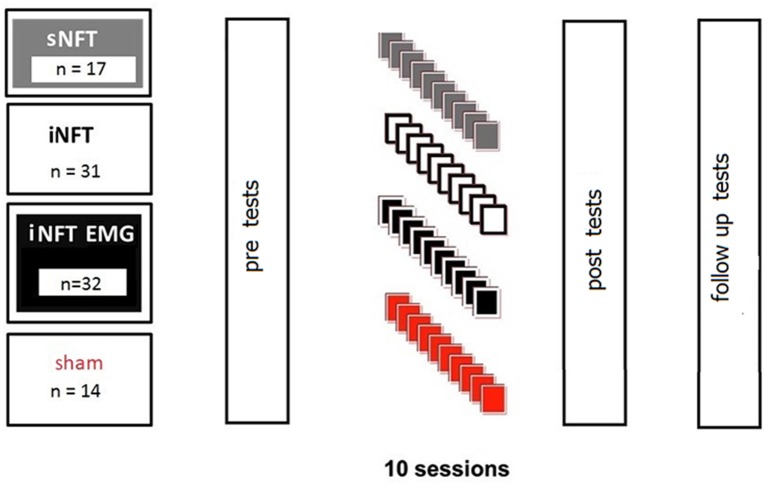
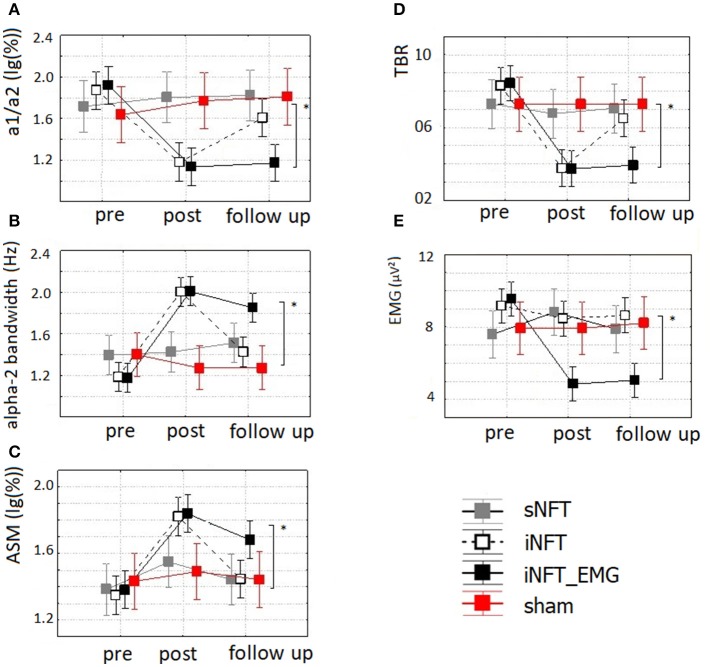
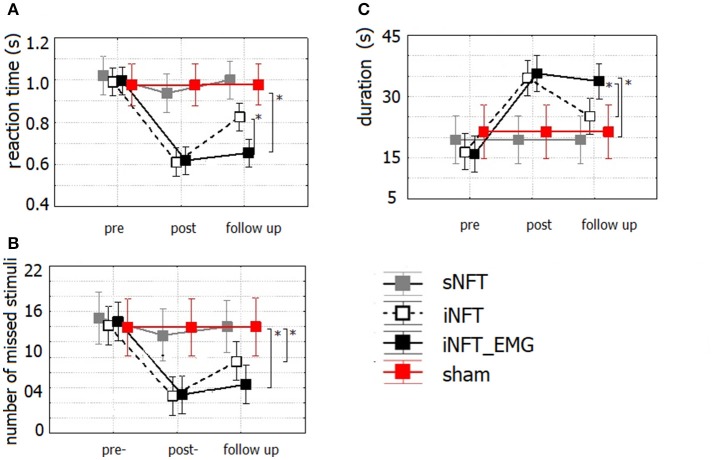
Neurofeedback training (NFT) to decrease the theta/beta ratio (TBR) has been used for treating hyperactivity and impulsivity in attention deficit hyperactivity disorder (ADHD); however, often with low efficiency. Individual variance in EEG profile can confound NFT, because it may lead to influencing non-relevant activity, if ignored. More importantly, it may lead to influencing ADHD-related activities adversely, which may even result in worsening ADHD symptoms. Electromyogenic (EMG) signal resulted from forehead muscles can also explain the low efficiency of the NFT in ADHD from both practical and psychological point-of-view. The first aim of this study was to determine EEG and EMG biomarkers most related to the main ADHD characteristics, such as impulsivity and hyperactivity. The second aim was to confirm our hypothesis that the efficiency of the TBR NFT can be increased by individual adjustment of the frequency bands and simultaneous training on forehead muscle tension. We recruited 94 children diagnosed with ADHD (ADHD) and 23 healthy controls (HC). All participants were male and aged between six and nine. Impulsivity and attention were assessed with Go/no-Go task and delayed gratification task, respectively; and 19-channel EEG and forehead EMG were recorded. Then, the ADHD group was randomly subdivided into (1) standard, (2) individualized, (3) individualized+EMG, and (4) sham NFT (control) groups. The groups were compared based on TBR and EEG alpha activity, as well as hyperactivity and impulsivity three times: pre-NFT, post-NFT and 6 months after the NFT (follow-up). ADHD children were characterized with decreased individual alpha peak frequency, alpha bandwidth and alpha amplitude suppression magnitude, as well as with increased alpha1/alpha2 (a1/a2) ratio and scalp muscle tension when c (η ≥ 0.212). All contingent TBR NFT groups exhibited significant NFT-related decrease in TBR not evident in the control group. Moreover, we detected a higher overall alpha activity in the individualized but not in the standard NFT group. Mixed MANOVA considering between-subject factor GROUP and within-subject factor TIME showed that the individualized+EMG group exhibited the highest level of clinical improvement, which was associated with increase in the individual alpha activity at the 6 months follow-up when comparing with the other approaches (post hoc t = 3.456, = 0.011). This study identified various (adjusted) alpha activity metrics as biomarkers with close relationship with ADHD symptoms, and demonstrated that TBR NFT individually adjusted for variances in alpha activity is more successful and clinically more efficient than standard, non-individualized NFT. Moreover, these training effects of the individualized TBR NFT lasted longer when combined with EMG.
通过神经反馈训练(NFT)降低θ/β比值(TBR)已被用于治疗注意力缺陷多动障碍(ADHD)中的多动和冲动症状;然而,其效率往往较低。脑电图(EEG)特征的个体差异可能会干扰NFT,因为如果忽视这种差异,可能会导致影响无关活动。更重要的是,这可能会对与ADHD相关的活动产生不利影响,甚至可能导致ADHD症状恶化。从实际和心理角度来看,前额肌肉产生的肌电(EMG)信号也可以解释NFT在ADHD治疗中效率低下的原因。本研究的首要目的是确定与ADHD主要特征(如冲动和多动)最相关的EEG和EMG生物标志物。第二个目的是证实我们的假设,即通过对频段进行个体调整以及同时训练前额肌肉张力,可以提高TBR NFT的效率。我们招募了94名被诊断为ADHD 的儿童和23名健康对照(HC)。所有参与者均为男性,年龄在6至9岁之间。分别通过Go/No-Go任务和延迟满足任务评估冲动性和注意力;记录19通道EEG和前额EMG。然后,将ADHD组随机分为(1)标准组、(2)个体化组、(3)个体化+EMG组和(4)假NFT(对照)组。在NFT前、NFT后和NFT后6个月(随访)这三个时间点,基于TBR、EEG阿尔法活动以及多动和冲动性对各组进行比较。ADHD儿童的特征表现为个体阿尔法峰值频率、阿尔法带宽和阿尔法振幅抑制幅度降低,以及阿尔法1/阿尔法2(a1/a2)比值和头皮肌肉张力增加(效应量η≥0.212)。所有TBR NFT组在TBR方面均出现了与NFT相关的显著下降,而对照组未出现这种情况。此外,我们在个体化NFT组中检测到更高的整体阿尔法活动,而标准NFT组中未检测到。考虑组间因素“组”和组内因素“时间”的混合多变量方差分析表明,个体化+EMG组表现出最高水平的临床改善,与其他方法相比,在6个月随访时,该组个体阿尔法活动增加(事后检验t = 3.456,P = 0.011)。本研究确定了各种(调整后的)阿尔法活动指标作为与ADHD症状密切相关的生物标志物,并证明针对阿尔法活动差异进行个体调整的TBR NFT比标准的、非个体化的NFT更成功且临床效率更高。此外,个体化TBR NFT与EMG相结合时,这些训练效果持续时间更长。