Tramacere Antonella, Ferrari Pier F, Gentilucci Maurizio, Giuffrida Valeria, De Marco Doriana
Lichtenberg-Kolleg - The Göttingen Institute for Advanced Study, The German Primate Center Cognitive Ethology Lab, Leibniz Institute for Primate Research, Georg-August-Universität Göttingen, Göttingen, Germany.
Unità di Neuroscienze, Dipartimento di Medicina e Chirurgia, Università degli Studi di Parma, Parma, Italy.
Front Psychol. 2018 Jan 18;8:2339. doi: 10.3389/fpsyg.2017.02339. eCollection 2017.
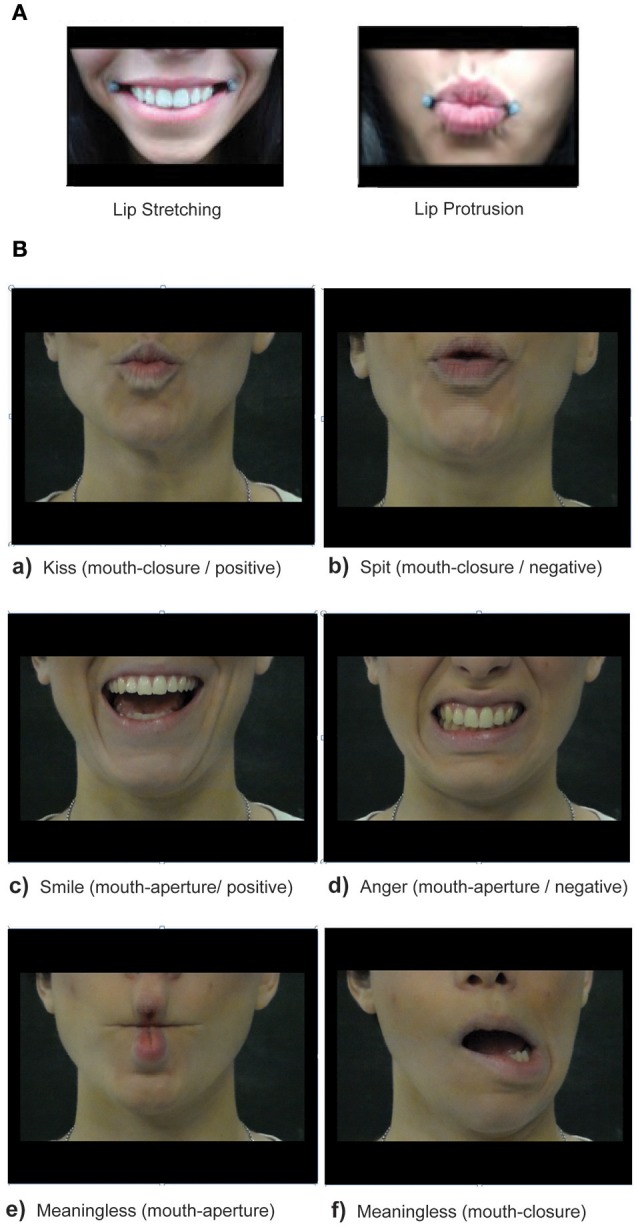
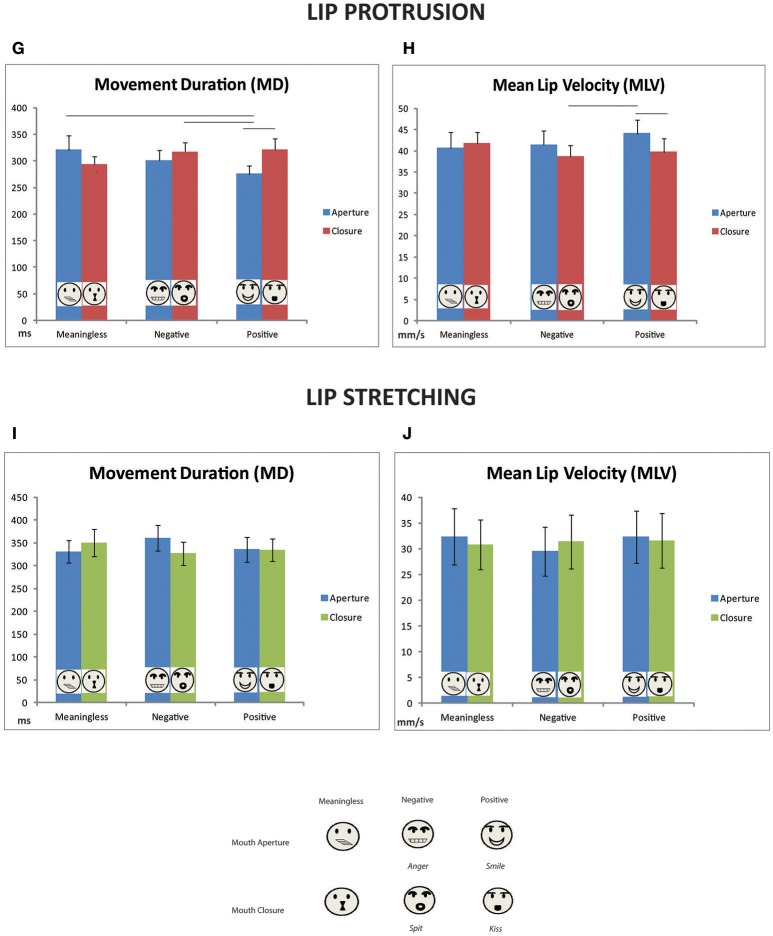
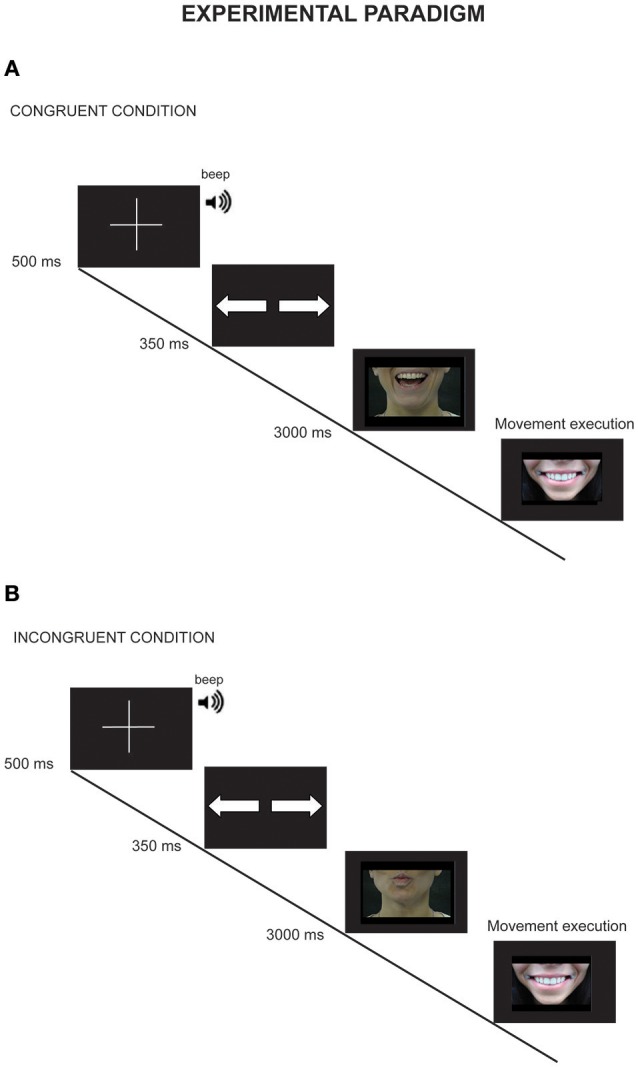
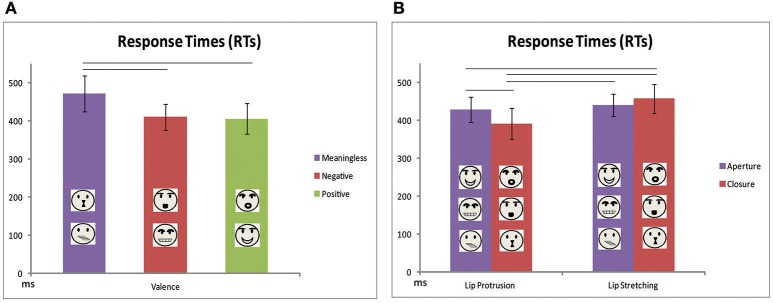
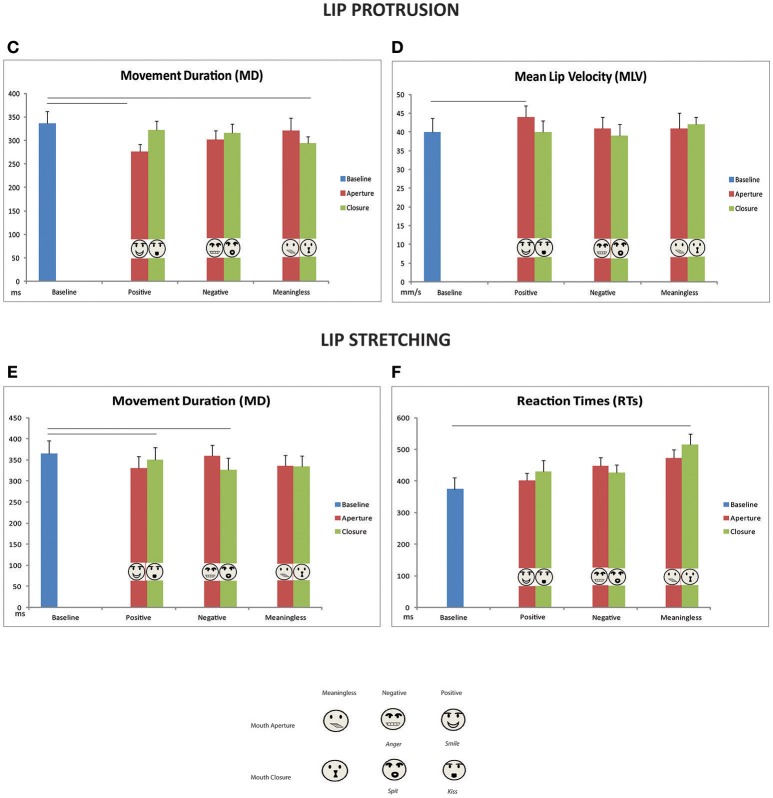
It is well-established that the observation of emotional facial expression induces facial mimicry responses in the observers. However, how the interaction between emotional and motor components of facial expressions can modulate the motor behavior of the perceiver is still unknown. We have developed a kinematic experiment to evaluate the effect of different oro-facial expressions on perceiver's face movements. Participants were asked to perform two movements, i.e., lip stretching and lip protrusion, in response to the observation of four meaningful (i.e., smile, angry-mouth, kiss, and spit) and two meaningless mouth gestures. All the stimuli were characterized by different motor patterns (mouth aperture or mouth closure). Response Times and kinematics parameters of the movements (amplitude, duration, and mean velocity) were recorded and analyzed. Results evidenced a dissociated effect on reaction times and movement kinematics. We found shorter reaction time when a mouth movement was preceded by the observation of a meaningful and motorically congruent oro-facial gesture, in line with effect. On the contrary, during execution, the perception of smile was associated with the facilitation, in terms of shorter duration and higher velocity of the incongruent movement, i.e., lip protrusion. The same effect resulted in response to kiss and spit that significantly facilitated the execution of lip stretching. We called this phenomenon , intended as the overturning of the effect normally observed during facial mimicry. In general, the findings show that both motor features and types of emotional oro-facial gestures (conveying positive or negative valence) affect the kinematics of subsequent mouth movements at different levels: while congruent motor features facilitate a general motor response, motor execution could be speeded by gestures that are motorically incongruent with the observed one. Moreover, valence effect depends on the specific movement required. Results are discussed in relation to the Basic Emotion Theory and embodied cognition framework.
众所周知,观察情绪性面部表情会在观察者身上诱发面部模仿反应。然而,面部表情的情绪成分与运动成分之间的相互作用如何调节感知者的运动行为,目前仍不清楚。我们开展了一项运动学实验,以评估不同口面部表情对感知者面部运动的影响。参与者被要求在观察四种有意义的(即微笑、愤怒的嘴型、亲吻和吐口水)和两种无意义的口部手势后,执行两种动作,即嘴唇伸展和嘴唇前突。所有刺激都具有不同的运动模式(嘴巴张开或嘴巴闭合)。记录并分析了动作的反应时间和运动学参数(幅度、持续时间和平均速度)。结果证明了对反应时间和运动运动学有分离效应。我们发现,当在嘴巴运动之前观察到一个有意义且运动上一致的口面部手势时,反应时间会更短,这与[效应名称未给出]效应一致。相反,在执行过程中,微笑的感知与促进作用相关,就不一致动作(即嘴唇前突)的持续时间更短和速度更高而言。对亲吻和吐口水的感知也产生了同样的效果,显著促进了嘴唇伸展动作的执行。我们将这种现象称为[现象名称未给出],即面部模仿过程中通常观察到的效应的反转。总体而言,研究结果表明,运动特征和情绪性口面部手势的类型(传达正性或负性效价)在不同层面上影响后续嘴巴动作的运动学:虽然一致的运动特征促进一般的运动反应,但与观察到的动作在运动上不一致的手势可以加快运动执行。此外,效价效应取决于所需的特定动作。我们结合基本情绪理论和具身认知框架对结果进行了讨论。