Zhu Xinyi, Gong Yan, Xu Tingting, Lian Wen, Xu Shuhui, Fan Lu
Department of Psychology, School of Education, Wenzhou University, Wenzhou, China.
Department of Psychology, Jing Hengyi School of Education, Hangzhou Normal University, Hangzhou, China.
Front Psychol. 2023 Aug 22;14:1199537. doi: 10.3389/fpsyg.2023.1199537. eCollection 2023.
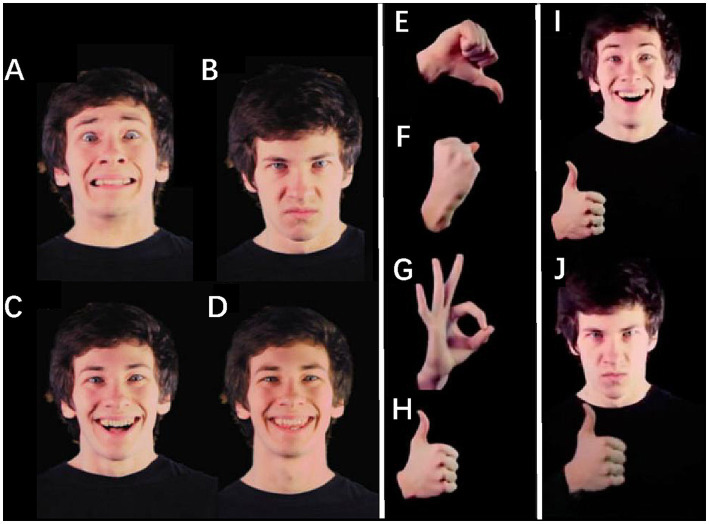
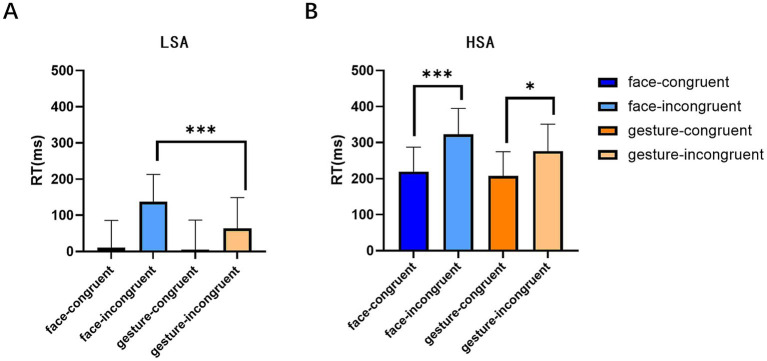
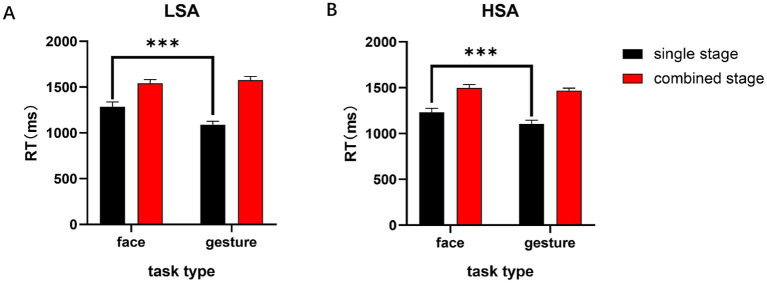
In recent years, an increasing number of studies have examined the mechanisms underlying nonverbal emotional information processing in people with high social anxiety (HSA). However, most of these studies have focused on the processing of facial expressions, and there has been scarce research on gesture or even face-gesture combined processing in HSA individuals. The present study explored the processing characteristics and mechanism of the interaction between gestures and facial expressions in people with HSA and low social anxiety (LSA). The present study recruited university students as participants and used the Liebowitz Social Anxiety Scale scores to distinguish the HSA and LSA groups. We used a 2 (group: HSA and LSA) × 2 (emotion valence: positive, negative) × 2 (task: face, gesture) multifactor mixed design, and videos of a single face or gesture and combined face-gesture cues were used as stimuli. We found that (1) there is a distinction in the processing of faces and gestures, with individuals recognizing gestures faster than faces; (2) there is an attentional enhancement in the processing of gestures, particularly for negative gestures; and (3) when the emotional valence of faces and gestures align, it facilitates the recognition of both. However, incongruent gestures have a stronger impact on the processing of facial expressions compared to facial expressions themselves, suggesting that the processing of facial emotions is more influenced by environmental cues provided by gestures. These findings indicated that gestures played an important role in emotional processing, and facial emotional processing was more dependent on the environmental cues derived from gestures, which helps to clarify the reasons for biases in the interpretation of emotional information in people with HSA.
近年来,越来越多的研究探讨了高社交焦虑(HSA)人群非言语情绪信息加工的潜在机制。然而,这些研究大多集中在面部表情的加工上,而对于HSA个体的手势甚至面部-手势联合加工的研究却很少。本研究探讨了HSA和低社交焦虑(LSA)人群中手势与面部表情交互作用的加工特点及机制。本研究招募大学生作为参与者,并使用利博维茨社交焦虑量表得分来区分HSA组和LSA组。我们采用了2(组:HSA和LSA)×2(情绪效价:积极、消极)×2(任务:面部、手势)多因素混合设计,以单一面部或手势以及面部-手势组合线索的视频作为刺激。我们发现:(1)面部和手势的加工存在差异,个体对手势的识别快于面部;(2)手势加工中存在注意增强,尤其是对消极手势;(3)当面部和手势的情绪效价一致时,有助于两者的识别。然而,与面部表情本身相比,不一致的手势对面部表情加工的影响更强,这表明面部情绪加工更容易受到手势提供的环境线索的影响。这些发现表明,手势在情绪加工中起重要作用,面部情绪加工更依赖于来自手势的环境线索,这有助于阐明HSA人群在情绪信息解读中出现偏差的原因。