Meng Guilin, Meng Xiuling, Tan Yan, Yu Jia, Jin Aiping, Zhao Yanxin, Liu Xueyuan
Shanghai Tenth People's Hospital, Tongji University School of Medicine, Shanghai, China.
School of Computer Science and Informatics, Indiana University BloomingtonBloomington, IN, United States.
Front Neurol. 2018 Jan 19;8:726. doi: 10.3389/fneur.2017.00726. eCollection 2017.
Rehabilitation training during the acute phase of stroke (<48 h) markedly improves impaired upper-limb movement. Hand-arm bimanual intensive training (HABIT) represents an intervention that promotes improvements in upper extremity function in children with cerebral palsy. This study repurposed HABIT in acute stroke patients and assessed recovery of upper extremity function when compared with a conventional rehabilitation program (CRP).
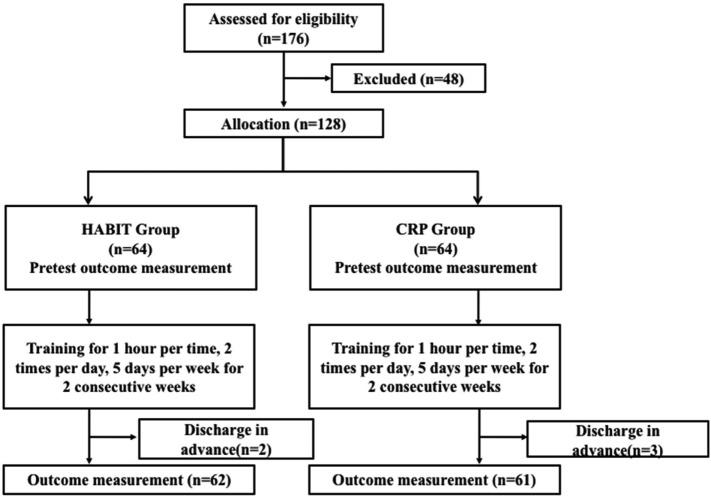
In a randomized trial, 128 patients with acute stroke were assigned to the HABIT or the CRP groups. The primary endpoint was clinical motor functional assessment that was guided by the Fugl-Meyer motor assessment (FMA) and outcomes of the action research arm test (ARAT). The secondary endpoint was an improved neurophysiological evaluation according to the motor-evoked potential amplitude (AMP), resting motion threshold (RMT), and central motor conduction time (CMCT) scores over the 2-week course of therapy. In both groups, scores were evaluated at baseline, 1 week from commencing therapy, and post-therapy.
After 2 weeks, the HABIT group showed improved scores as compared the CRP group for FMA (51.7 ± 6.44 vs. 43.5 ± 5.6, < 0.001), ARAT (34.5 ± 6.2 vs. 33.3 ± 6.3, = 0.022), and AMP (1.1 ± 0.1 vs. 1.0 ± 0.1, < 0.001). However, CMCT (8.6 ± 1.0 vs. 9.1 ± 0.6, = 0.054) and RMT (55.3 ± 4.2 vs. 57.5 ± 4.1, = 0.088) were similar when comparing between groups.
HABIT significantly improved motor functional and neuro-physiological outcomes in patients with acute stroke, which suggested that HABIT might represent an improved therapeutic strategy as compared CRP.
中风急性期(<48小时)的康复训练可显著改善受损的上肢运动。手-臂双手强化训练(HABIT)是一种促进脑瘫儿童上肢功能改善的干预措施。本研究将HABIT应用于急性中风患者,并与传统康复方案(CRP)比较,评估上肢功能的恢复情况。
在一项随机试验中,128例急性中风患者被分配到HABIT组或CRP组。主要终点是由Fugl-Meyer运动评估(FMA)和动作研究臂测试(ARAT)结果指导的临床运动功能评估。次要终点是在为期2周的治疗过程中,根据运动诱发电位幅度(AMP)、静息运动阈值(RMT)和中枢运动传导时间(CMCT)评分进行的神经生理学评估改善情况。两组均在基线、开始治疗1周后和治疗后进行评分评估。
2周后,与CRP组相比,HABIT组在FMA(51.7±6.44对43.5±5.6,<0.001)、ARAT(34.5±6.2对33.3±6.3,=0.022)和AMP(1.1±0.1对1.0±0.1,<0.001)方面得分有所改善。然而,两组之间的CMCT(8.6±1.0对9.1±0.6,=0.054)和RMT(55.3±4.2对57.5±4.1,=0.088)相似。
HABIT显著改善了急性中风患者的运动功能和神经生理结果,这表明与CRP相比,HABIT可能是一种更好的治疗策略。