Shelton Rebecca E, Jacobsen Krista L, McCulley Rebecca L
Department of Plant and Soil Sciences, University of Kentucky, Lexington, KY, United States.
Department of Horticulture, University of Kentucky, Lexington, KY, United States.
Front Plant Sci. 2018 Jan 22;8:2260. doi: 10.3389/fpls.2017.02260. eCollection 2017.
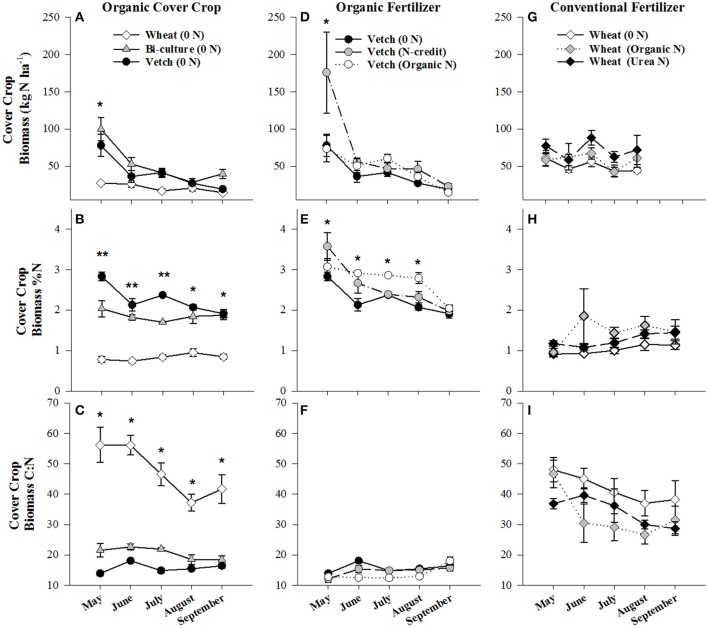
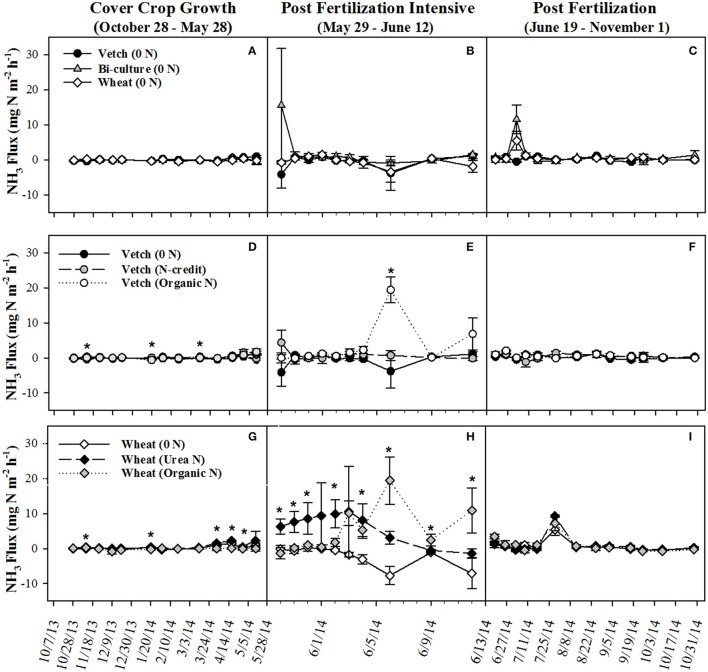
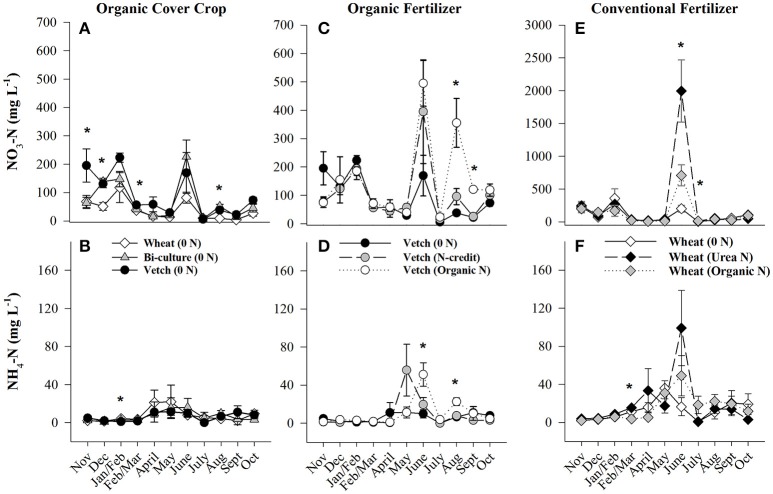
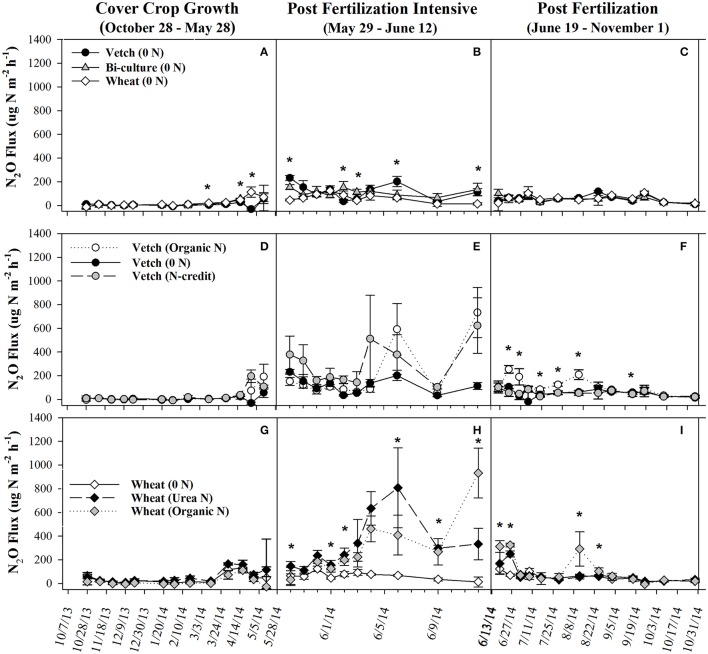
Agroecosystem nitrogen (N) loss produces greenhouse gases, induces eutrophication, and is costly for farmers; therefore, conservation agricultural management practices aimed at reducing N loss are increasingly adopted. However, the ecosystem consequences of these practices have not been well-studied. We quantified N loss via leaching, NH volatilization, NO emissions, and N retention in plant and soil pools of corn conservation agroecosystems in Kentucky, USA. Three systems were evaluated: (1) an unfertilized, organic system with cover crops hairy vetch (), winter wheat (), or a mix of the two (bi-culture); (2) an organic system with a hairy vetch cover crop employing three fertilization schemes (0 N, organic N, or a fertilizer N-credit approach); and (3) a conventional system with a winter wheat cover crop and three fertilization schemes (0 N, urea N, or organic N). In the unfertilized organic system, cover crop species affected NO-N leaching (vetch > bi-culture > wheat) and NO-N emissions and yield during corn growth (vetch, bi-culture > wheat). Fertilization increased soil inorganic N, gaseous N loss, N leaching, and yield in the organic vetch and conventional wheat systems. Fertilizer scheme affected the magnitude of growing season NO-N loss in the organic vetch system (organic N > fertilizer N-credit) and the timing of loss (organic N delayed NO-N loss vs. urea) and NO-N leaching (urea >> organic N) in the conventional wheat system, but had no effect on yield. Cover crop selection and N fertilization techniques can reduce N leaching and greenhouse gas emissions without sacrificing yield, thereby enhancing N conservation in both organic and conventional conservation agriculture systems.
农业生态系统中的氮(N)流失会产生温室气体、导致富营养化,并且对农民来说成本高昂;因此,旨在减少氮流失的保护性农业管理措施越来越多地被采用。然而,这些措施对生态系统的影响尚未得到充分研究。我们对美国肯塔基州玉米保护性农业生态系统中通过淋溶、氨挥发、一氧化氮排放以及植物和土壤库中的氮保留所造成的氮流失进行了量化。评估了三种系统:(1)未施肥的有机系统,种植覆盖作物毛苕子()、冬小麦()或两者的混合(双作);(2)种植毛苕子覆盖作物的有机系统,采用三种施肥方案(零氮、有机氮或肥料氮信用方法);(3)传统系统,种植冬小麦覆盖作物并采用三种施肥方案(零氮、尿素氮或有机氮)。在未施肥的有机系统中,覆盖作物种类影响玉米生长期间的硝态氮淋溶(苕子>双作>小麦)、一氧化氮排放和产量(苕子、双作>小麦)。施肥增加了有机苕子系统和传统小麦系统中的土壤无机氮、气态氮损失、氮淋溶以及产量。施肥方案影响了有机苕子系统中生长季一氧化氮损失的幅度(有机氮>肥料氮信用)以及传统小麦系统中损失的时间(有机氮延迟一氧化氮损失,与尿素相比)和硝态氮淋溶(尿素>>有机氮),但对产量没有影响。选择覆盖作物和氮肥施用技术可以在不牺牲产量的情况下减少氮淋溶和温室气体排放,从而增强有机和传统保护性农业系统中的氮保护。