Raboshchuk Ganna, Nadeu Climent, Jancovic Peter, Lilja Alex Peiro, Kokuer Munevver, Munoz Mahamud Blanca, Riverola De Veciana Ana
TALP Research CenterDepartment of Signal Theory and CommunicationsUniversitat Politècnica de Catalunya08034BarcelonaSpain.
Department of Electronic, Electrical and Systems EngineeringUniversity of BirminghamBirminghamB15 2TTU.K.
IEEE J Transl Eng Health Med. 2017 Dec 22;6:4400110. doi: 10.1109/JTEHM.2017.2781224. eCollection 2018.
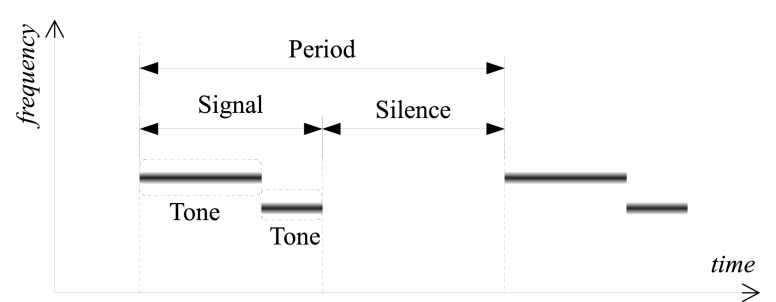
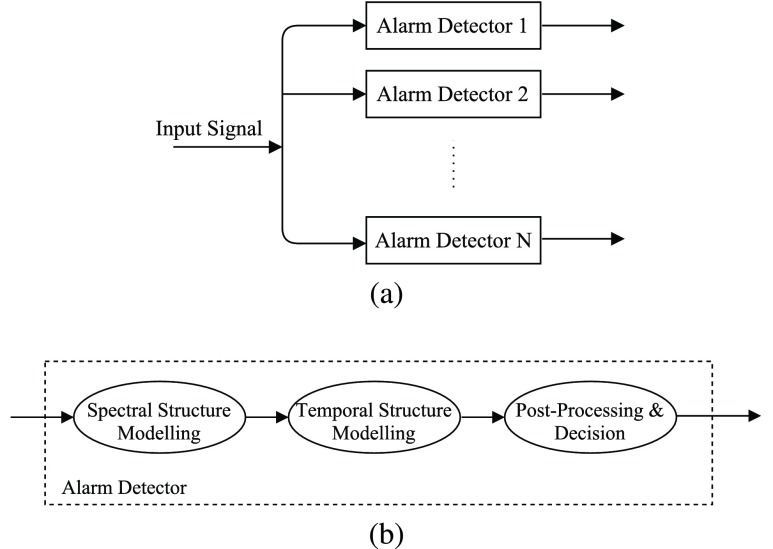
A large number of alarm sounds triggered by biomedical equipment occur frequently in the noisy environment of a neonatal intensive care unit (NICU) and play a key role in providing healthcare. In this paper, our work on the development of an automatic system for detection of acoustic alarms in that difficult environment is presented. Such automatic detection system is needed for the investigation of how a preterm infant reacts to auditory stimuli of the NICU environment and for an improved real-time patient monitoring. The approach presented in this paper consists of using the available knowledge about each alarm class in the design of the detection system. The information about the frequency structure is used in the feature extraction stage, and the time structure knowledge is incorporated at the post-processing stage. Several alternative methods are compared for feature extraction, modeling, and post-processing. The detection performance is evaluated with real data recorded in the NICU of the hospital, and by using both frame-level and period-level metrics. The experimental results show that the inclusion of both spectral and temporal information allows to improve the baseline detection performance by more than 60%.
在新生儿重症监护病房(NICU)嘈杂的环境中,生物医学设备触发的大量警报声频繁出现,并且在提供医疗保健方面发挥着关键作用。本文介绍了我们在开发用于在这种困难环境中检测声学警报的自动系统方面所做的工作。对于研究早产儿如何对NICU环境的听觉刺激做出反应以及改进实时患者监测而言,需要这样的自动检测系统。本文提出的方法包括在检测系统的设计中使用有关每个警报类别的可用知识。关于频率结构的信息用于特征提取阶段,而时间结构知识则纳入后处理阶段。对特征提取、建模和后处理的几种替代方法进行了比较。使用在医院NICU记录的真实数据,并通过帧级和周期级指标来评估检测性能。实验结果表明,同时包含频谱和时间信息能够将基线检测性能提高60%以上。