Zhao Qian, Liu Cuimin
State Key Laboratory of Plant Cell and Chromosome Engineering, Institute of Genetics and Developmental Biology, Chinese Academy of Sciences, Beijing, China.
University of Chinese Academy of Sciences, Beijing, China.
Front Mol Biosci. 2018 Jan 19;4:98. doi: 10.3389/fmolb.2017.00098. eCollection 2017.
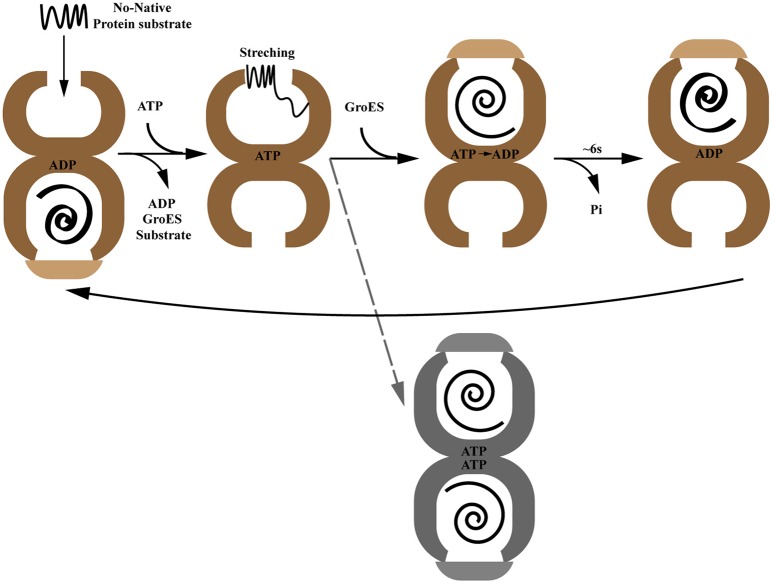
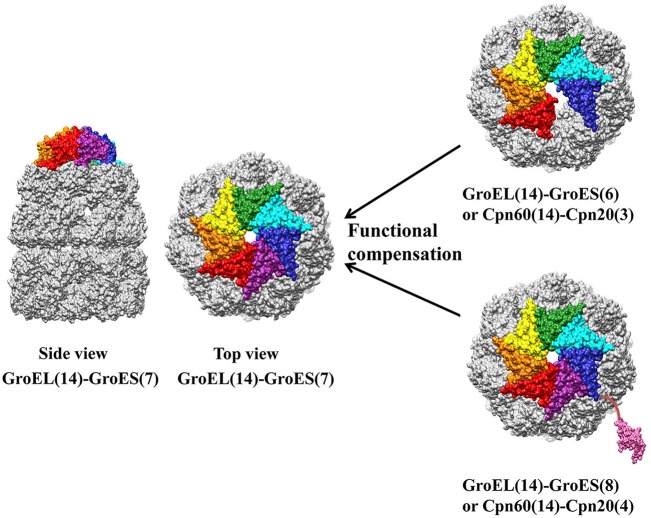
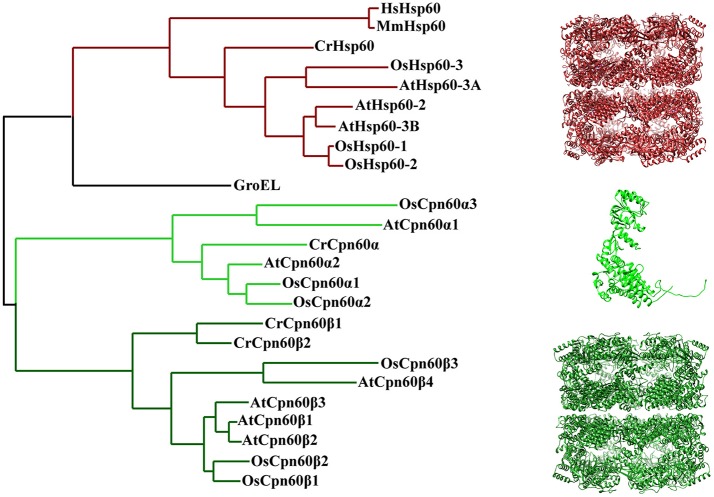
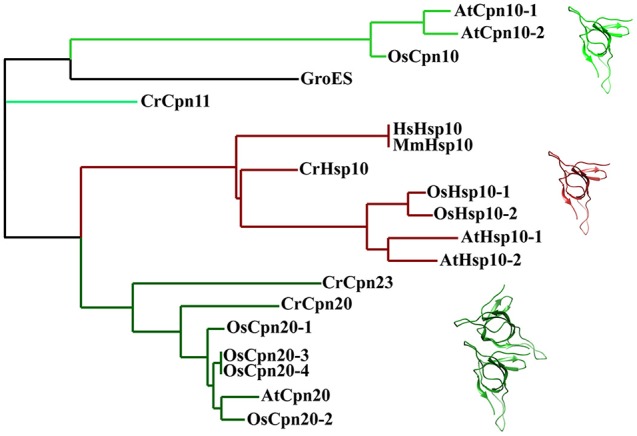
Group I chaperonins are large cylindrical-shaped nano-machines that function as a central hub in the protein quality control system in the bacterial cytosol, mitochondria and chloroplasts. In chloroplasts, proteins newly synthesized by chloroplast ribosomes, unfolded by diverse stresses, or translocated from the cytosol run the risk of aberrant folding and aggregation. The chloroplast chaperonin system assists these proteins in folding into their native states. A widely known protein folded by chloroplast chaperonin is the large subunit of ribulose 1,5-bisphosphate carboxylase/oxygenase (Rubisco), an enzyme responsible for the fixation of inorganic CO into organic carbohydrates during photosynthesis. Chloroplast chaperonin was initially identified as a Rubisco-binding protein. All photosynthetic eucaryotes genomes encode multiple chaperonin genes which can be divided into α and β subtypes. Unlike the homo-oligomeric chaperonins from bacteria and mitochondria, chloroplast chaperonins are more complex and exists as intricate hetero-oligomers containing both subtypes. The Group I chaperonin requires proper interaction with a detachable lid-like co-chaperonin in the presence of ATP and Mg for substrate encapsulation and conformational transition. Besides the typical Cpn10-like co-chaperonin, a unique co-chaperonin consisting of two tandem Cpn10-like domains joined head-to-tail exists in chloroplasts. Since chloroplasts were proposed as sensors to various environmental stresses, this diversified chloroplast chaperonin system has the potential to adapt to complex conditions by accommodating specific substrates or through regulation at both the transcriptional and post-translational levels. In this review, we discuss recent progress on the unique structure and function of the chloroplast chaperonin system based on model organisms and . Knowledge of the chloroplast chaperonin system may ultimately lead to successful reconstitution of eukaryotic Rubisco .
第一组伴侣蛋白是大型圆柱形纳米机器,在细菌细胞质、线粒体和叶绿体的蛋白质质量控制系统中充当核心枢纽。在叶绿体中,由叶绿体核糖体新合成的蛋白质、因各种压力而解折叠的蛋白质或从细胞质转运而来的蛋白质都有异常折叠和聚集的风险。叶绿体伴侣蛋白系统帮助这些蛋白质折叠成其天然状态。一种由叶绿体伴侣蛋白折叠的广为人知的蛋白质是1,5-二磷酸核酮糖羧化酶/加氧酶(Rubisco)的大亚基,该酶在光合作用过程中负责将无机CO固定为有机碳水化合物。叶绿体伴侣蛋白最初被鉴定为一种Rubisco结合蛋白。所有光合真核生物基因组都编码多个伴侣蛋白基因,这些基因可分为α和β亚型。与来自细菌和线粒体的同寡聚体伴侣蛋白不同,叶绿体伴侣蛋白更复杂,以包含两种亚型的复杂异寡聚体形式存在。第一组伴侣蛋白在ATP和Mg存在的情况下需要与可分离的盖子样共伴侣蛋白进行适当相互作用,以实现底物封装和构象转变。除了典型的Cpn10样共伴侣蛋白外,叶绿体中还存在一种独特的共伴侣蛋白,它由两个首尾相连的串联Cpn10样结构域组成。由于叶绿体被认为是各种环境压力的传感器,这种多样化的叶绿体伴侣蛋白系统有可能通过容纳特定底物或通过转录和翻译后水平的调节来适应复杂条件。在这篇综述中,我们基于模式生物讨论了叶绿体伴侣蛋白系统独特结构和功能的最新进展。对叶绿体伴侣蛋白系统的了解最终可能导致真核生物Rubisco的成功重组。