Zhou Youlian, Xu Zhenjiang Zech, He Yan, Yang Yunsheng, Liu Le, Lin Qianyun, Nie Yuqiang, Li Mingsong, Zhi Fachao, Liu Side, Amir Amnon, González Antonio, Tripathi Anupriya, Chen Minhu, Wu Gary D, Knight Rob, Zhou Hongwei, Chen Ye
Department of Gastroenterology, State Key Laboratory of Organ Failure Research, Guangdong Provincial Key Laboratory of Gastroenterology, Nanfang Hospital, Southern Medical University, Guangzhou, China.
Department of Gastroenterology, Guangzhou Digestive Disease Center, Guangzhou First People's Hospital, Guangzhou Medical University, Guangzhou, China.
mSystems. 2018 Jan 30;3(1). doi: 10.1128/mSystems.00188-17. eCollection 2018 Jan-Feb.
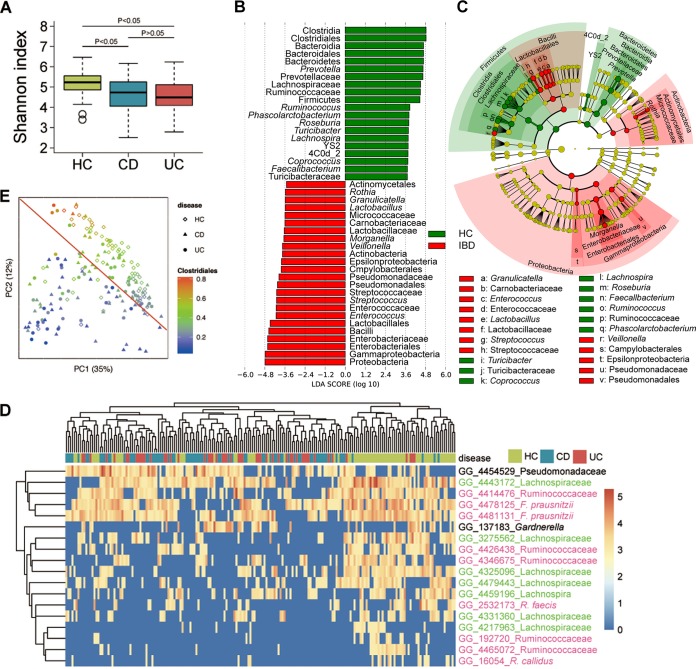
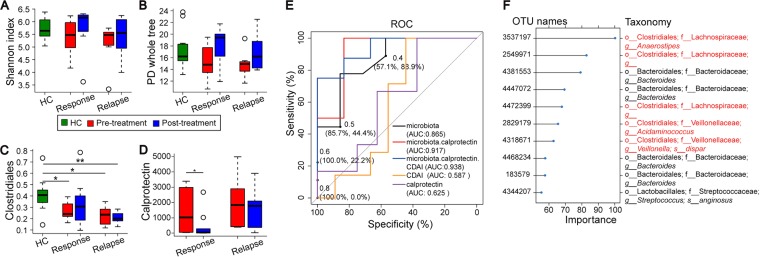
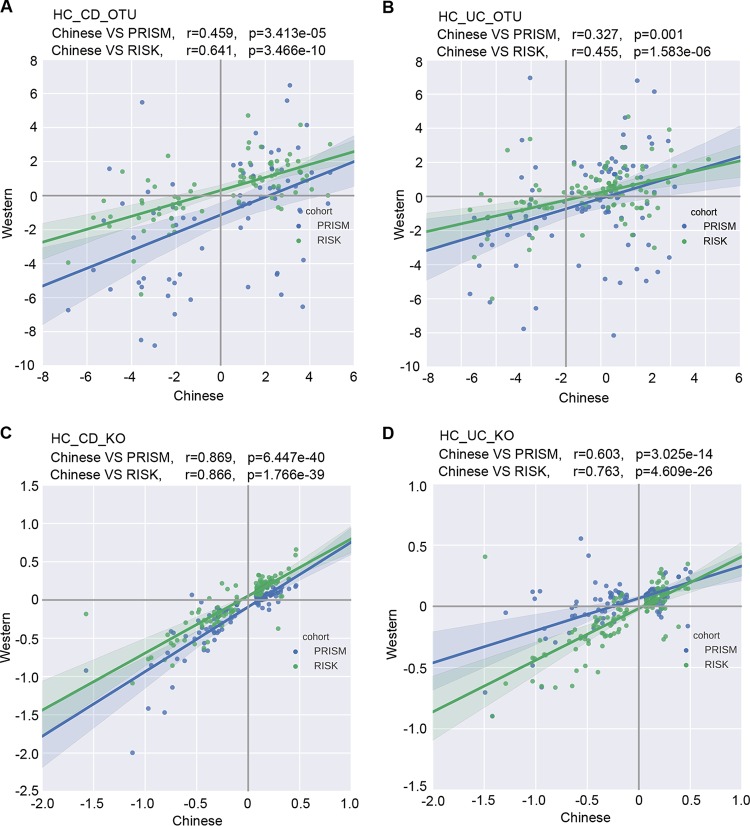
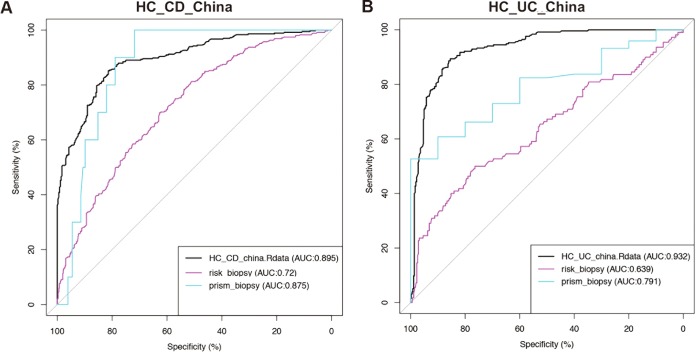
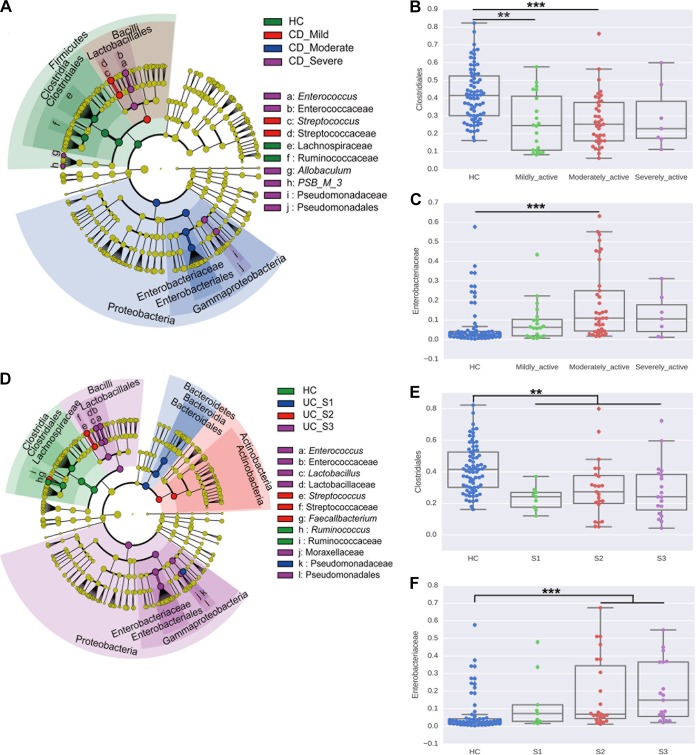
Gut microbiota dysbiosis contributes to the onset and perpetuation of inflammatory bowel disease (IBD). Given that gut microbiotas vary across geography and ethnicity, it remains obscure whether any universal microbial signatures for IBD diagnosis and prognosis evaluation exist irrespective of populations. Here we profiled the fecal microbiota of a series of Chinese IBD patients and combined them with two Western IBD cohorts, PRISM and RISK, for meta-analyses. We found that the gut microbial alteration patterns in IBD are similar among Chinese and Westerners. Our prediction model based on gut microbiome for IBD diagnosis is robust across the cohorts, which showed 87.5% and 79.1% prediction accuracy in Crohn's disease (CD) and ulcerative colitis (UC) patients, respectively. A relative increase in the levels of and () and a relative decrease in the levels of () were strongly correlated with IBD severity ( < 0.05). Additionally, restoration of gut microbiota diversity and a significant increase in relative abundance were found in patients responding to infliximab (IFX [Remicade]) treatment compared to those in relapse. Moreover, certain microbes, mainly , predicted the treatment effectiveness with 86.5% accuracy alone and 93.8% accuracy in combination with calprotectin levels and Crohn's disease activity index (CDAI). Taking the results together, we conclude that gut microbiota can offer a set of universal biomarkers for diagnosis, disease activity evaluation, and infliximab treatment response prediction in IBD. In the present report, we show that the human fecal microbiota contains promising and universal biomarkers for the noninvasive evaluation of inflammatory bowel disease severity and IFX treatment efficacy, emphasizing the potential ability to mine the gut microbiota as a modality to stratify IBD patients and apply personalized therapy for optimal outcomes.
肠道微生物群失调会导致炎症性肠病(IBD)的发生和持续发展。鉴于肠道微生物群因地域和种族而异,目前尚不清楚是否存在适用于所有人群的、用于IBD诊断和预后评估的通用微生物特征。在此,我们对一系列中国IBD患者的粪便微生物群进行了分析,并将其与两个西方IBD队列(PRISM和RISK)进行荟萃分析。我们发现,IBD患者的肠道微生物改变模式在中国人和西方人中相似。我们基于肠道微生物组的IBD诊断预测模型在各个队列中都很稳健,在克罗恩病(CD)和溃疡性结肠炎(UC)患者中的预测准确率分别为87.5%和79.1%。 水平的相对升高和 水平的相对降低与IBD严重程度密切相关(<0.05)。此外,与复发患者相比,接受英夫利昔单抗(IFX [类克])治疗的患者肠道微生物群多样性得到恢复, 的相对丰度显著增加。此外,某些微生物(主要是 )单独预测治疗效果的准确率为86.5%,与钙卫蛋白水平和克罗恩病活动指数(CDAI)联合预测的准确率为93.8%。综合这些结果,我们得出结论,肠道微生物群可以为IBD的诊断、疾病活动评估和英夫利昔单抗治疗反应预测提供一组通用的生物标志物。在本报告中,我们表明人类粪便微生物群包含用于非侵入性评估炎症性肠病严重程度和IFX治疗疗效的有前景的通用生物标志物,强调了挖掘肠道微生物群作为对IBD患者进行分层并应用个性化治疗以实现最佳结果的一种方式的潜在能力。